

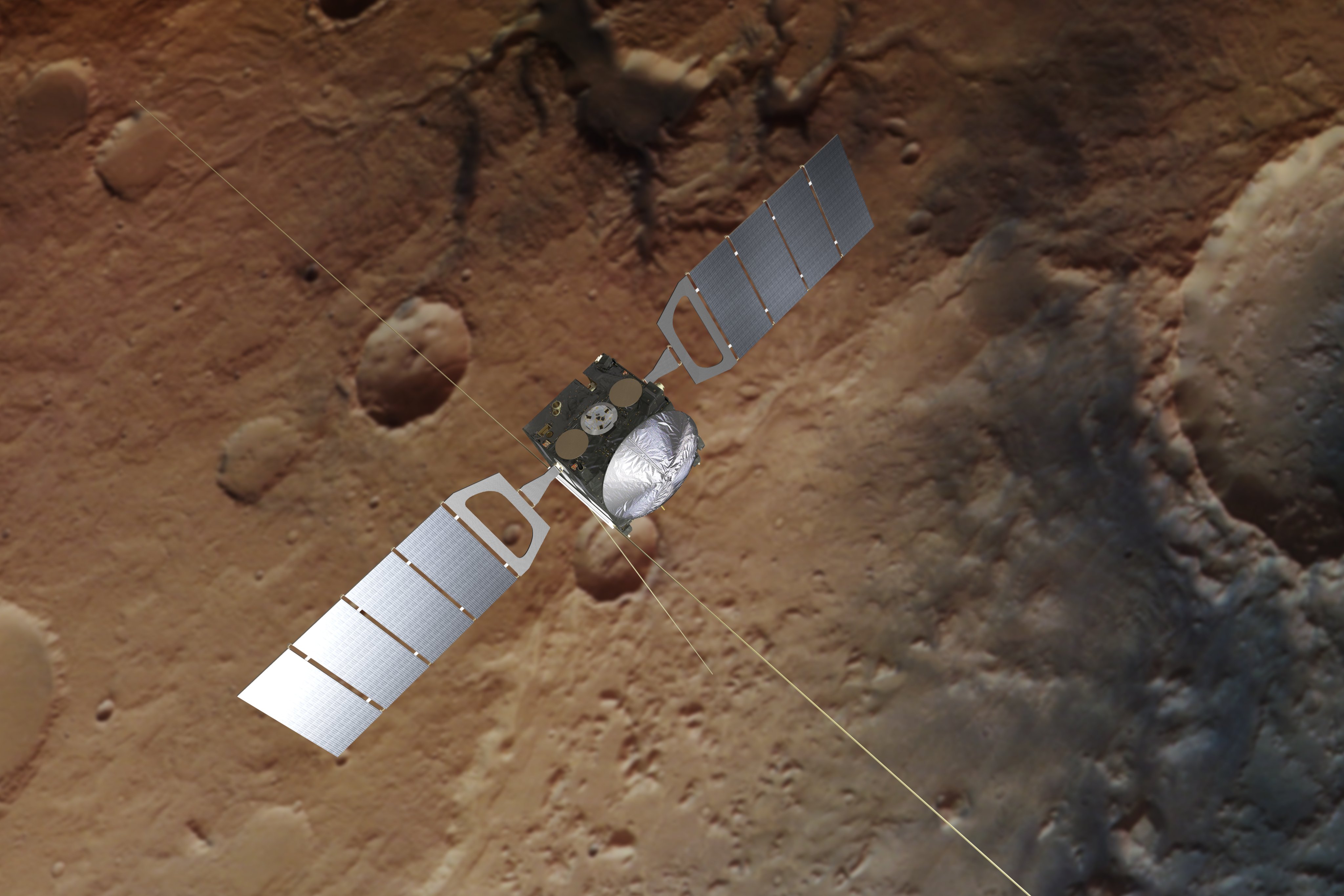
ESA's Mars Express radar instrument which helped detect liquid water on Mars is receiving major software upgrade
- Country:
- France
The Mars Advanced Radar for Subsurface and Ionospheric Sounding (MARSIS) instrument on the European Space Agency's Mars Express spacecraft is getting a major software upgrade, the agency said on Tuesday.
The new software will allow the 19-year-old radar instrument, which was crucial in the search for and discovery of signs of liquid water on Mars, to see beneath the surfaces of Mars and its moon Phobos in more detail than ever before. It includes a series of upgrades that improve signal reception and onboard data processing to increase the amount and quality of science data sent to Earth, according to ESA.
"We faced a number of challenges to improve the performance of MARSIS. Not least because the MARSIS software was originally designed over 20 years ago, using a development environment based on Microsoft Windows 98," noted Carlo Nenna, MARSIS on-board software engineer at Enginium, who is implementing this software upgrade.
"The new software will help us more quickly and extensively study these regions in high resolution and confirm whether they are home to new sources of water on Mars. It really is like having a brand new instrument on board Mars Express almost 20 years after launch," said ESA Mars Express scientist Colin Wilson.
From Windows 98 to #Mars 2022 – a veteran martian water-spotter is getting a big software upgrade🔎💧🔴"It's like having a brand new instrument on @esa's #MarsExpress almost 20 years after launch..."⬇️https://t.co/NJJQApo4Ri pic.twitter.com/tcglzhdudD
— ESA Operations (@esaoperations) June 21, 2022
ESA's Mars Express has spent almost two decades studying Earth's neighbour and revolutionising our understanding of the history, present and future of Mars. MARSIS is one of the seven scientific instruments launched aboard the orbiter 19 years ago, on 2 June 2003.
MARSIS is operated by the Istituto Nazionale di Astrofisica (INAF), Italy, and fully funded by the Italian Space Agency (ASI). The instrument was developed by the University of Rome, Italy, in partnership with NASA's Jet Propulsion Laboratory in Pasadena, California.


 Google News