

This supermassive black hole spins slower than most of its smaller peers
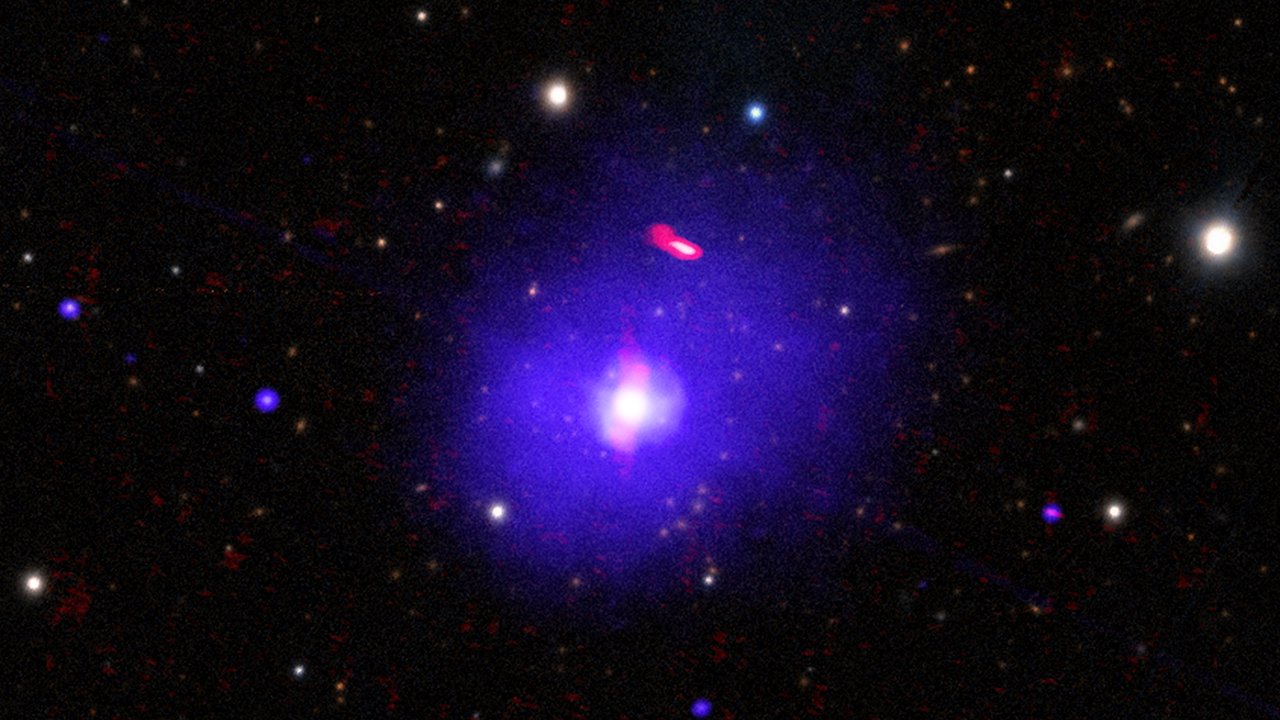
Astronomers have gauged how fast a supermassive black hole is spinning inside H1821+643, a quasar located about 3.4 billion light years from Earth. Using nearly a week's worth of Chandra observing time, taken over two decades ago, the researchers found that the black hole in this quasar is rotating at about half the speed of light.
The supermassive black hole contains between about three and 30 billion solar masses, making it one of the most massive known. In this composite image, the black hole is located in the bright dot in the center of the radio and X-ray emission.
According to the researchers, the black hole is rotating at a modest rate compared to its less massive peers that spin close to the speed of light. This is the most accurate spin measurement for such a massive black hole, providing clues about how some of the universe's biggest black holes grow.
"Every black hole can be defined by just two numbers: its spin and its mass. While that sounds fairly simple, figuring those values out for most black holes has proved to be incredibly difficult," said the lead author, Julia Sisk-Reynes of the Institute of Astronomy (IoA) at the University of Cambridge in the U.K.
Astronomers have made a record-breaking measurement of a black hole's spin, 1 of 2 fundamental properties of black holes. NASA's Chandra shows this black hole is spinning slower than most of its smaller cousins, providing clues to how this black hole grew: https://t.co/uvhm0Bs4wk pic.twitter.com/bUz2TQFvpL
— Chandra Observatory (@chandraxray) June 30, 2022
This composite image of H1821+643 contains X-rays from NASA's Chandra observatory (blue) that have been combined with radio data from NSF's Karl G. Jansky Very Large Array (red) and an optical image from the PanSTARRS telescope on Hawaii (white and yellow).
A paper describing the latest findings appears in the Monthly Notices of the Royal Astronomical Society.


 Google News