

Hubble snaps globular cluster Terzan 2 in the constellation Scorpio
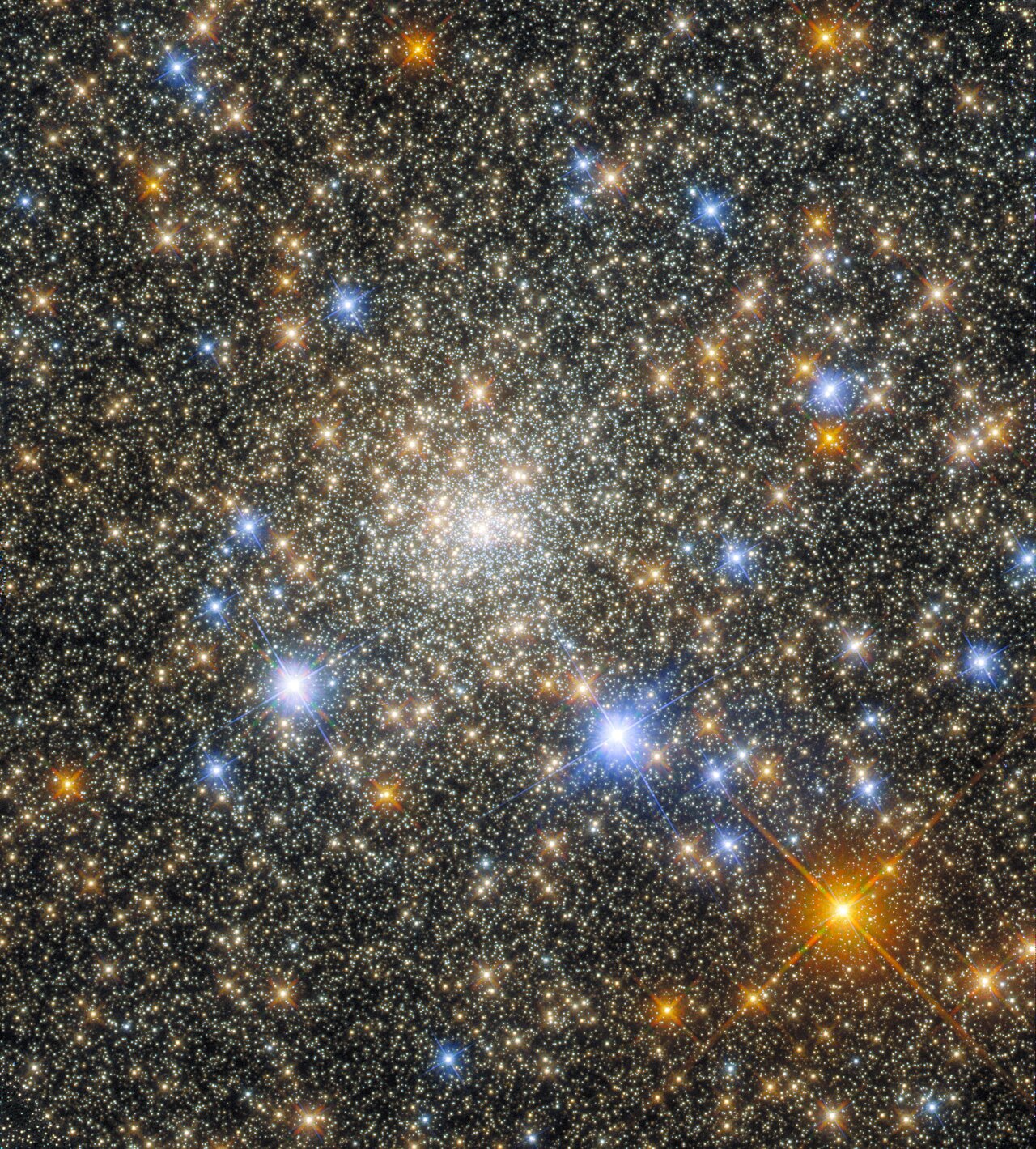
This glittering picture of Terzan 2, a globular cluster which lies in the constellation Scorpio, is captured by the NASA/ESA Hubble Space Telescope. The portrait is crowded with a multitude of glittering stars, thanks to the intense gravitational attraction between them.
Globular clusters are stable, tightly gravitationally bound clusters of tens of thousands to millions of stars found in a wide variety of galaxies. The intense gravitational attraction between the closely packed stars gives them a regular, spherical shape.
For this observation of globular cluster Terzan 2, Hubble used two of its powerful instruments -
- The Advanced Camera for Surveys (ACS): The camera was installed on Hubble during Servicing Mission 3B in 2002. Its wavelength range extends from the ultraviolet, through the visible and out to the near-infrared and the camera has the ability to map large areas of the sky in great detail.
- The Wide Field Camera 3 (WFC3) - It was installed during Hubble Servicing Mission 4 in 2009 and it can observe ultraviolet, visible, and near-infrared light. It studies a diverse range of objects and phenomena - from young and extremely distant galaxies to much more nearby stellar systems, to objects within our very own solar system and exoplanets - planets outside our solar system.
The Hubble Space Telescope, a project of international collaboration between NASA and ESA, was launched on 24 April 1990.
Sharing this picture, the European Space Agency (ESA) wrote, "Each of the four operational instruments on Hubble is a masterpiece of astronomical engineering in its own right, and contains an intricate array of mirrors and other optical elements to remove any aberrations or optical imperfections from observations, as well as filters which allow astronomers to observe specific wavelength ranges. The mirrors inside each instrument also correct for the slight imperfection of Hubble's primary mirror. The end result is a crystal-clear observation, such as this glittering portrait of Terzan 2."
Our latest Picture of the Week features a portrait of a globular cluster: Terzan 2 in the constellation Scorpio. Globular clusters are stable, tightly gravitationally bound clusters of tens of thousands to millions of stars. 🔗 https://t.co/wgDQ89bsyM pic.twitter.com/0IDIdfNtev
— HUBBLE (@HUBBLE_space) July 11, 2022


 Google News