

NASA's Webb beams back new spellbinding image of Cartwheel Galaxy

This stunning new image captured by NASA's powerful James Webb Space Telescope reveals new details about star formation and the black hole at the centre of the Cartwheel Galaxy, which lies about 500 million light-years away in the Sculptor constellation. The galaxy is composed of a bright inner ring and an active outer ring.
Webb's powerful infrared gaze produced this detailed image of the Cartwheel galaxy and two smaller companion galaxies, providing a new view of how the galaxy has changed over billions of years.
Time to reinvent the wheel.Here's the Cartwheel Galaxy in a whole new light — as a composite image from 2 instruments on the Webb telescope. Webb uniquely offers not just a snapshot of the galaxy's current state, but also a peek into its past & future: https://t.co/QdXPwAwwac pic.twitter.com/SJD3wTxwRP
— NASA Webb Telescope (@NASAWebb) August 2, 2022
Webb's primary imager, the Near-Infrared Camera (NIRCam), covers the infrared wavelength range 0.6 to 5 microns. It is the only near-infrared instrument with coronagraphic and time-series imaging capabilities.
In this image, NIRCam data are coloured blue, orange, and yellow. The individual blue dots are individual stars or pockets of star formation in the Cartwheel galaxy.
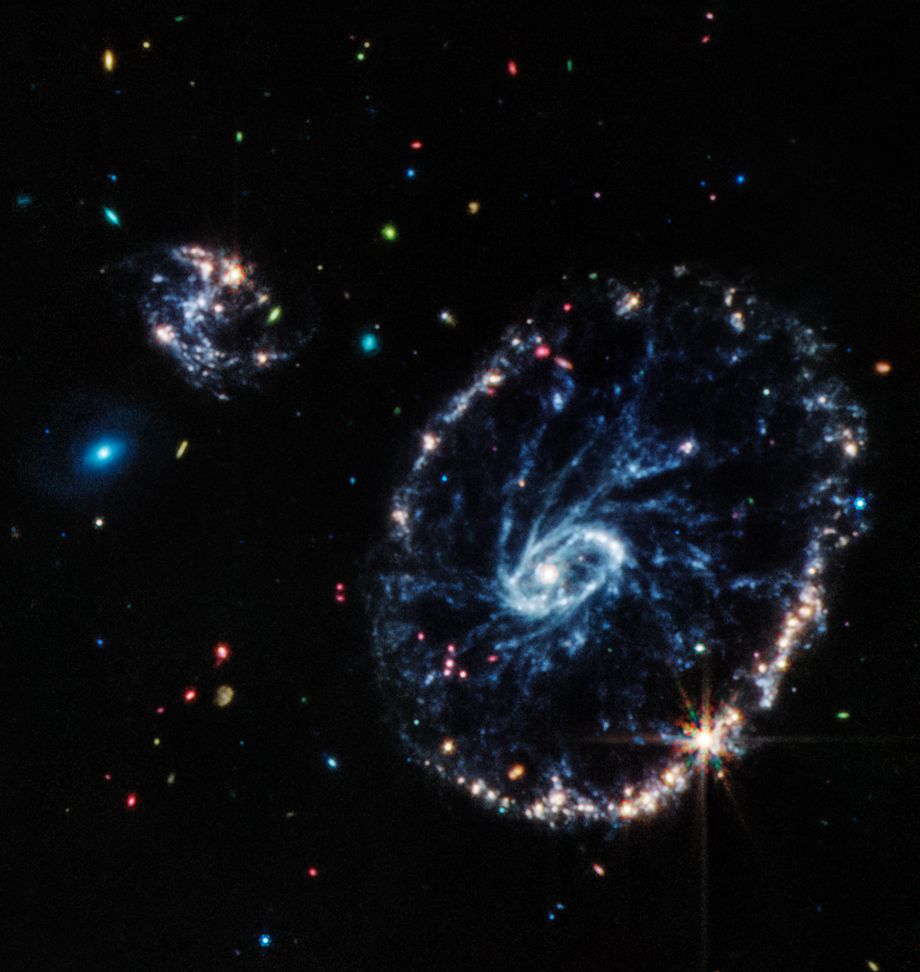 Image Credits: NASA, ESA, CSA, STScI, Webb ERO Production Team
Secondly, Webb's Mid-Infrared Instrument (MIRI) captures mid-infrared light. In this above composite image, MIRI data are coloured red, revealing regions within the Cartwheel Galaxy rich in hydrocarbons and other chemical compounds, as well as silicate dust, like much of the dust on Earth.
The James Webb Space Telescope is a premium premier space science observatory designed to solve mysteries in our solar system, look beyond distant worlds around other stars, and probe the mysterious structures and origins of our universe and our place in it. The telescope was launched from Europe's Spaceport in French Guiana on 25 December 2021.
In the coming weeks, NASA will roll out more images captured by the Webb telescope.


 Google News