



Astronomers discover fiery new world, carpeted with volcanos
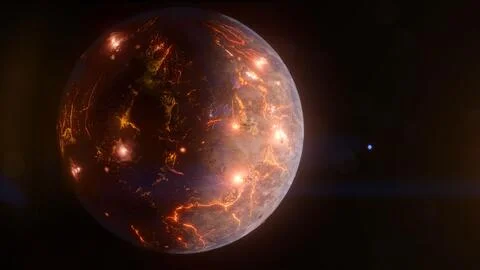
Using data from NASA's Transiting Exoplanet Survey Satellite (TESS )and the retired Spitzer Space Telescope, astronomers have discovered an Earth-size planet that's covered with active volcanoes.
The newly-discovered world, named LP 791-18d, is tidally locked - half side is locked in permanent daytime and the other half in permanent night. It orbits a small red dwarf star about 90 light years away and it does not rotate.
"The day side would probably be too hot for liquid water to exist on the surface. But the amount of volcanic activity we suspect occurs all over the planet could sustain an atmosphere, which may allow water to condense on the night side," said Björn Benneke, corresponding co-author of the paper and astronomy professor at the Trottier Institute for Research on Exoplanets, based at the University of Montreal.
Astronomers were already aware of two additional planets within this star system, LP 791-18b and c. Planet c, which is the outermost planet, has a size approximately 2.5 times that of Earth and a mass nearly nine times greater.
According to the researchers, the gravitational tug from LP 791-18c, which is more massive than d, makes the latter's orbit more elliptical. This may result in internal heating and volcanic eruptions
While the presence of numerous active volcanoes on LP 791-18d may likely make it inhospitable for life, their presence does provide valuable insights into the process of evolution, the researchers said.
"Why is volcanism important? It is the major source contributing to a planetary atmosphere, and with an atmosphere, you could have surface liquid water - a requirement for sustaining life as we know it," said UC Riverside astrophysicist Stephen Kane, who was part of the team that did the original TESS observations, and he co-authored a paper about the newly discovered planet published in the journal Nature.


 Google News