

Astronomers discover frosty planet with longest orbit yet detected by TESS
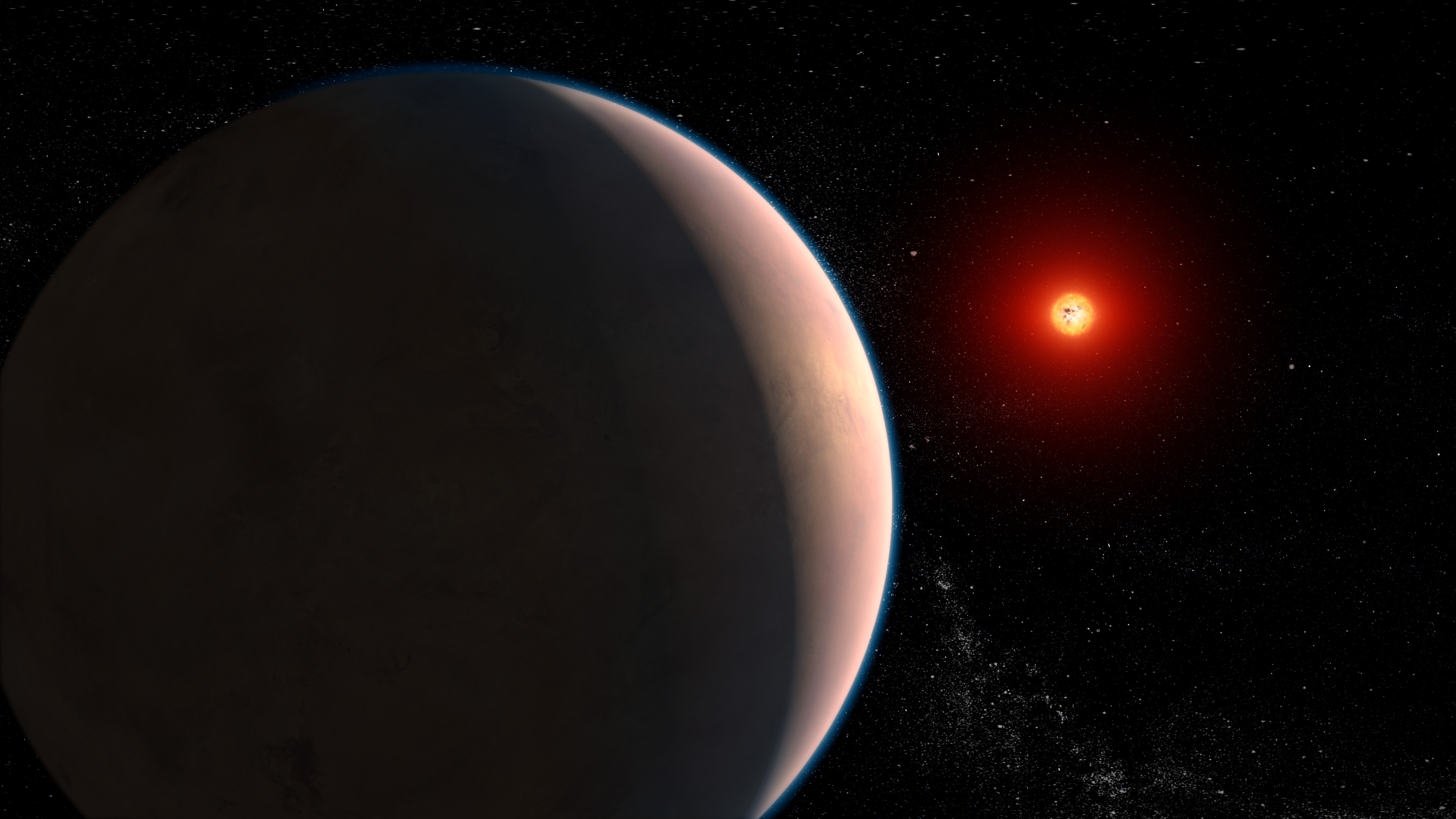
An international team of astronomers has discovered a rare system containing two long-period planets orbiting a nearby star. Of the two planets, one is a gas giant like Jupiter and Saturn and it has the longest orbit yet detected by NASA's Transiting Exoplanet Survey Satellite (TESS).
The star, TOI-4600, lies 815 light years from Earth, and hosts an inner planet with an orbit of 82 days, similar to Mercury, while the outer planet circles every 482 days.
The newly-discovered gas giant is also one of the coldest, at about -117 degrees Fahrenheit, while the inner planet is a more temperate 170 degrees Fahrenheit.
Both planets are likely gas giants, though the composition of the inner planet may be more of a mix of gas and ice. According to the team, which included astronomers from MIT, the University of New Mexico and elsewhere, the two planets bridge the gap between hot Jupiters - the toasty, short-orbit planets that make up the majority of exoplanet discoveries, and the much colder, longer-period gas giants in our solar system.
"These longer-period systems are a comparatively unexplored range. As we're trying to see where our solar system falls in comparison to the other systems we've found out there, we really need these more edge-case examples to better understand that comparison. Because a lot of systems we have found don't look anything like our solar system," says team member Katharine Hesse, a technical staff member at MIT's Kavli Institute for Astrophysics and Space Research.
The team's results have been published in Astrophysical Journal Letters.
NASA's TESS has identified thousands of exoplanet candidates and confirmed over 320 planets to date. The telescope monitors the nearest stars for signs of exoplanets - planets beyond our solar system - by pointing at a patch of the sky and continuously measuring the star's brightness in that sector for 30 days.


 Google News