



This newly-discovered planet is far too massive for its sun
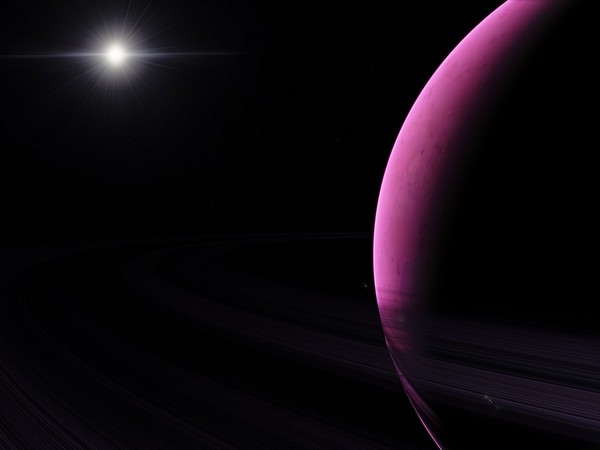
Researchers at Penn State have reported the discovery of a planet that is far too massive for its sun, challenging current understanding of the formation of planets and their solar systems.
The planet is more than 13 times as massive as Earth and orbits an ultracool star, LHS 3154, which is nine times less massive than our sun. The mass ratio between the newly discovered planet and its host star is more than 100 times higher than that of Earth and the sun.
This marks the first time a planet with such high mass has been spotted orbiting such a low-mass star.
The discovery also raises doubts about prior understandings of the formation of stars. According to the researchers, the dust mass and dust-to-gas ratio of the disk that surrounds stars like LHS 3154 during their initial formation would need to be ten times higher than what was previously observed, to create a planet as massive as the one discovered.
"This discovery really drives home the point of just how little we know about the universe. We wouldn’t expect a planet this heavy around such a low-mass star to exist," said Suvrath Mahadevan, the Verne M. Willaman Professor of Astronomy and Astrophysics at Penn State and co-author on the paper.
The oversized planet, named LHS 3154b, was discovered using an astronomical spectrograph, called the Habitable Zone Planet Finder (HPF), at Penn State. The instrument, designed to find planets orbiting the coolest stars outside our solar system with the potential for having liquid water on their surfaces, provides some of the highest precision measurements to date of such infrared signals from nearby stars.
"Based on current survey work with the HPF and other instruments, an object like the one we discovered is likely extremely rare, so detecting it has been really exciting. Our current theories of planet formation have trouble accounting for what we’re seeing," said Megan Delamer, astronomy graduate student at Penn State and co-author on the paper.
- READ MORE ON:
- exoplanets
- LHS 3154
- Habitable Zone Planet Finder


 Google News