

A galaxy that is flat and misshapen: Check out this Hubble image
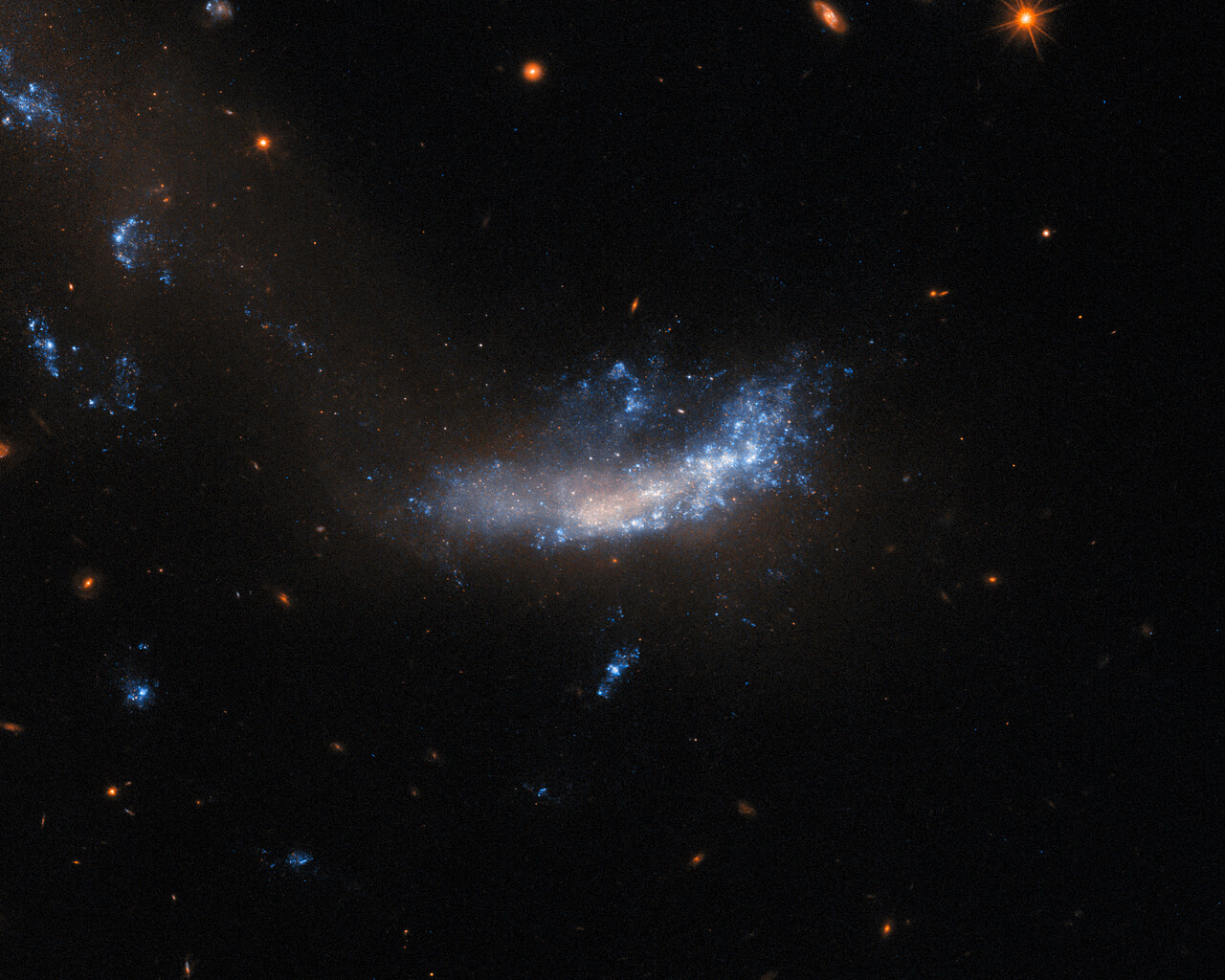
The European Space Agency (ESA) has shared this captivating image captured by the Hubble Space Telescope, showcasing a small galaxy that is both flat and uniquely misshapen. Known as UGC 5189A, the galaxy is located about 150 million light-years away in the constellation Leo.
Hubble observed UGC 5189A to study a supernova explosion in 2010 known as SN 2010jl. Supernovae are powerful explosions that occur when a massive star reaches the end of its life cycle. The stellar explosion is so intense that it briefly outshines an entire galaxy, radiating more energy than our sun will emit over its entire lifetime.
This particular supernova was exceptionally luminous and is noteworthy for having released at least 2.5 billion times more visible energy than our Sun over a period of three years, across all wavelengths.
Despite the fading of the observable supernovae, studying the surroundings or environments where they occurred remains significant. By looking at the remnants and the surrounding space, astronomers can gain valuable insights, which can help improve our understanding of the conditions necessary for them to be triggered. Furthermore, follow-up studies after supernovae can improve our understanding of the immediate aftermath of such events - the impact of the explosion on the surrounding gas and dust to the stellar remnants they leave behind.
Since 2010 Hubble has observed UGC 5189A many times by Hubble. This image is a composite of data collected in three of the latest Hubble studies of UGC 5189A, which also examined several other relatively nearby galaxies that recently hosted supernovae.
📷This NASA/ESA @HUBBLE_space Telescope image features a relatively small galaxy known as UGC 5189A.This galaxy was observed by Hubble to study a supernova explosion, SN 2010jl, which was an exceptionally luminous event. In fact, over a period of three years, SN 2010jl… pic.twitter.com/aY1nC113QG
— ESA (@esa) January 15, 2024


 Google News