

Oscillating Shocks Explain Black Hole ‘Flickers’, Say Indian Astronomers
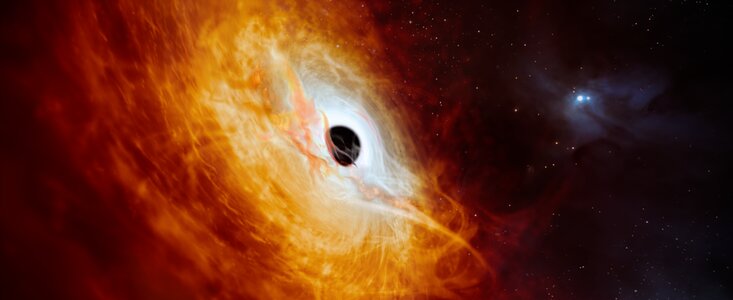
Black holes themselves emit no light, but the matter spiralling into them forms a hot, dense accretion disc that radiates intensely.
- Country:
- India
Astronomers have uncovered the physical mechanism behind the mysterious rhythmic flickering observed in black hole systems, offering a long-sought explanation for quasi-periodic oscillations (QPOs)—one of the most intriguing signatures of accreting black holes.
In a study recently published in The Astrophysical Journal, scientists from the Aryabhatta Research Institute of Observational Sciences (ARIES), an autonomous institute under the Department of Science and Technology (DST), used advanced computer simulations to show that oscillating shocks in accretion discs can naturally generate the observed flickers in black hole radiation.
Why black holes flicker
Black holes themselves emit no light, but the matter spiralling into them forms a hot, dense accretion disc that radiates intensely. Astronomers have long observed that many stellar-mass black holes do not shine steadily—instead, their X-ray output flickers rhythmically, producing QPOs with frequencies ranging from less than one hertz to several tens of hertz.
The physical origin of these oscillations has remained debated for decades.
Shocks at the edge of light-speed flows
Using a 2D numerical simulation code developed at ARIES, the research team modelled viscous, relativistic gas flowing towards a black hole at speeds approaching that of light. Unlike earlier models, the simulations employed a relativistic equation of state for electron–proton plasma, conserving energy, mass and momentum.
The team found that under specific conditions—when the accreting gas has significant infall velocity, sufficient viscosity, and undergoes radiative cooling—the flow does not plunge smoothly into the black hole. Instead, it forms shocks, abrupt transitions where the gas slows down, heats up and becomes denser.
Crucially, these shocks are unstable. They begin to wobble and oscillate, shifting back and forth over time.
From oscillating shocks to QPOs
According to the researchers, these oscillations in the post-shock region cause the high-energy radiation to vary periodically, producing QPOs similar to those detected in real black hole systems. Because the post-shock disc behaves like a hot fluid torus, its oscillations generate a power density spectrum with a fundamental frequency and secondary peaks—hallmarks of observed QPOs.
The simulations also revealed that when viscosity is high (α ≥ 0.05), bubble-like turbulent regions form behind the shock. These regions oscillate and occasionally erupt, driving powerful bipolar outflows and jets perpendicular to the disc. In such cases, the average outflow speed can exceed 25% of the speed of light.
A first-of-its-kind simulation
The study is likely the first two-dimensional simulation of viscous, transonic black hole accretion flows using a relativistic equation of state tailored for electron–proton plasma. The results provide a unified, physically grounded explanation for low-frequency C-type QPOs observed around stellar-mass black holes.
By linking disc shocks, turbulence and radiation variability, the findings mark a significant step forward in understanding how black holes interact with their surroundings—and why some of the darkest objects in the Universe flicker with surprising regularity.


 Google News