

AI can cut panic, boost health resilience during armed conflicts
The research provides actionable guidance for health ministries, NGOs, and international agencies operating in volatile environments. It bridges the often-isolated disciplines of epidemiology, behavioral psychology, data science, and project management. Moreover, it highlights the pressing need for ethical frameworks and skilled human oversight to complement AI’s computational power.
 COE-EDP
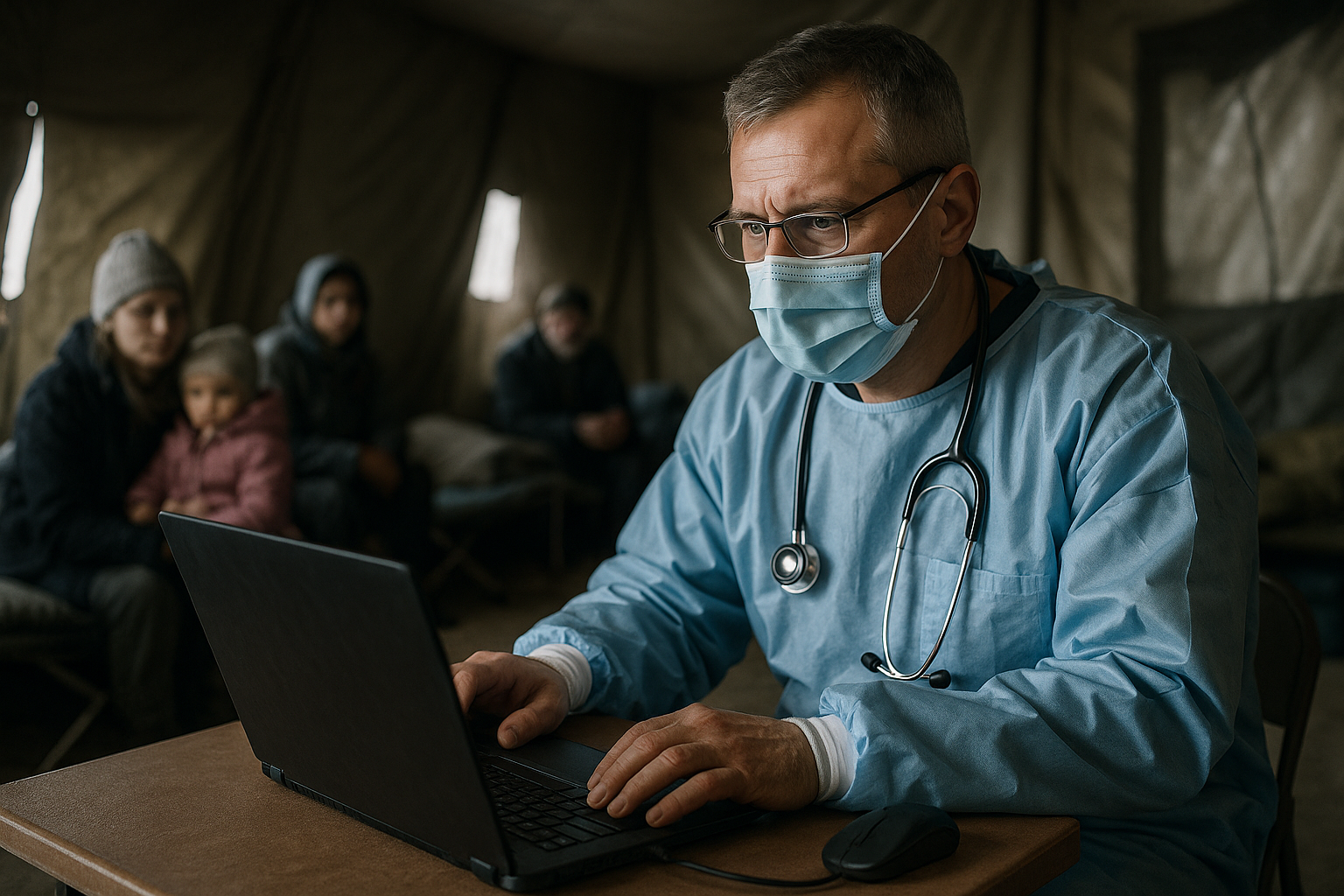
Researchers have developed a new artificial intelligence (AI)-driven strategy to manage public health challenges under crisis conditions. Their findings are published in a study titled "Successful Management of Public Health Projects Driven by AI in a BANI Environment," in the journal Computation.
The research focuses on Kharkiv, a frontline city in Ukraine, and presents a detailed AI-supported framework to address infectious disease spread, misinformation, and panic in a BANI, short for brittle, anxious, non-linear, and incomprehensible, environment.
How does AI address the complex interplay of epidemics, panic, and misinformation?
The study introduces an integrated simulation model, SEIR–Infodemic–Panicdemic, that extends beyond traditional infectious disease frameworks by incorporating the psychological and informational dimensions of crisis. Using AI and real-time data processing, the model simulates 1500 days of public health dynamics in Kharkiv, factoring in emergency conditions such as population displacement, healthcare infrastructure collapse, and periodic war-related events.
Three main compartments, disease (SEIR), misinformation (Infodemic), and emotional response (Panicdemic), are coupled with war-specific variables. These include displacement rate (δ), healthcare disruption factor (κ), and event frequency (ω). The system tracks transitions between health states (e.g., susceptible, infected, recovered) and also monitors the flow of misinformation and emotional panic among the population. Parameters like misinformation transmission (βm) and panic amplification (α) further define the system's sensitivity to war-related shocks.
According to simulations, increases in displacement (δ) and healthcare disruption (κ) significantly elevate infection rates, by up to 28.3%. Meanwhile, misinformation surges amplify panic, reducing public compliance and further worsening disease spread. For example, increased panic alone can indirectly elevate infection rates by 12.6%.
What risks and opportunities does AI reveal in a war-inflicted public health crisis?
The study categorizes risks and opportunities into technical, organizational, ethical, regulatory, and military domains. Among the highest risks are:
- Displacement and Infrastructure Breakdown: Overcrowded internally displaced persons (IDP) camps elevate disease transmission. Displacement alone raised infection peaks by over 20.8% in simulations.
- Misinformation Proliferation: War-time propaganda, often spread via Telegram and other platforms, caused misinformation spikes of up to 22.7% and panic increases of 18.9%.
- Privacy and Security Breaches: Cyberattacks on digital health systems could compromise sensitive data for vulnerable populations.
However, AI also unlocks transformative opportunities:
- Fact-Checking and Counter-Messaging: Enhancing misinformation recovery rates (γm) reduced misinformation prevalence by 18.2% and panic by 15.6%.
- Mental Health Interventions: AI-driven monitoring of social media for signs of PTSD and anxiety improved early detection of psychological distress by up to 40% in previous deployments.
- Infrastructure Recovery Modeling: Improved healthcare facility functionality (reflected by lower κ) reduced peak infections by 10.7%.
The model's sensitivity analysis, conducted through Python, confirmed that the most influential levers of change lie in disease transmission, misinformation control, and panic management. Adjusting these parameters by ±20% revealed substantial shifts in infection, misinformation, and panic curves, quantified with Monte Carlo simulations.
Can this AI framework be replicated beyond Ukraine?
While the research is focused on Ukraine's current crisis, the AI architecture was explicitly designed to be globally adaptable. It features modular components that can be re-calibrated using region-specific data, such as:
- Health facility and utility damage reports
- Social media sentiment and misinformation indices
- Displacement patterns from IOM or UNHCR data
By updating external parameter files rather than altering core model logic, the framework can be transplanted to other conflict or disaster zones facing BANI characteristics.
The localization protocol involves three sequential steps: calibrating infrastructure disruptions, assessing infodemic variables through media scraping and surveys, and integrating displacement matrices. This ensures model fidelity without compromising its universality.
The research provides actionable guidance for health ministries, NGOs, and international agencies operating in volatile environments. It bridges the often-isolated disciplines of epidemiology, behavioral psychology, data science, and project management. Moreover, it highlights the pressing need for ethical frameworks and skilled human oversight to complement AI's computational power.
- FIRST PUBLISHED IN:
- Devdiscourse


 Google News