

Intel, QuTech outline key features of new cryogenic quantum control chip
According to Intel, Horse Ridge addresses fundamental challenges in building a quantum system powerful enough to demonstrate quantum practicality that covers three aspects: scalability, flexibility, and fidelity.

- Country:
- United States
Intel Labs and QuTech, a collaboration of Delft University of Technology (TU Delft) and the Netherlands Organisation for Applied Scientific Research (TNO) have detailed the technical features of Horse Ridge, a first-of-its-kind highly integrated system-on-chip (SoC) that provides an elegant solution to enable control of multiple qubits with high fidelity required for quantum computing.
According to Intel, Horse Ridge addresses fundamental challenges in building a quantum system powerful enough to demonstrate quantum practicality that covers three aspects: scalability, flexibility, and fidelity.
The new cryogenic quantum control chip, which Intel calls a major milestone on the path to quantum practicality, is based on Intel's 22nm FinFET Low Power CMOS technology and leverages four radio frequency (RF) channels and frequency multiplexing to control up to 128 qubits with a single device.
Today, quantum researchers work with just a small number of qubits, using smaller, custom-designed systems surrounded by complex control and interconnect mechanisms. Intel's Horse Ridge greatly minimizes this complexity. By systematically working to scale to thousands of qubits required for quantum practicality, we're continuing to make steady progress toward making commercially viable quantum computing a reality in our future.
Horse Ridge can cover a wide frequency range, enabling control of both superconducting qubits that typically operate around 6 to 7 GHz and spin qubits that operate around 13 to 20 GHz, Intel said.
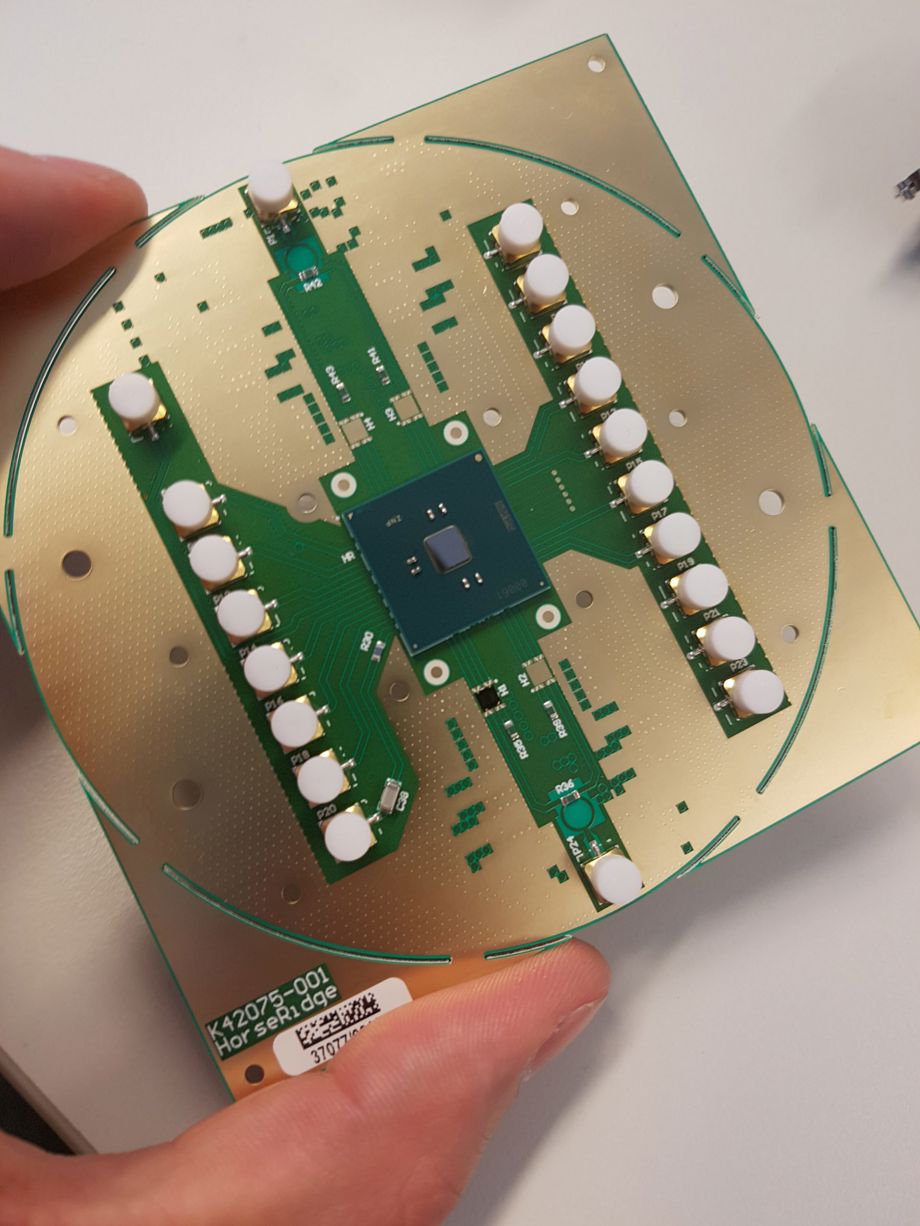
Image Credit: QuTech
Commenting on the achievement, Fabio Sebastiano, the leading researcher from QuTech and the Faculty of Electrical Engineering, Mathematics and Computer Science said, "this result brings us closer to a large-scale quantum computer which can solve problems that are intractable by even the most powerful supercomputers. Solutions to those problems can make a strong impact on everyday life, for instance in the fields of medicine and energy."
Intel says this research paves the way for integrating silicon spin qubit devices and the cryogenic controls of Horse Ridge to create a solution that delivers the qubits and controls in one streamlined package. The research paper was released at the 2020 International Solid-State Circuits Conference (ISSCC) in San Francisco, California.
Quantum computing technologies are still in the developmental stage. Tech giants including Google, IBM, Microsoft, are also in the race to achieve quantum supremacy and realize the power and potential of quantum computers to solve real-world problems.


 Google News