

Will Brexit mean history for the UK housing market?
For 2020, the question is will Brexit repeat or rewrite history for the property market of UK?
 Sarah Morris

- Country:
- United Kingdom
It is often said that history repeats itself and when the housing market is concerned the statement is certainly true, particularly when you look at the market in relation to major political events. For 2020, the question is will Brexit repeat or rewrite history for the property market?
We have already seen a swift uplift in growth and activity in reaction to a resounding election win by Boris Johnson and the Conservative Party in December last year. It was perhaps the promise to 'get Brexit done' that helped restore some certainty across the UK and subsequently enough confidence to give the market a boost. But what happens next, and is this 'Boris bounce' long or short-lived?
If the answer lies in the cyclical patterns of history, there is little quite on this scale – politically and economically – to compare Brexit with. So then maybe it's best to go back to where it all began, at the point of Britain joining the EU.
Interestingly, according to leading UK developer SevenCapital, who has crunched the numbers, by doing this we already see a very clear trend in the way events unfold and the impacts on house prices.
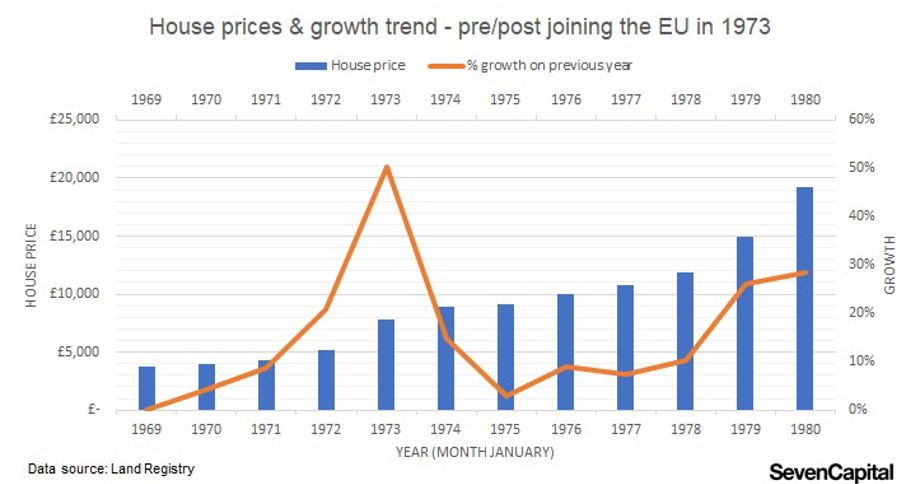
House prices & growth trend - pre/post joining the EU in 1974
House price data (fig 1) shows that on the lead up to Britain joining the EEC (now the EU) on January 1, 1973, house price growth, in anticipation, was strong – reaching more than 50% in the 12 months between the Treaty of Accession being signed in January 1972 and the day the UK officially became part of the EEC.
However, in the following couple of years, with a new Labour government coming into power and campaigning to renegotiate the terms of the UK's EEC membership, house price growth, potentially driven by uncertainty, dropped to a low of 3% from January 1974 to 1975.
It was only when a referendum, in June 1975, on whether the UK should remain in the EEC had taken place, which saw 67.3% of voters voting in favor of maintaining membership, that house prices began to pick back up again. Between the referendum and January 1976 house prices increased 6.3%, followed by 7.5% YOY January 1977 and 10.2% YOY January 1978. (fig 2).
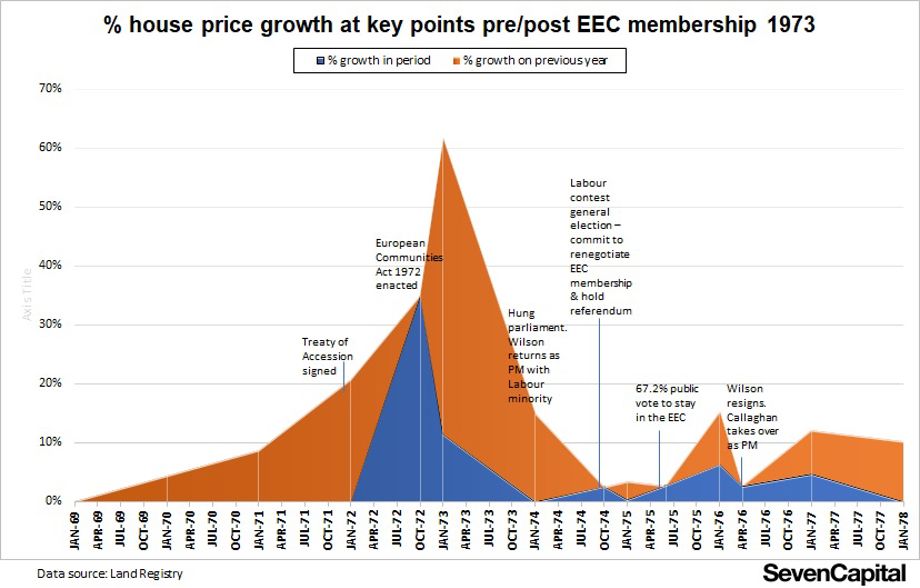
house price growth at key points pre/post EEC membership 1973
So how does this correlate to Brexit now?
Firstly, where we saw significant house price growth on the lead up to the UK joining the EU (EEC), we also saw very healthy house price growth in the two years before the referendum to leave the EU in 2016 – the highest since 2010 (fig 3).
Then, over the next two years, uncertainty ruled with opposing political parties and MEPs campaigning against the government to revoke Article 50. House price growth dropped to a low of 1.7% in the year to January 2019 – the lowest since circa 2012.
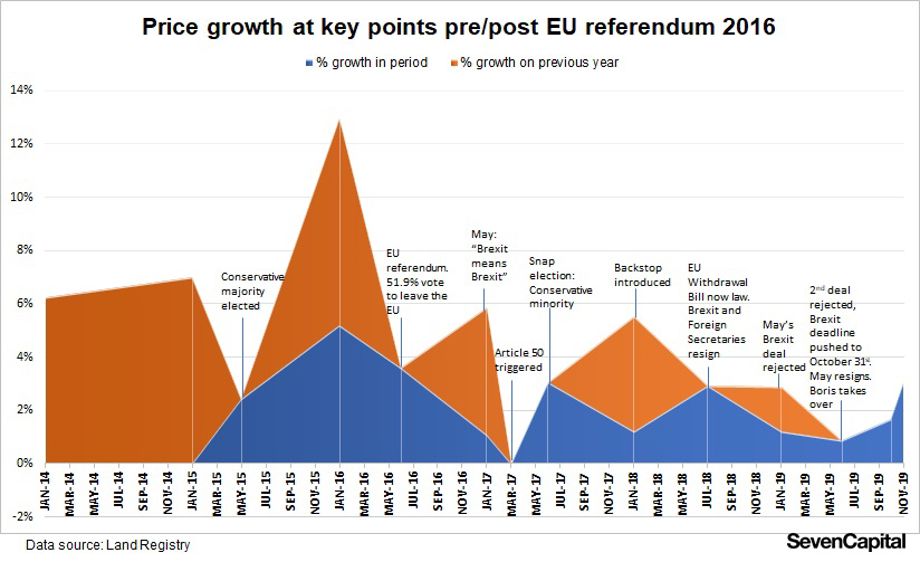
Price growth at key points pre/post EU referendum 2016
In a similar move to the referendum in 1975 when certainty was restored by the public voting almost unanimously in favor of remaining in the EU (EC), we have only recently begun to see more positive movement – the 'Boris bounce' - in the housing market following a clear win by Boris Johnson leading the Conservatives, with the promise to "Get Brexit Done".
Rightmove recently reported that in the month following the election – between December 13 and January 15 – average property prices jumped 2.3% in the biggest rise for the period since the website launched its house price index in 2002.
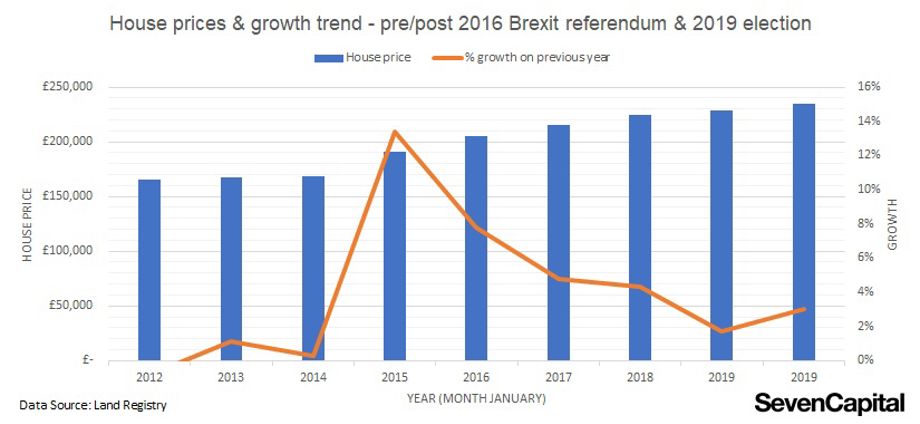
House prices & growth trend - pre/post 2016 Brexit referendum & 2019 election
What happens next, of course, will depend on how the negotiations for the future relations between Britain and the EU pan out. If the right trade deal can be agreed by November 26, then the UK's future relationship can begin in earnest on January 1, 2021. In this scenario, we can perhaps expect house prices to return to a good growth level over the next 12 months.
However, with a summit set to be held in June to assess the progress of talks, at which point the UK can request to extend the transition period up to two years – to December 2022. As a worst-case scenario, this could mean the housing market remains at a steady growth level for a longer period of time until there is the assurance of what the future looks like. Whichever scenario, it seems apparent that growth is set to return.
Andy Foote, director at SevenCapital, comments, "we've seen the beginnings of what is being dubbed a 'Boris bounce' in the housing market, and experts, SevenCapital included, have predicted a post-Brexit housing boom. Short-term, I expect this is likely to happen after January 31st. However, what happens next all falls on the speed and success of negotiations over the next five months."
"What is apparent and is important to take note of, particularly for property investors and buyers wondering whether to buy now or wait, is that whilst we're in this period of uncertainty, house prices are still growing – however slow they might seem. This is the market simply saying it wants to move, but 'let's just hang fire for a moment whilst we find out what is happening'. It is potentially an opportunity for the less risk-averse to invest, or buy before the bounce and wait for the market to return to higher growth again."
(Disclaimer: The opinions expressed are the personal views of the author. The facts and opinions appearing in the article do not reflect the views of Devdiscourse and Devdiscourse does not claim any responsibility for the same.)
- FIRST PUBLISHED IN:
- Sarah Morris


 Google News