

High Costs Ground Drones in Healthcare Logistics: A Financial Hurdle to Adoption
The study finds that while drones offer potential benefits in healthcare logistics, their high operational costs remain a significant barrier to widespread adoption. Substantial cost reductions are necessary for drones to become financially viable in routine logistics systems.
 CoE-EDP, VisionRI
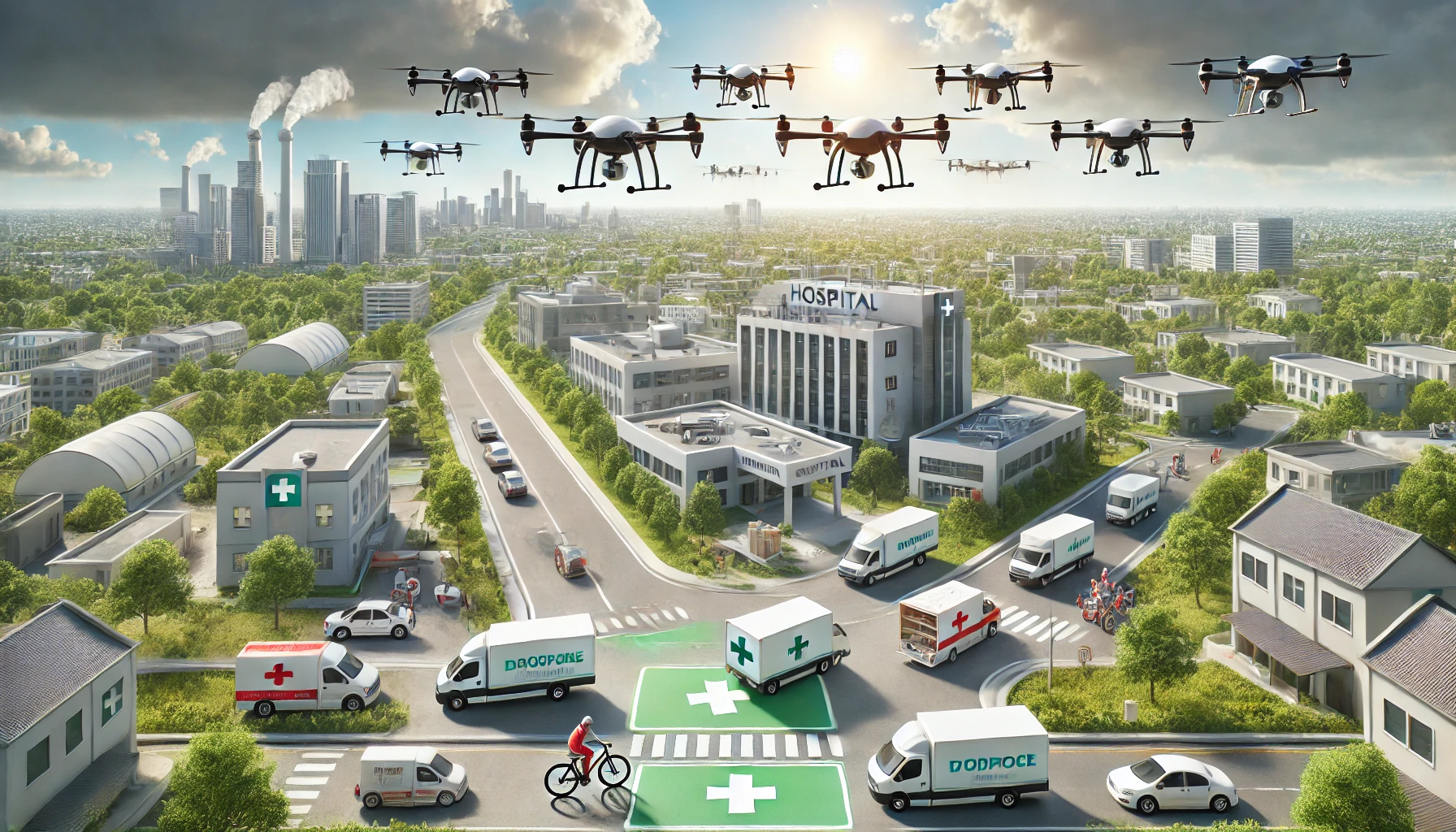
A recent study by researchers from the University of Southampton and University College London delves into the economic challenges associated with integrating drones into healthcare logistics systems, particularly in the United Kingdom. The study is motivated by the increasing interest in Uncrewed Aerial Vehicles (UAVs), commonly known as drones, as a viable transport mode for logistics. Drones promise several benefits, including reduced transit times and improved access to remote or hard-to-reach locations. However, their adoption in routine logistics operations, especially in healthcare, has been limited, largely due to the higher costs associated with operating drones compared to traditional surface transport modes like vans and bicycle couriers.
Exploring the Financial Viability of Drones in Healthcare
To explore this issue, the researchers conducted a detailed analysis using two real-world logistics networks in the UK. The first network serves Southampton General Hospital, while the second covers Saint Mary's Hospital on the Isle of Wight. These case studies were chosen to represent contrasting logistics environments: one in a densely populated urban area and the other in a more geographically isolated setting. The primary aim of the study was to investigate how the costs of drones influence their adoption in integrated, multi-modal logistics systems, particularly in healthcare where timely and reliable transport of patient pathology samples is critical.
Cost Barriers and the Potential for Drones
The study employed a novel logistics model known as FORSETI to simulate various scenarios and assess the impact of drone costs on logistics mode choices. The researchers found that drones could indeed become a financially viable option within these logistics systems, but only if their operational costs were significantly reduced by about 19% from current levels. This finding underscores the substantial cost barrier that currently prevents drones from being widely adopted in routine healthcare logistics. Even though drones can reduce sample transit times by up to 70% compared to vans, the study revealed that these time savings had negligible benefits for the broader healthcare system. The current level of service requirements for transit times could be adequately met by all modes of transport, including vans and bicycle couriers, making the additional costs of drones hard to justify.
Tipping Points for Drone Adoption
In scenarios where only surgeries with suitable landing zones for drones were considered, drones began to emerge as a cost-effective option when their costs were reduced to about 3.5% of current values. However, when the analysis was expanded to include all surgeries, regardless of their suitability for drone landings, the tipping point for drone adoption occurred at 18.5% of current costs. This difference highlights how logistical and geographical factors influence the cost-effectiveness of drones in healthcare settings.
The Role of Future Automation and Cost Reductions
The researchers also explored the potential for future cost reductions through increased automation and the use of shared-capacity regimes, where one mission commander could oversee multiple drones simultaneously. Such advancements could reduce labor costs, which are currently a major component of drone operating expenses. For instance, the study estimated that future drone costs, factoring in these technological improvements, could be reduced to approximately 43% of current levels. In scenarios where mission commanders could manage drones across multiple networks, costs could be further reduced to about 40% of current levels. However, even with these optimistic projections, the estimated future costs of drones still fall short of the reduction needed to make them financially viable on a large scale. In the most favorable scenario studied, drones would need to be 82.5% cheaper than they are today to be competitive with traditional transport modes.
A Cautious Outlook on the Future of Drones in Healthcare
The study's findings are particularly relevant in the context of public sector organizations like the UK's National Health Service (NHS), where budgets are tight and cost-effectiveness is paramount. The researchers argue that while drones offer promising benefits in terms of speed and accessibility, these advantages do not translate into meaningful improvements in patient outcomes unless the entire healthcare logistics and treatment system is optimized to leverage these time savings. In the current system, where patients often wait days or even weeks for diagnostic results and subsequent treatment, the marginal gains offered by faster drone deliveries are unlikely to justify the higher costs.
The study presents a cautious outlook on the future of drones in healthcare logistics. While technological advancements may eventually lower the costs of drones, making them more competitive with traditional modes of transport, the significant cost reductions required suggest that widespread adoption is still a distant prospect. The study highlights the need for further research into the specific network characteristics and logistical factors that influence the viability of drones in different settings. Until these cost barriers can be overcome, drones are unlikely to play a major role in routine healthcare logistics, despite their potential benefits.
- FIRST PUBLISHED IN:
- Devdiscourse


 Google News