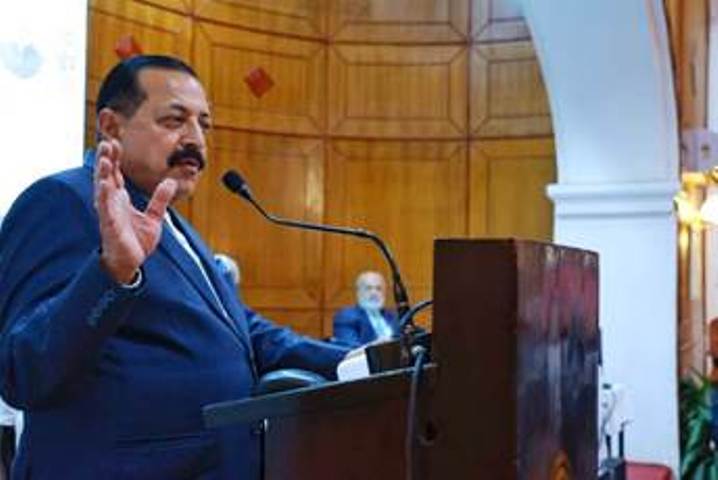
Union Minister Dr. Jitendra Singh emphasized the significance of the Kargil War during the 25th Kargil Vijay Diwas celebration at the Ambedkar International Centre today. He highlighted that the conflict reaffirmed India's readiness to counter any threat to its sovereignty and demonstrated the nation's unified resolve in the face of adversity.
Dr. Singh asserted that the Kargil War sent a strong message of India's unwavering commitment to defending its territorial integrity. "Whenever our boundaries are challenged, the entire nation stands united to overcome adversaries," he said, adding that the conflict underscored India's ability to address unexpected threats and outmaneuver adversaries.
The Union Minister praised the war's representation of India's secular values, noting that soldiers of all backgrounds fought together with a singular dedication to the country. He also pointed out that the Kargil conflict highlighted Pakistan's persistent reluctance to acknowledge the status of Pakistan-Occupied Jammu and Kashmir (PoJK) as part of India. Despite previous conflicts and ongoing infiltration attempts, Pakistan had not reconciled with this reality, which reinforced the need for India to evolve its political and military strategies.
Following the Kargil War, significant changes occurred in India's defense approach, particularly under Prime Minister Narendra Modi's leadership since 2014. The government granted the military greater autonomy to respond strategically, as seen in the surgical strikes and retaliation to the Pulwama attack. The defense budget was substantially increased, with ₹6.22 lakh crore allocated in the interim budget, reflecting a strong focus on national security.
India's defense sector has transitioned from being a major importer to a key exporter of defense equipment, with plans to cease the import of 5,000 defense-related items marking a shift towards self-reliance. Dr. Singh also noted the importance of vigilance due to the unstable policies of Islamabad and the lack of coordination between Pakistan's political and military leadership.
In Kashmir, post-abrogation of Article 370 and the revised defense strategy, peace has been restored, evidenced by a surge in tourism. The youth of Kashmir are now more optimistic about the opportunities under Prime Minister Modi's leadership and are moving forward, learning from past mistakes.
Dr. Singh reaffirmed India's commitment to reclaiming PoJK, referencing the 1993 resolution and the 1980 resolution which underscore PoJK as an integral part of India. He praised the Jammu and Kashmir Study Centre for its efforts in raising awareness among the youth about the region's significance and recalled his association with the group since his early public service days.
Col. Girish Kumar Mediratta and Shri Ashutosh Bhatnagar also attended the ceremony.


 Google News
RSS
Google News
RSS



