

Harsh Malhotra Lays Foundation for NH-48 Flyovers & FOBs to Ease NCR Traffic
“India now builds roads at a record speed, demonstrating our capacity to create infrastructure that fuels economic growth and connects every corner of the nation,” Shri Malhotra remarked.
- Country:
- India
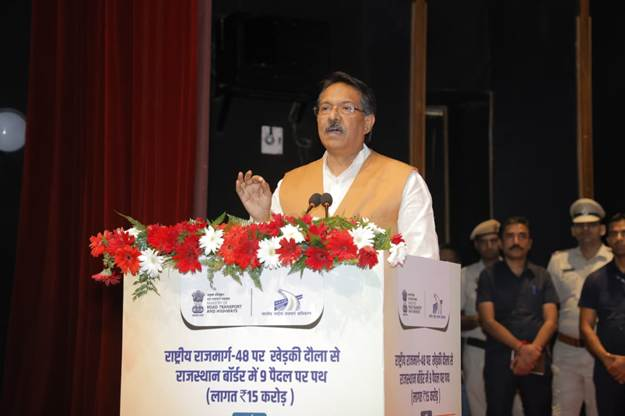
In a major push to strengthen connectivity and improve safety in the National Capital Region, Union Minister of State for Road Transport & Highways and Corporate Affairs, Shri Harsh Malhotra, laid the foundation stone for four new flyovers and nine Foot Over Bridges (FOBs) along the Gurgaon–Kotputli–Jaipur stretch of National Highway-48. The projects, estimated at a cost of ₹282 crore, were announced at a public ceremony attended by Dr. Inderjeet Yadav, Union Minister of Statistics & Planning and MoS for Culture, local mayors, councillors, and senior officials of NHAI.
The four new flyovers will be built at Panchgaon Chowk, Rathiwas, near Hero Company, and Sahlawas, while FOBs will be constructed at Shikhopur, Manesar, Binola, Rathiwas, Malpura, Jaisinghpurkhera, Sidhrawali, Kharkhara, and Khijuri. Together, they aim to decongest traffic, reduce accidents, and ensure smoother, safer journeys for lakhs of commuters traveling daily along the busy corridor.
Transforming Infrastructure Under PM Modi's Vision
Shri Malhotra said the projects are part of Prime Minister Narendra Modi's vision of a "Viksit Bharat", supported by Union Minister Nitin Gadkari's leadership in infrastructure transformation. He highlighted that in the last 11 years, India's road network has witnessed unprecedented expansion:
-
National highways increased from 91,000 km in 2014 to over 1.46 lakh km in 2024, making India's highway system the second-largest globally.
-
High-speed corridors grew from 93 km to 2,474 km.
-
Four-lane and above highways increased 2.5 times in the past decade.
-
Construction pace rose from 12.1 km/day in 2014–15 to 33.8 km/day in 2023–24, with a record average of 34 km/day.
-
Budget allocation for highways saw a 570% increase since 2014.
"India now builds roads at a record speed, demonstrating our capacity to create infrastructure that fuels economic growth and connects every corner of the nation," Shri Malhotra remarked.
Local Impact: Safer Travel for Gurugram and Rewari
The Minister stressed that the new flyovers and FOBs will directly benefit residents of Gurugram, Rewari, and adjoining regions, particularly service professionals and industrial workers who depend on NH-48 for daily commutes.
-
The flyovers will remove at-grade conflicts and address long-standing blackspots prone to accidents, easing traffic at crucial junctions.
-
The FOBs will feature ramps, stairways, and dedicated lighting systems, ensuring universal accessibility and safe pedestrian movement even at night.
"These works will significantly reduce pedestrian fatalities, address congestion, and provide a safer, smoother experience for commuters," Shri Malhotra said.
Strategic Development in Delhi-NCR
The Minister also placed these projects in the broader context of Delhi-NCR's infrastructure boom. He noted that:
-
Projects worth ₹80,545 crore covering 1,679 km have been completed.
-
Additional projects worth ₹7,084 crore are under implementation.
-
Future projects worth ₹23,850 crore are in planning, including:
-
Delhi–Amritsar–Katra and Delhi–Dehradun expressway extensions via UER-II.
-
Eastern extension of UER-II connecting Noida, Ghaziabad, and Faridabad.
-
5 km Dwarka Expressway–Nelson Mandela Marg tunnel.
-
20 km elevated corridor from AIIMS to Mahipalpur Bypass extending to Gurugram–Faridabad Road.
-
Interchange at Kalindi Kunj near Okhla Barrage.
-
Malhotra praised Minister Rao Inderjit Singh for his pivotal role in Gurugram's transformation into an economic and technology hub, supported by landmark projects such as the Dwarka Expressway, UER-II, Delhi–Mumbai Expressway, Metro extensions, and the Gurugram–Sohna elevated corridor.
Infrastructure as a Driver of Growth
Shri Malhotra reiterated that public infrastructure is the backbone of economic development, noting that every rupee spent on infrastructure yields a 3.2x multiplier effect on GDP. He highlighted that under the Pradhan Mantri Gati Shakti Master Plan, infrastructure development is now integrated with logistics, ports, railways, and urban planning, ensuring seamless connectivity and regional balance.
He urged NHAI officials to expedite the projects to ensure timely delivery to the public, stressing that infrastructure is not just about roads but about creating a foundation for India's transformation into a global economic powerhouse.
The launch of new flyovers and FOBs along NH-48 marks another milestone in India's journey towards becoming a world-class infrastructure leader. By easing congestion, improving safety, and strengthening regional connectivity, the projects will contribute to the social and economic well-being of Delhi-NCR, in line with the broader vision of Viksit Bharat by 2047.


 Google News