

Future of Agriculture: Cutting-Edge UAV Technology for Automated Fruit Harvesting
 CoE-EDP, VisionRI
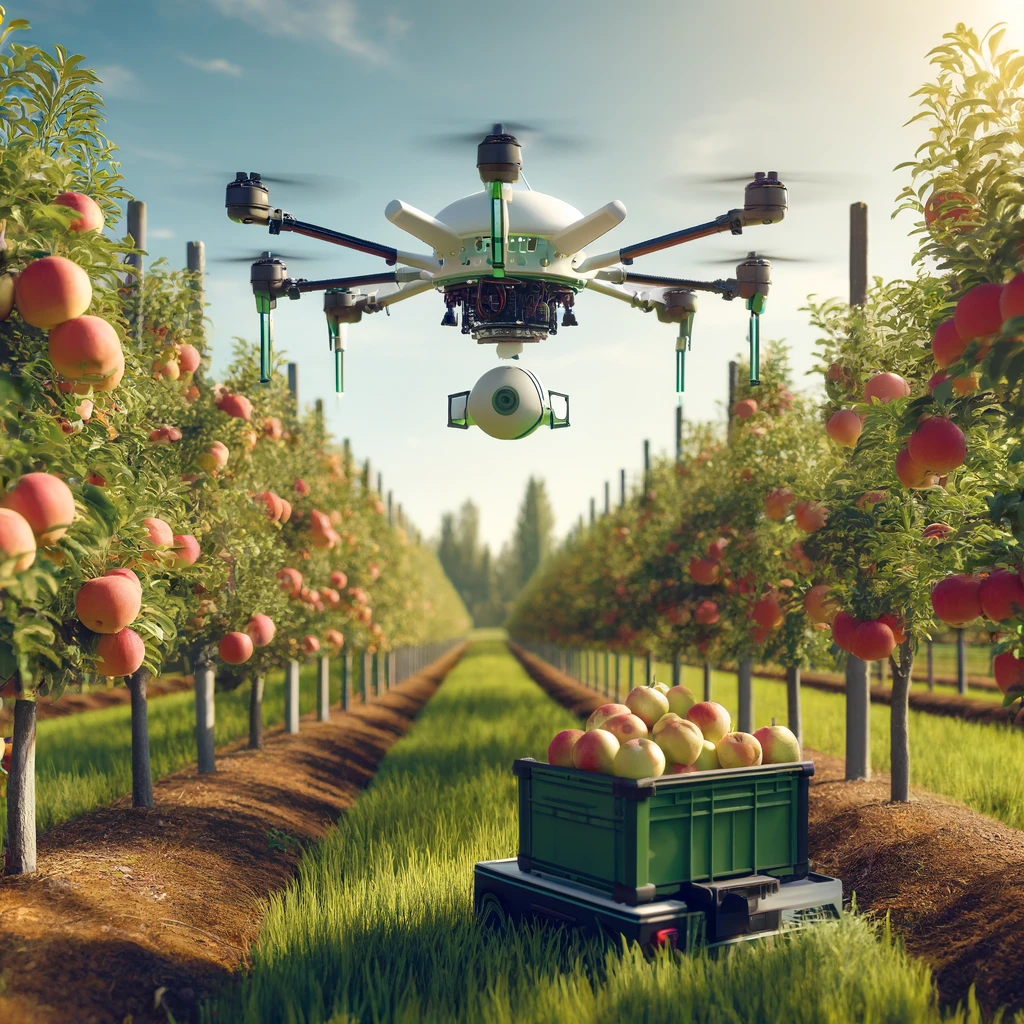
In recent years, the shortage of labor in agriculture has led to an increased interest in using robots to assist with tasks like fruit picking. One particularly promising technology is the use of Unmanned Aerial Vehicles (UAVs), commonly known as drones, to pick fruits. Drones have the advantage of being able to fly and operate in a variety of terrains, which makes them very versatile. However, one major challenge is that drones have a limited field of view, meaning they can't see all the fruits in an orchard at once. This makes it hard for them to efficiently move from one fruit to the next without wasting time searching.
The Problem with Continuous Picking
For drones to be effective at picking fruits continuously, they need a way to know where the next fruit is located without having to look for it every time. This is where the idea of "picking waypoints" comes in. Waypoints are specific locations that the drone can move to in order to pick the next fruit. If these waypoints are pre-determined and given to the drone, it can move from one fruit to the next much more quickly, improving its efficiency.
A New Method for Finding Picking Waypoints
Researchers from the College of Artificial Intelligence, South China Agricultural University, Guangzhou, Guangdong Laboratory for Lingnan Modern Agriculture, Guangzhou, and (NPAAC), South China Agricultural University, Guangzhou developed a new method to estimate these waypoints using multiple sensors. They used a combination of LiDAR (which measures distances using laser light), IMU (which tracks the drone's movement), and RGB-D cameras (which capture images and depth information). First, the drone uses these sensors to map the entire picking environment, identifying the locations of all the fruits. Then, special algorithms called Flag-kdtree and PCA (Principal Component Analysis) are used to determine the best waypoints for each fruit. Additionally, odometry information (which tracks the drone's position over time) is used to ensure the drone can smoothly move from one waypoint to the next.
Testing the Method
The researchers tested their method by setting up experiments with drones picking apples. They measured how accurately the waypoints were calculated by comparing the estimated positions to the actual positions of the fruits. The results were very promising. On average, the position of the estimated waypoints was off by only 34 millimeters, and the orientation was off by just 2.5 degrees. This level of accuracy is very good for practical use and shows that the method can effectively guide the drone to pick fruits without wasting time.
Paving the Way for Efficient and Autonomous Fruit Harvesting
While the method shows great potential, there are still some challenges to overcome. One challenge is improving the stability of the localization algorithm, which is how the drone knows where it is at all times. Better sensors and more advanced algorithms could help with this. Another challenge is ensuring the drone's end-effector (the part that actually picks the fruit) can precisely locate and pick the fruit every time. The researchers suggest that combining drones with ground-based mobile equipment could enhance performance. For instance, ground equipment could store picked fruits, provide power to the drone, and offer additional positioning data.
This study presents a novel approach to improving the efficiency of drones for fruit picking by using multi-sensor fusion to estimate picking waypoints. This method not only helps drones pick fruits faster but also reduces the time they spend searching for the next target. While there are still challenges to address, the results are promising and pave the way for more advanced and efficient agricultural robots. Future research will focus on developing a comprehensive system that integrates visual, control, and mechanical aspects to further enhance the performance of UAV-based fruit picking. This innovation could significantly impact the agriculture industry by making fruit picking more efficient and less reliant on human labor.
- FIRST PUBLISHED IN:
- Devdiscourse


 Google News