

Saline Agriculture Solutions: Securing Viet Nam’s Mekong Delta Farms
The Mekong Delta's agriculture faces severe saline intrusion due to climate change, threatening rice production and farmers' livelihoods. ADB, in partnership with global institutions, introduced innovative training on saline agriculture, hydroponics, and adaptive techniques to ensure long-term agricultural resilience.
 CoE-EDP, VisionRI
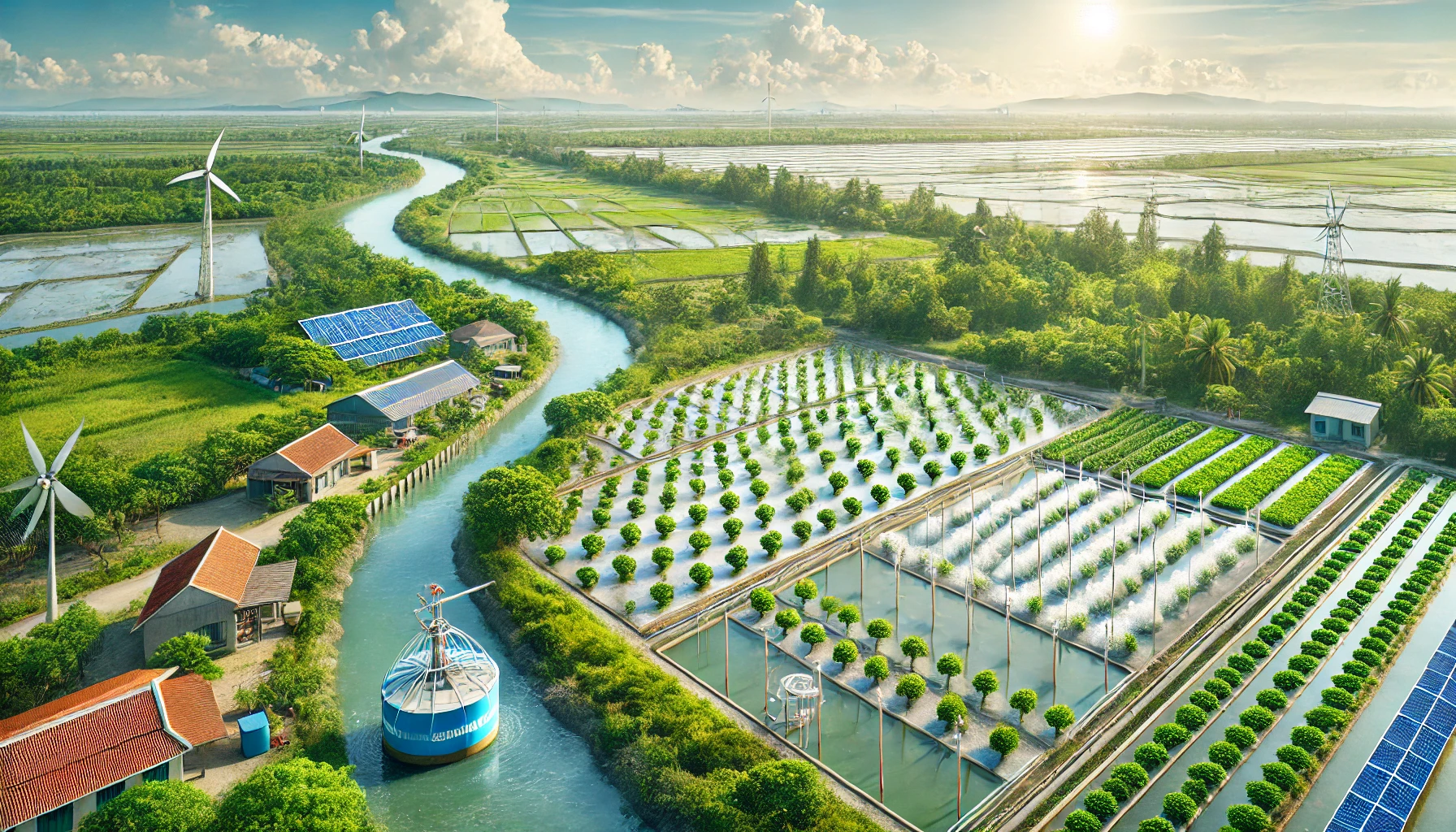
The Mekong Delta, Viet Nam's agricultural lifeline, plays a vital role in the country's food security, producing nearly half of its rice harvest and three-quarters of its fisheries and fruit. However, climate change is drastically altering this fertile region. Rising sea levels and shifting rainfall patterns have led to widespread saline intrusion, making freshwater scarce and severely impacting rice production. Currently, 70% of rice crops in the region are affected by salt, while the remaining 30% fail to yield any grain. This crisis has resulted in severe financial losses for thousands of farmers who depend on agriculture for their livelihood.
To address these challenges, the Asian Development Bank (ADB), under the Netherlands Trust Fund through the Water Financing Partnership Facility (WFPF), joined forces with the Netherlands Water Partnership, Can Tho University, Eurofins, Fresh Studio, Royal Eijkelkamp, SkillEd, The Salt Doctors, Wageningen University and Research, and Witteveen+Bos. Together, they developed a pioneering training program focused on saline agriculture to help farmers and agricultural professionals adapt to these harsh conditions. This initiative was designed to provide the necessary knowledge, skills, and resources to ensure agricultural resilience in an increasingly saline environment.
A Master Class for Farmers and Agricultural Experts
A core part of this effort was the launch of a master class on saline agriculture, conducted in Ben Tre Province, a region significantly affected by salinity. The program was structured into three comprehensive training sessions, each lasting three days, and was attended by farmers, cooperatives, government representatives, and private-sector stakeholders. The training combined theoretical learning with practical demonstrations, ensuring that participants could apply their knowledge in real-world agricultural settings.
Key topics covered in the master class included soil health, salinity-tolerant crops, water quality monitoring, freshwater harvesting, improved irrigation techniques, and alternative farming methods such as hydroponics. The training also focused on soil drainage, water table management, and the economic feasibility of transitioning to saline-resilient crops. A significant advantage of the program was its interactive and blended learning approach, where farmers were encouraged to participate in discussions, conduct field experiments, and work on group assignments to reinforce their learning.
The Importance of Measuring and Managing Salinity
One of the critical lessons imparted during the training was the need to measure salinity levels in both soil and water before making agricultural decisions. Farmers were trained to use salinity-measuring tools and interpret data to determine which crops could be cultivated under specific conditions. Understanding soil salinity levels is essential, as different crops react differently to salt exposure.
For example, fruit trees, which have deep root systems, are more sensitive to saline groundwater than seasonal vegetable crops. This insight is crucial in determining which areas should be allocated for fruit cultivation versus vegetable farming. Additionally, improper irrigation with sodium-rich water can cause salt buildup in the soil's upper layers, leading to stunted root development and reduced crop yields. The training emphasized strategies to mitigate these risks, such as implementing better drainage systems, using salt-tolerant crop varieties, and adopting smart irrigation techniques.
Hydroponics: A Game-Changer for Saline Agriculture
Among the innovative solutions introduced, hydroponic farming stood out as one of the most promising techniques for saline-affected areas. A demonstration was set up to compare hydroponic farming with traditional open-field farming, and the results were groundbreaking. Hydroponic systems can reduce water usage by 80-90% compared to conventional irrigation methods while also accelerating plant growth cycles. This efficiency makes hydroponics a viable option for farmers struggling with both salinity and water scarcity.
The hydroponic demonstration was designed using low-cost materials, including plastic lining, local walls, and shade nets. A small oxygen pump powered by solar panels from the Netherlands was introduced to ensure efficient nutrient circulation. Farmers who attended the training witnessed firsthand how hydroponic farming allows crops to grow faster and healthier, making it a sustainable alternative to conventional farming in saline environments.
Public-Private Partnerships and Future Innovations
Beyond training and demonstrations, the initiative emphasized the importance of long-term collaboration between farmers, researchers, and private-sector stakeholders. The establishment of public-private hubs, or "living labs," was recommended as a way to continue research, share knowledge, and develop adaptive solutions tailored to the needs of the Mekong Delta. These hubs would serve as incubators for innovation, enabling farmers to access new techniques and test solutions in controlled environments before implementing them on a larger scale.
Additionally, all training materials and research findings were uploaded onto the SkillEd digital platform, ensuring continued learning opportunities. This platform provides access to a hydroponics manual and an introductory course on saline agriculture, both available in English and Vietnamese. By making these resources widely available, the program ensures that knowledge-sharing remains an ongoing process, even after the formal training sessions have ended.
The success of this program marks a shift in how farmers approach saline intrusion from resisting it to adapting and innovating. Rather than viewing salinity as an insurmountable obstacle, farmers are now equipped with the tools and techniques to turn it into an opportunity for agricultural sustainability. With continued investment in research, training, and technology, Vietnam's salt-affected farmlands can remain productive, ensuring food security and economic stability for future generations.
The lessons learned from this initiative could serve as a model for other regions facing similar climate challenges. By fostering a culture of resilience, collaboration, and technological advancement, saline agriculture is no longer just a survival strategy but a pathway to sustainable growth in a changing world.
- FIRST PUBLISHED IN:
- Devdiscourse


 Google News