

Cooperation, collaboration, connections important tools to fight pandemic: DST secy Renu Swarup
Sanjeev K Varshney the head of International Cooperation, Department of Science and Technology, emphasised that the BRICS conclave can function as a network building opportunity among the young scientists to solve common problems.
- Country:
- India
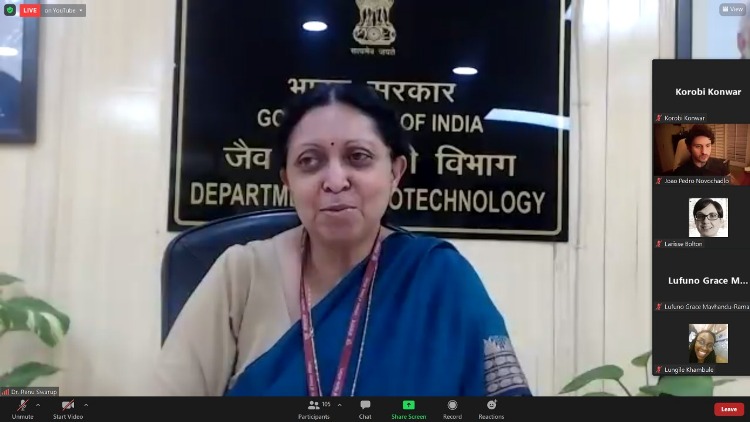
Secretary of the Department of Science and Technology Renu Swarup has stressed that cooperation, collaboration and connections have been important tools in the path of fighting the potent war against the Covid pandemic, according to an official statement on Tuesday.
Addressing the sixth edition of the BRICS Young Scientists Forum (BRICS-YSF) Swarup encouraged countries to have a science-driven agenda and to focus on the importance of globally common themes of translation, generation and application of knowledge.
The programme was organised by the Department of Science and Technology in collaboration with the National Institute of Advanced Studies (NIAS), Bengaluru.
''We know exactly the role science and technology innovation has played over the globe to fight the potent war against the pandemic. Cooperation, collaboration and connections have been important tools in the path,'' she said during her inaugural address.
Focusing on the importance of data generation, data analysis and application, she encouraged the participation of youth in these areas and requested scientists to concentrate on precision medicine, genomic tools and biomarkers to help with the early detection of key diseases.
Swarup also appealed to the global community to engage through innovation and incubation hubs for data generation, analysis and application.
NIAS Director Shailesh Nayak urged the participants to continue engaging in future interactions and networking to produce sustainable solutions and facilitate innovative transition into the future. Sanjeev K Varshney the head of International Cooperation, Department of Science and Technology, emphasised that the BRICS conclave can function as a network building opportunity among the young scientists to solve common problems. To incentivise the collaborations, he also proposed fellowships supported by the sponsors of the BRICS YSF 2021.
The forum saw the participation of 125 scientists from different countries. The delegations from Brazil, Russia and India were headed by Carlos Matsumoto, Ms Albina Kutuzova, and Arvind Kumar respectively. Li Wenjing and Dr Stanley Maphosa headed the delegations from China and South Africa respectively. The BRICS-YSF summits were first hosted by India in 2016, followed by China in 2017, South Africa in 2018, Brazil in 2019, and Russia in 2020. This year the four-day conclave started on September 13. The best young scientist with an idea on innovation would be awarded at the BRICS-YSF 2021. The next conclave would be organised by China in 2022, the Department of Science and Technology said.


 Google News