

NASA's MAVEN and UAE's Hope Probe Mars missions agree to exchange data
- Country:
- United States
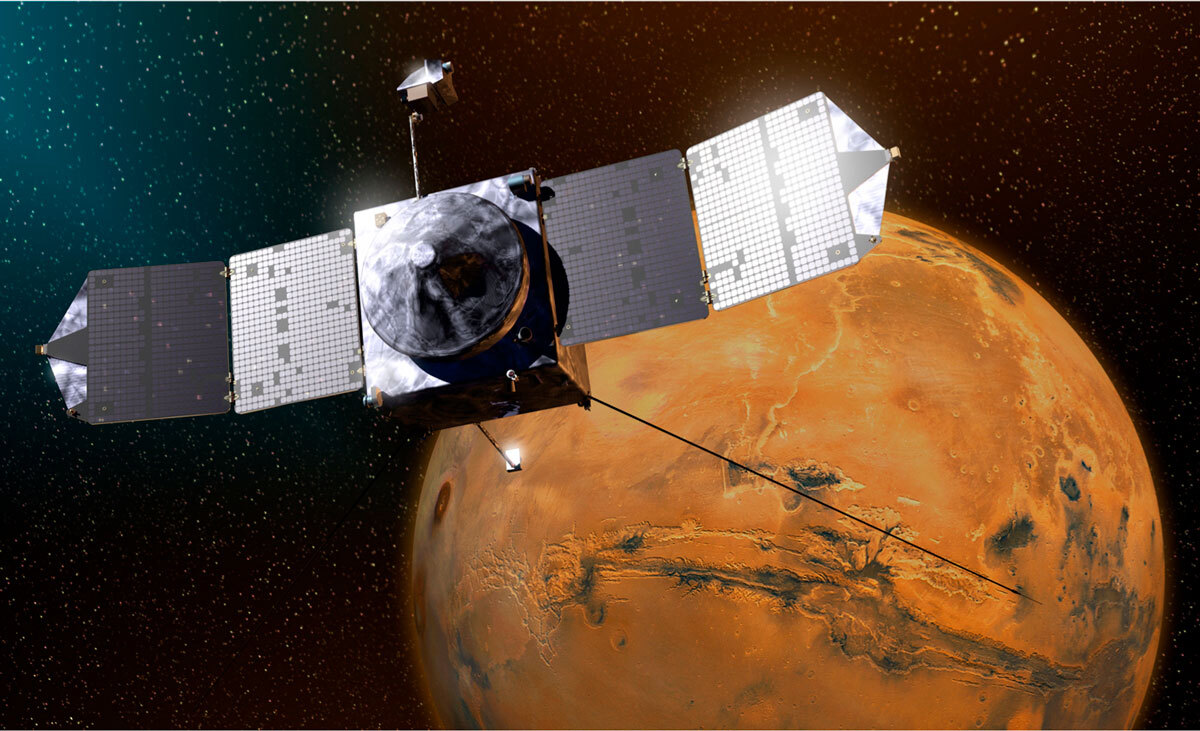
NASA's Mars Atmosphere and Volatile Evolution (MAVEN) and the United Arab Emirates' Hope Probe missions have agreed to exchange science data as they continue to study the Red Planet's atmosphere.
"A new partnership that encourages the sharing of data between NASA's MAVEN (Mars Atmosphere and Volatile Evolution) project and the Emirates Mars Mission's (EMM) Hope Probe will enhance scientific returns from both spacecraft," NASA said in a statement on Tuesday, adding that the arrangement will add value to both MAVEN and EMM, as well as the scientific communities involved in analyzing the data the two Mars orbiters collect.
Commenting on this collaboration, Shannon Curry, MAVEN principal investigator from the University of California, Berkeley, said, "MAVEN and EMM are each exploring different aspects of the Martian atmosphere and upper-atmosphere system. Combined, we will have a much better understanding of the coupling between the two, and the influence of the lower atmosphere on the escape to space of gas from the upper atmosphere."
NASA's MAVEN mission and the United Arab Emirates' Hope Probe mission are paving the way toward greater scientific collaboration and data exchange between the two Mars orbiters as they study the Red Planet's atmosphere. More: https://t.co/F4V5BS1NgT pic.twitter.com/W0LEnRA4wd
— NASA Mars (@NASAMars) April 12, 2022
NASA's MAVEN has been making observations of the atmosphere since September 2014. The mission's primary objective is to investigate the upper atmosphere and ionosphere of Mars to give a better understanding of how the planet's climate has changed over time.
On the other hand, Emirates Mars Mission Hope Probe, which entered orbit around Mars on February 9, 2021, is designed to provide the first-ever complete picture of the Martian atmosphere. Hope is studying the weather system of Mars, monitoring for the first-time weather changes throughout the day, across the planet, during all seasons. The mission also aims to understand the link between weather changes in Mars' lower atmosphere, with the loss of hydrogen and oxygen from the upper layers of the atmosphere.


 Google News