

ESA's Solar Orbiter captures space hedgehog and more breathtaking views: Check out pics
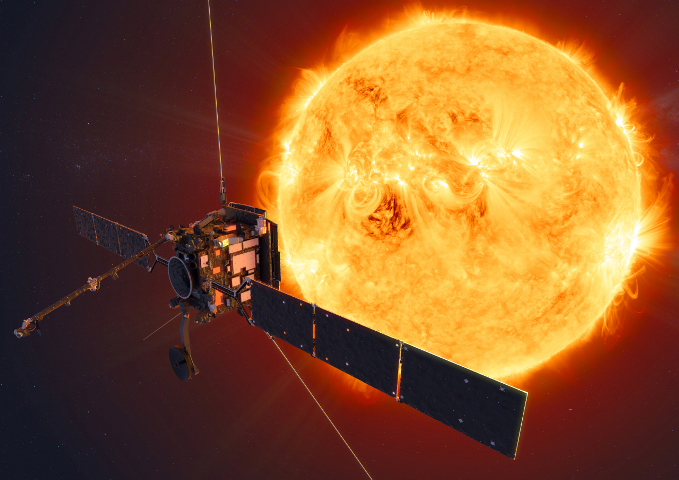
During its first close approach to the Sun, the European Space Agency's Solar Orbiter recently captured breathtaking views across the solar poles, powerful flares and a never-before-seen feature, nicknamed the hedgehog, among others.
The closest approach, known as perihelion, took place on 26 March, when the spacecraft was inside the orbit of Mercury, at about one-third the distance from the Sun to the Earth.
"There is no doubt that the instrument teams now have their work cut out. The perihelion was a huge success and has generated a vast quality of extraordinary data. And it's just a taste of what is to come," ESA said in a statement on Wednesday.
The spacecraft carries ten science instruments including an Extreme Ultraviolet Imager (EUI), Spectral Imaging of the Coronal Environment (SPICE) and Polarimetric and Helioseismic Imager (PHI) to study the Sun.
According to the agency, the solar hedgehog spotted during the March 26 perihelion stretches 25, 000 kilometres across the Sun and has a multitude of spikes of hot and colder gas that reach out in all directions. The EUI instrument team will now dig through past solar observations by other space missions to see if anything similar has been seen before.
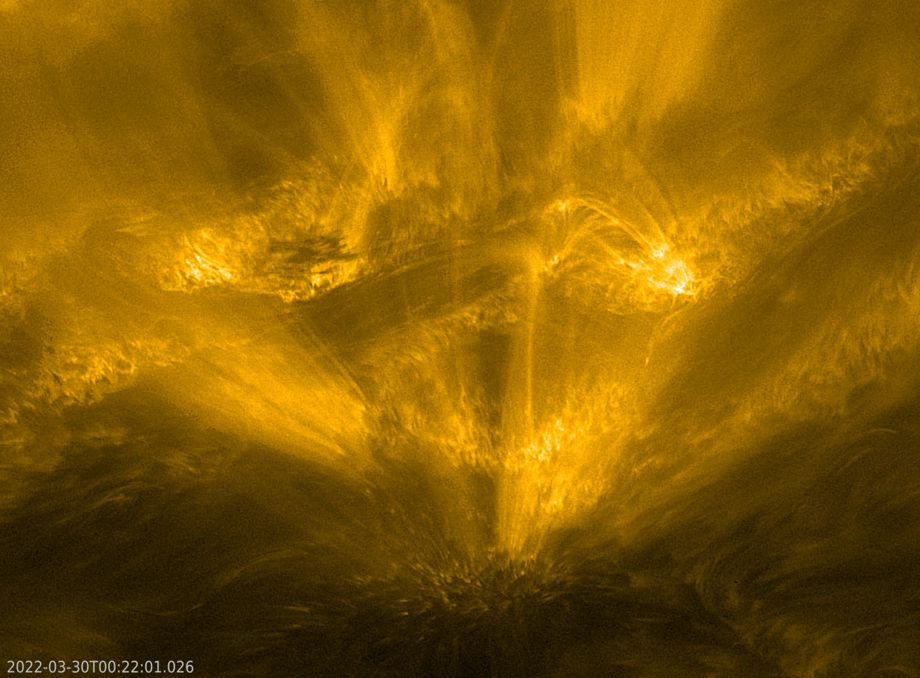
Image Credit: ESA
The spacecraft also captured high-resolution images of the Sun's largely unexplored polar regions, several coronal mass ejections (CME) and solar flares, including an X-class flare, the most energetic solar flare known.
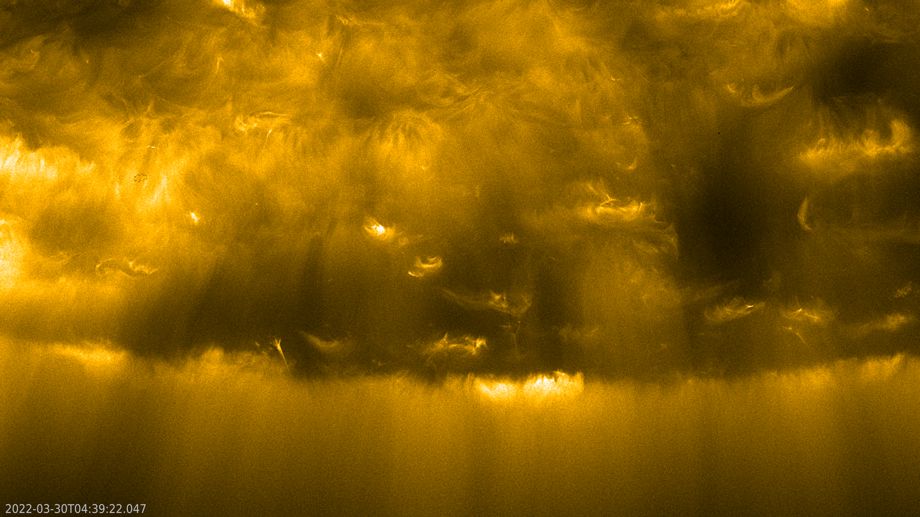
Image Credit: ESA
The Solar Orbiter's next and slightly closer perihelion pass will take place on 13 October at 0.29 times the Earth-Sun distance. Prior to this, the spacecraft will make its third flyby of Venus on 4th September.
More information can be found here.
A breathtaking view over the #Sun's south pole captured 30 March by @esasolarorbiter. #SolarOrbiter will use Venus gravity to crank up its orbit inclination for a more top-down view of our star's poles, unlocking secrets of solar activity https://t.co/pO6oQCLizg #ExploreFarther pic.twitter.com/CpDev8f24D
— ESA Science (@esascience) May 18, 2022


 Google News