

Underwater snow may play a role in building Jovian moon Europa's icy shell
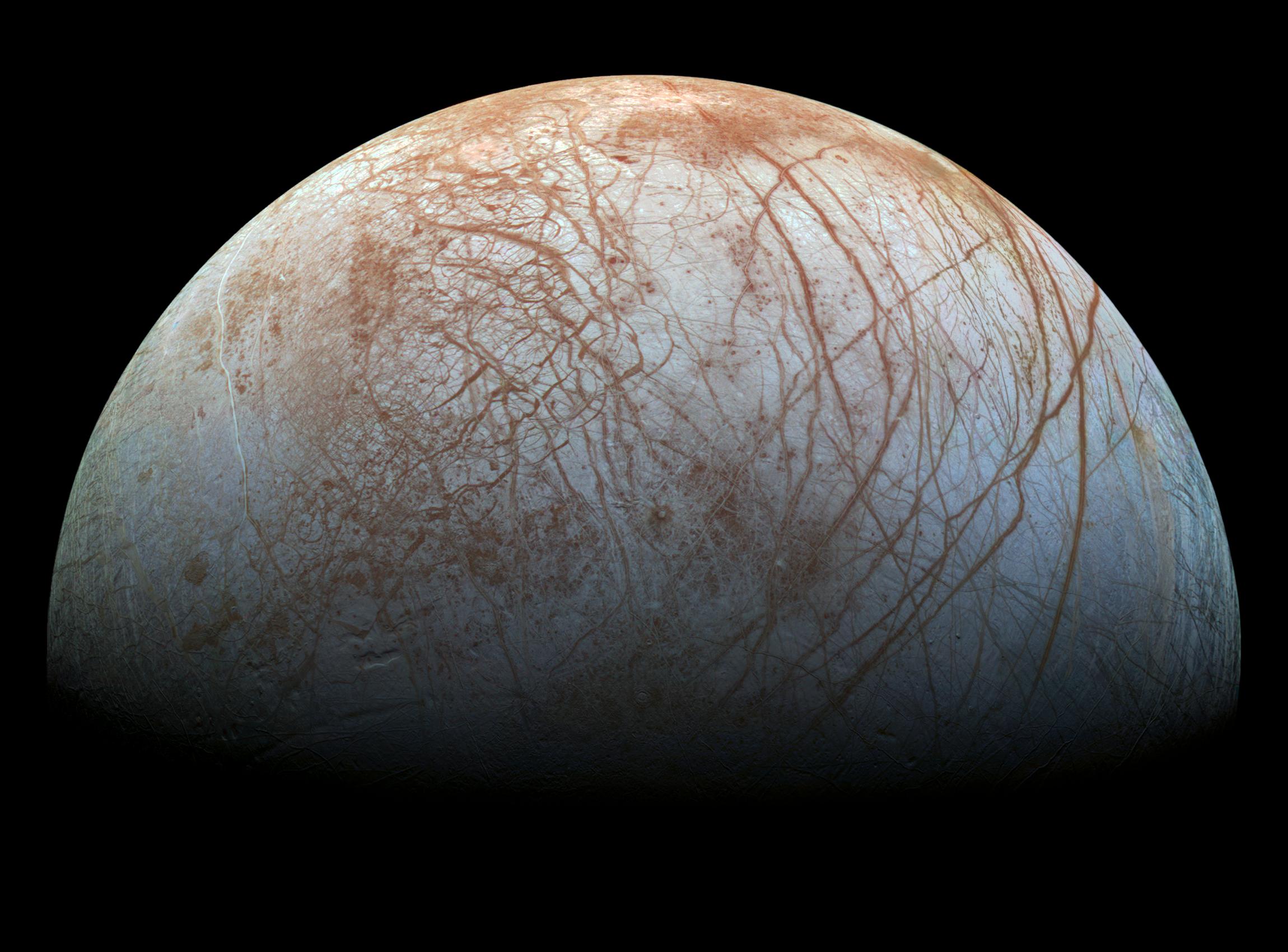
Jupiter's moon Europa - a rocky world about the size of the Earth's moon - is believed to harbor a vast underwater ocean where snow floats upwards onto inverted ice peaks and submerged ravines in the massive ocean.
The bizarre underwater snow is known to occur below ice shelves on Earth, but a new study by researchers at the University of Texas at Austin shows that the same is likely true for Jupiter's moon, where it may play a role in building its ice shell.
The underwater snow is much purer than other kinds of ice, which means the icy shell of the Jovian moon could be much less salty than previously thought. The new information will be critical because salt trapped in the ice can affect what and how deep the radar will see into the ice shell, so being able to predict what the ice is made of will help scientists make sense of the data, the researchers said in a statement.
"When we're exploring Europa, we're interested in the salinity and composition of the ocean, because that's one of the things that will govern its potential habitability or even the type of life that might live there, said the study's lead author Natalie Wolfenbarger, a graduate student researcher at the University of Texas Institute for Geophysics (UTIG) in the UT Jackson School of Geosciences.
Previous studies suggest that the temperature, pressure and salinity of Europa's ocean nearest to the ice is similar to that beneath an ice shelf in Antarctica.
The UT Austin researchers examined the two different ways that water freezes under ice shelves - congelation ice and frazil ice. Congelation ice grows directly from under the ice shelf whereas Frazil ice forms as ice flakes in supercooled seawater which float upwards through the water, settling on the bottom of the ice shelf.
Both ways make ice that's less salty than seawater, which Wolfenbarger found would be even less salty when scaled up to the size and age of Europa's ice shell.
According to her calculations, frazil ice – which keeps only a tiny fraction of the salt in seawater – could be very common on Europa, which means its ice shell could be orders of magnitude purer than previous estimates. This affects everything from its strength, to how heat moves through it, and forces that might drive a kind of ice tectonics.
Launching in 2024, NASA's Europa Clipper will gather data on Europa's atmosphere, surface, and interior – information that scientists will use to gauge the depth and salinity of the ocean, the thickness of the ice crust, and potential plumes that may be venting subsurface water into space.


 Google News