

Feast your eyes on this spectacular image of Phantom Galaxy as seen by Webb and Hubble telescope

In this picture, data from the NASA/ESA/CSA James Webb Space Telescope and the NASA/ESA Hubble Space Telescope compliment each other to provide a comprehensive view of the spectacular M74 galaxy, aka Phantom Galaxy, which lies around 32 million light-years away from Earth in the constellation Pisces.
On the left, Hubble's view of the Phantom Galaxy ranges from the older, redder stars towards the centre, to younger and bluer stars in its spiral arms, to the most active stellar formation in the red bubbles of H II regions.
On the right, Webb's image highlights the masses of gas and dust within the galaxy's arms and the dense cluster of stars at its core. Webb gazed into the galaxy with its Mid-InfraRed Instrument (MIRI) in order to learn more about the earliest phases of star formation in the local Universe.
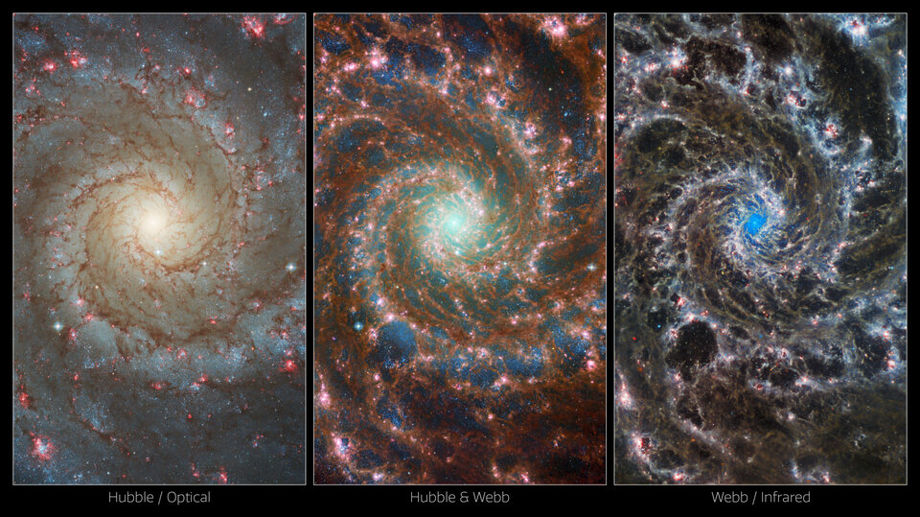 Image Credit: ESA/Webb, NASA & CSA, J. Lee and the PHANGS-JWST Team; ESA/Hubble & NASA, R. Chandar/Acknowledgement: J. Schmidt
The combined image in the centre (pictured above) merges these two for a truly unique look at this "grand design" spiral galaxy.
NASA calls Webb the scientific successor to Hubble. While Webb is designed to primarily look at the Universe in the infrared, the Hubble telescope studies it primarily at optical and ultraviolet wavelengths.
By combining data from telescopes operating across the electromagnetic spectrum, scientists can gain greater insight into astronomical objects than by using a single observatory – even one as powerful as Webb, the European Space Agency said in a statement.
1/ Here we have some brand new images of the Phantom Galaxy, M74, taken by a tag team of Hubble and Webb. Left is @HUBBLE_space 's optical image, with the right being @ESA_Webb 's infrared view of the same galaxy. In the centre is the astonishing composite of the two. pic.twitter.com/V1ZaQGspeR
— HUBBLE (@HUBBLE_space) August 30, 2022


 Google News