



Throwback: When NASA’s Cassini spacecraft made its final dive into Saturn's atmosphere and ended its epic 13-year exploration of the ringed planet
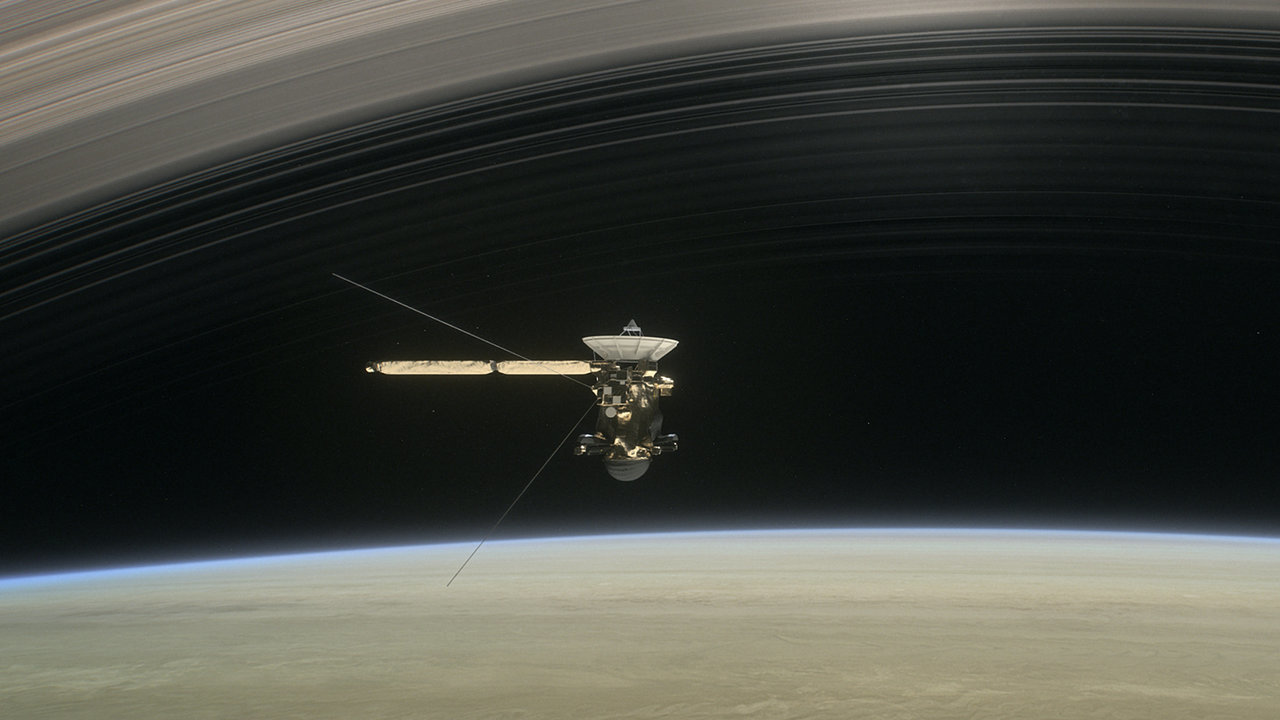
Five years ago, on September 15, NASA's Cassini spacecraft made its final approach to Saturn and dove into the planet's upper atmosphere, ending its remarkable 13-year exploration of the ringed planet.
A joint endeavor of NASA, the European Space Agency (ESA) and the Italian space agency, Agenzia Spaziale Italiana (ASI), the Cassini mission carried a European probe called Huygens, which parachuted to the surface of Saturn's largest moon, Titan, in January 2005 and returned spectacular results.
The mission revealed Titan to be one of the most Earth-like worlds we've encountered and shed light on the history of our home planet. After its four-year prime mission, Cassini's tour was extended twice.
On its final orbit, Cassini plunged into Saturn's atmosphere at tens of thousands of miles per hour. Even as the spacecraft made its fateful dive into the planet's atmosphere, it was sending home new data in real time. Soon after, it burned up and disintegrated like a meteor, becoming a part of the planet itself.
In its final moments, the spacecraft brought unparalleled observations of the gas giant planet and its rings from closer than ever before.
All good things... Five years ago today, our Cassini spacecraft became part of the planet it had studied for more than 13 years. Re-trace the steps of the mission's grand finale: https://t.co/pr4U3PnCxQ pic.twitter.com/X1q5jF8ta7
— NASA Solar System (@NASASolarSystem) September 15, 2022
Why NASA ended the mission?
After 20 years in space, the spacecraft an out of fuel. If left unchecked, this situation, according to the agency, would have eventually prevented mission operators from controlling the course of the spacecraft.
In order to avoid the unlikely possibility of Cassini someday colliding with moons of Saturn that could have conditions suitable for life, NASA decided to safely dispose of the spacecraft in the atmosphere of Saturn. This ensured that Cassini could not contaminate any future studies of habitability and potential life on the two moons of Saturn - Enceladus, and Titan.


 Google News