

NASA's IXPE telescope helps astronomers solve 40-year-old black hole jet mystery
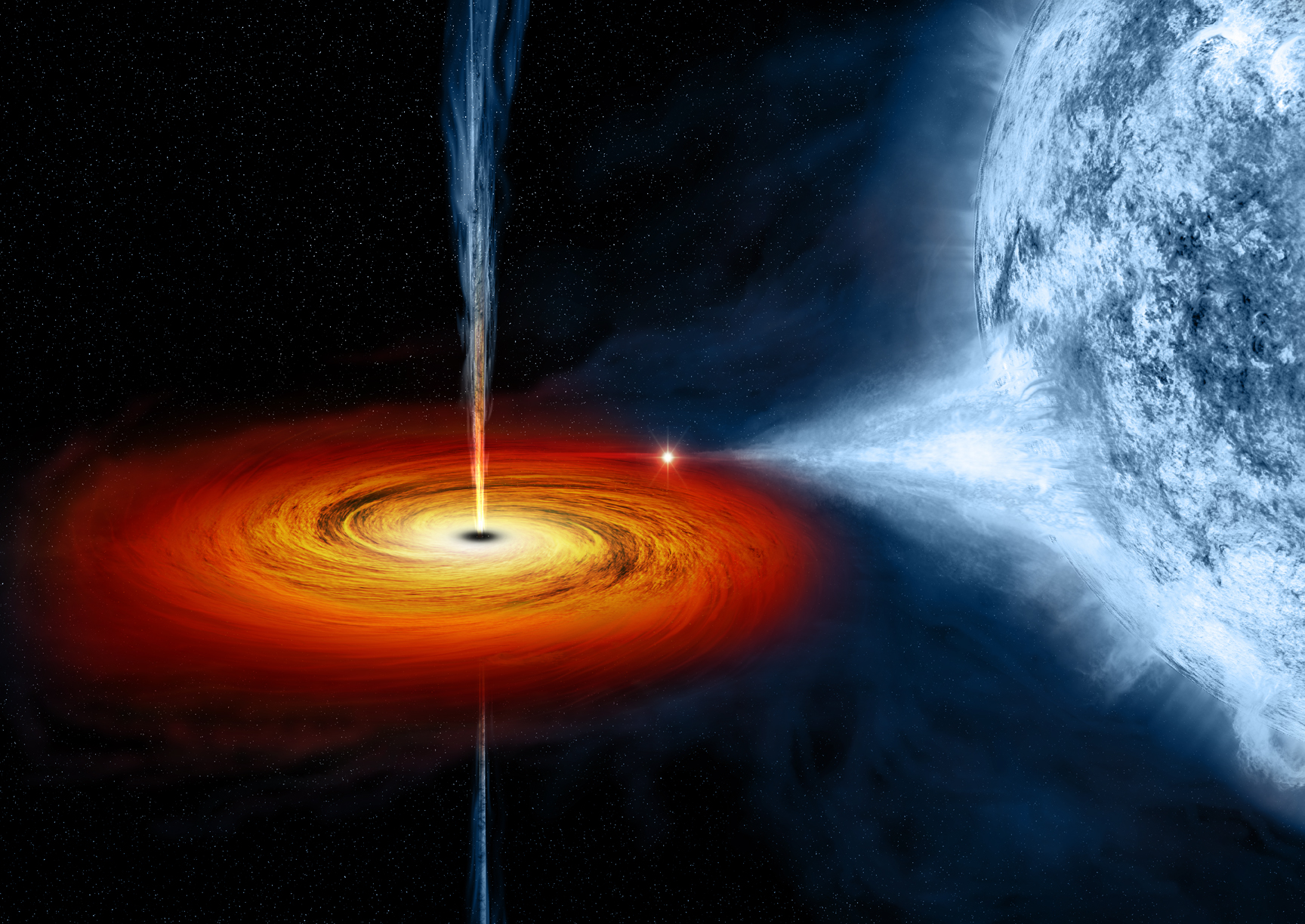
Blazars, one of the brightest and most energetic celestial objects, consist of a supermassive black hole feeding off material swirling around it in a disk, which can create two powerful jets perpendicular to the disk on each side.
NASA's Imaging X-Ray Polarimetry Explorer, or IXPE, has helped astronomers solve a decades-old mystery of how particles in these jets get accelerated to such high energies.
"This is a 40-year-old mystery that we've solved. We finally had all of the pieces of the puzzle, and the picture they made was clear," said Yannis Liodakis, lead author of the study and astronomer at FINCA, the Finnish Centre for Astronomy with ESO.
The new study used IXPE to point at Markarian 501, a blazar in the constellation Hercules. IXPE watched Markarian 501 for three days in early March of 2022, and then again two weeks later. In parallel, astronomers used other space and ground-based telescopes to gather information about the blazar in a wide range of wavelengths including radio, optical, and X-ray.
"Scientists found that X-ray light is more polarized than optical, which is more polarized than radio. But the direction of the polarized light was the same for all the wavelengths of light observed and was also aligned with the jet's direction," NASA said in a statement.
The team compared their information with theoretical models and realized that the data most closely matched a scenario in which a shock wave accelerates the jet particles. According to NASA, a shock wave is generated when something moves faster than the speed of sound of the surrounding material, such as when a supersonic jet flies by in our Earth's atmosphere.
The active black hole system will remain under observation to see if the polarization changes over time.
It's shocking!Our IXPE telescope turned its special X-ray vision to black-hole-powered galaxy Markarian 501 to help us understand what accelerates its jets of particles. Scientists found that it's likely the result of shock waves. Read more: https://t.co/JhxOnmPjDr pic.twitter.com/mpdijco2U3
— NASA Universe (@NASAUniverse) November 23, 2022


 Google News