

This NASA visualization shows best-known black hole systems in our galaxy and its neighbor | Watch
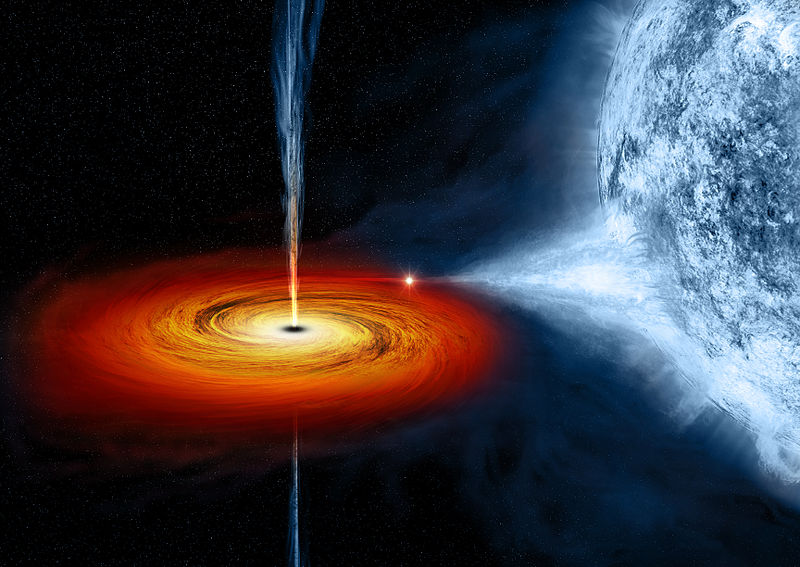
Black holes are some of the most mysterious and fascinating objects in the universe. They are regions of space where gravity is so strong that nothing, not even light, can escape. For centuries, scientists have been intrigued by these mysterious objects, and in recent years, our understanding of them has grown exponentially.
Black holes are the ultimate fate of stars that are born with a mass of more than approximately 20 times that of the Sun. Because no light can get out, people can't see black holes. They are invisible. However, scientists can detect black holes by looking for their gravitational effects on nearby stars and gas. They can also detect the radiation emitted by matter as it falls into the black hole.
Scientific evidence shows that in the middle of the Milky Way is a supermassive black hole. This black hole, dubbed Sagittarius A*, is believed to be the source of the intense radiation and high-energy particles that are found in the center of the galaxy. It is estimated to have a mass of 4.3 million times that of the Sun and is located more than 26,000 light-years away from Earth.
This NASA visualization displays 22 X-ray binary systems that contain confirmed black holes, all at the same scale and with their orbits accelerated by 22,000 times. The view of each system is how it appears from Earth. The stars are colored from blue-white to reddish, representing temperatures from 5 times hotter to 45% cooler than the Sun.
Credits: NASA's Goddard Space Flight Center and Scientific Visualization Studio
In most of these systems, matter from the star forms an accretion disk around the black hole. In others, such as Cygnus X-1, the star produces a powerful outflow that is partially drawn in by the black hole's gravity to form the disk. The accretion disks have a different color scheme due to their even higher temperatures than the stars. The largest disk, belonging to GRS 1915, is larger than the distance between Mercury and the Sun. The black holes are shown larger than they actually are, with spheres scaled to their masses.


 Google News