

Super-Earth may provide clues to habitable zone enigma
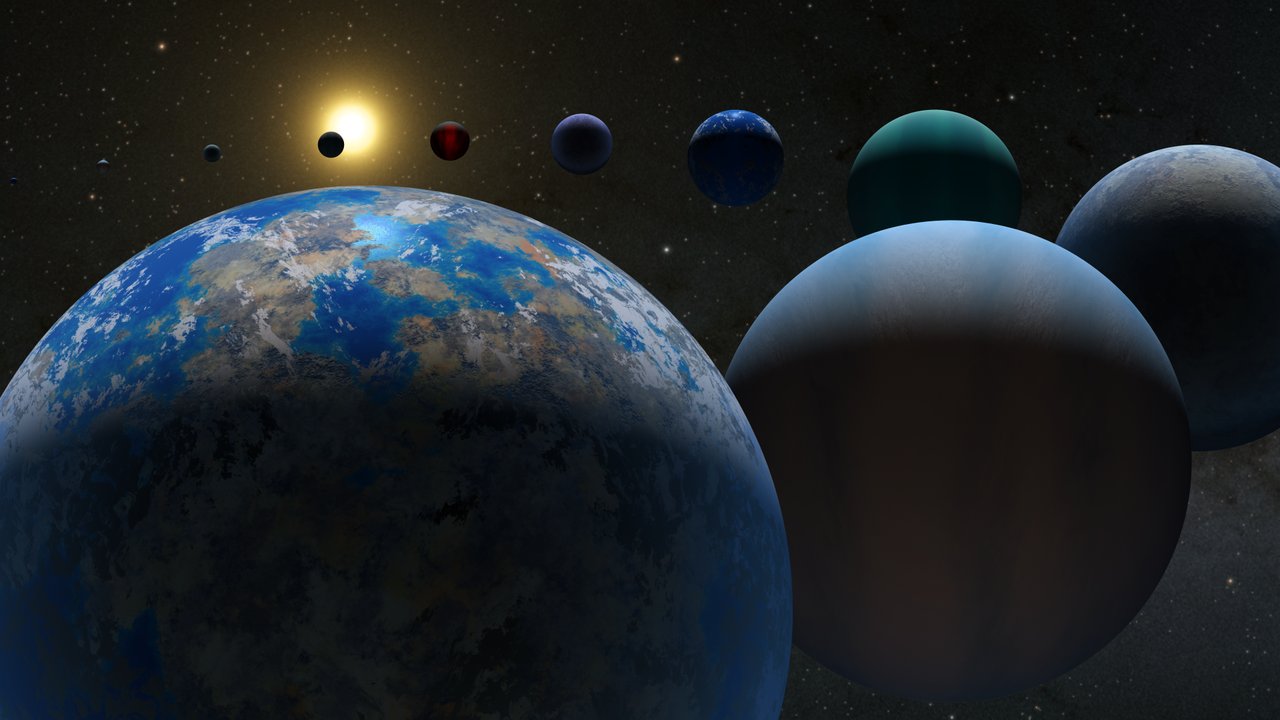
Late last year, an international team, led by Laetitia Delrez, an astrophysicist at the University of Liège, announced the discovery of two super-Earths - named LP 890-9b and LP 890-9c. Now, new research led by Lisa Kaltenegger, director of the Carl Sagan Institute and associate professor of astronomy in the College of Arts and Sciences, suggests that LP 890-9c (also known as SPECULOOS-2c) could hold the key to understanding the conditions at the inner edge of a star's habitable zone and why Earth and its twin Venus evolved so differently.
LP 890-9c lies close to the inner edge of its solar system's habitable zone and orbits a red dwarf star situated 100 light years away from Earth. The planet is about 40% larger than Earth but has an orbital period of about 8.5 days. The researchers believe that liquid water or a water-rich atmosphere could exist on this exoplanet.
The planet's appearance would vary depending on factors such as the presence of warm oceans, a steam atmosphere, or the loss of water if it once had oceans similar to Earth's.
"Looking at this planet will tell us what's happening on this inner edge of the habitable zone - how long a rocky planet can maintain habitability when it starts to get hot. It will teach us something fundamental about how rocky planets evolve with increasing starlight, and about what will one day happen to us and Earth," Kaltenegger said.
A companion study led by graduate student Jonathan Gomez Barrientos suggests that NASA's James Webb Space Telescope (JWST) has the potential to distinguish between different atmospheres on the exoplanet, making it an ideal target for the powerful space-based observatory. The companion paper proposes that JWST could identify the presence of an atmosphere, particularly if it primarily consists of water vapor, within three transits. Further observations could reveal a Venus-like atmosphere in eight transits or evidence of a potentially habitable "hot Earth" scenario in 20 transits.
While it is uncertain whether LP 890-9c has an atmosphere or supports life, further investigation using JWST promises to provide valuable insights into the planet's composition and characteristics.
"It's possible that LP 890-9c has no atmosphere and hosts no life, or that it resembles a Venus with thick clouds that would block light from reflecting and thus yield little information. Deeper investigation promises to provide valuable clues," Kaltenegger said.
More details can be found here.


 Google News