

NASA spacecraft captures ultraviolet views of Mars

NASA's MAVEN (Mars Atmosphere and Volatile EvolutioN) mission has recently unveiled captivating ultraviolet images of Mars, offering scientists a unique perspective on the planet's atmosphere and surface features. The images were captured by MAVEN's Imaging Ultraviolet Spectrograph (IUVS) instrument in 2022 and 2023, at different points along the planet's orbit around the Sun.
By observing Mars in ultraviolet wavelengths, outside the visible spectrum, researchers can glean valuable information about atmospheric dynamics and examine surface characteristics in exceptional detail.
The IUVS instrument measures wavelengths ranging from 110 to 340 nanometers. To make these wavelengths visible to the human eye and facilitate interpretation, the images are rendered using a color scheme where the varying brightness levels of three ultraviolet wavelength ranges are represented as red, green, and blue.
In this representation, atmospheric ozone appears purple, while clouds and hazes manifest as white or blue. The surface can exhibit shades of tan or green, depending on contrast enhancements to highlight specific details.
The first image (pictured above), taken in July 2022 during the southern hemisphere's summer season, showcases intriguing features. The Argyre Basin, one of Mars' deepest craters, is visible at the bottom left, filled with atmospheric haze depicted as pale pink. The majestic Valles Marineris, a complex system of canyons, dominates the top left portion of the image, shrouded in clouds (tan-colored in the above representation).
The southern polar ice cap is depicted in white at the bottom, gradually shrinking due to the relative warmth of summer. During this season, increased water vapor at high altitudes, driven by southern summer warming and dust storms, contributes to MAVEN's discovery of enhanced hydrogen loss from Mars.
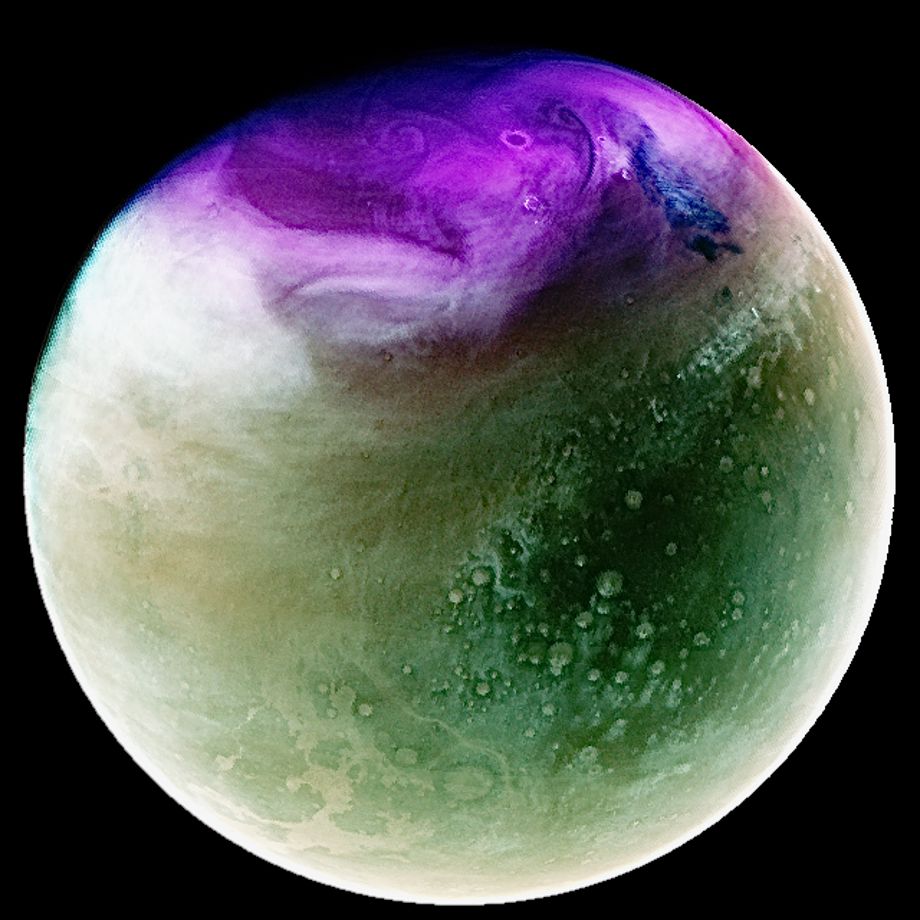
Image Credits: NASA/LASP/CU Boulder
The second image, captured in January 2023 after Mars had passed its farthest point from the Sun, provides a glimpse of the planet's northern hemisphere. The rapidly changing seasons in the planet's north polar region result in an abundance of white clouds. The Valles Marineris canyons can be observed in tan at the lower left, accompanied by numerous craters. In this view, ozone appears magenta, accumulated during the northern winter's frigid polar nights. As northern spring approaches, chemical reactions with water vapor, primarily limited to low atmospheric altitudes during this time, gradually deplete the ozone.
The MAVEN mission's UV images of Mars offer scientists a fresh perspective on the planet's atmospheric composition, dynamics, and surface characteristics. As the mission continues to investigate Mars' atmosphere and its interaction with the Sun and solar wind, the insights gleaned from these ultraviolet observations will contribute to our broader understanding of planetary atmospheres and their evolution.
Just wow 🤩MAVEN's IUVS instrument has released 2 stunning images of Mars in ultraviolet taken at different points along Mars' orbit around the Sun. By viewing the planet in this way, scientists can gain insight into the Martian atmosphere. Learn more: https://t.co/YJYkdIUGRn pic.twitter.com/YFwg9rvytc
— MAVEN Mission to Mars (@MAVEN2Mars) June 22, 2023


 Google News