

NASA’s first two-way laser relay system completes first year of experiments in space
- Country:
- United States
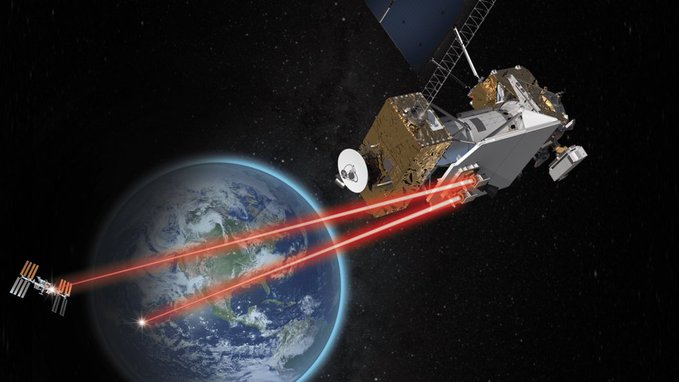
The Laser Communications Relay Demonstration (LCRD) - NASA's first two-way laser relay system to transmit information to and from space - has achieved a significant milestone, completing its first year of experiments on June 28.
LCRD is a payload aboard the Department of Defense's Space Test Program Satellite-6 (STPSat-6).Positioned in geosynchronous orbit 22,000 miles above Earth, it is currently serving as an experimental platform for NASA, other government agencies, academia, and commercial companies to test the capabilities of laser communications.
It represents a game-changing technology that could revolutionize the way data is sent and received from space. Unlike traditional radio wave systems, the LCRD utilizes infrared light, or invisible lasers, to transmit and receive signals. By harnessing the tight wavelengths of infrared light, space missions can pack significantly more data into a single transmission - an impressive 10 to 100 times more. This increase in data capacity opens up a world of possibilities for scientific discoveries.
Following the experiment phase, there is an opportunity for the mission to transition into an operational relay, which means future missions utilizing laser communications would no longer require a clear line of sight to Earth. Instead, they would simply transmit their data to the LCRD, which would then beam it down to Earth, the agency said.
Through a collaboration between NASA's Space Communications and Navigation (SCaN) program and NASA's Space Technology Mission Directorate, the LCRD was launched to test and refine laser communications technology. As systems like the LCRD continue to prove the capabilities of laser communications, future science and human exploration missions adopting this technology could transmit a significantly larger amount of data back to Earth.
The LCRD is part of a series of missions aimed at showcasing laser communications technology. NASA's ongoing efforts include the deployment of future terminals on the International Space Station, the Artemis II Orion spacecraft that will orbit the Moon, and the Deep Space Optical Communications experiment aboard the Psyche spacecraft. The latter will test laser communications at even greater distances from Earth as the Psyche spacecraft journeys towards its asteroid destination in deep space.
The LCRD team is now preparing for the late 2023 launch of NASA's Integrated LCRD Low-Earth Orbit User Modem and Amplifier Terminal (ILLUMA-T). Once deployed on the space station, ILLUMA-T will transmit experiment data to the LCRD, which will then relay it back to the ground. This critical step will enable NASA to test laser communications between low Earth orbit and geosynchronous orbit, showcasing the benefits of the LCRD's relay capabilities.
More data 👉 More discoveries@NASA's first two-way laser relay system has completed its first year of experiments. The LCRD has shown that laser communications can be a game-changing technology and the future for sending and receiving data from space >> https://t.co/38lZl1prkS pic.twitter.com/Zf3HbptChe
— NASA Marshall (@NASA_Marshall) June 29, 2023


 Google News