



Astronomers discover first planet that survived a red giant star
- Country:
- Australia
In approximately five billion years, our Sun will exhaust its nuclear fuel and enter the final stages of its life. During this phase, the Sun will expand to around 100 times its current size, likely engulfing our planet in a hot and tenuous outer atmosphere, obliterating any traces of life. Similarly many exoplanets will face a similar doom once their host stars grow old.
However, not all planets will suffer the same fate. An international team of astronomers, including researchers from the University of Sydney, have found a planet that seems to have survived its sun expanding to become a red giant - a star located in the Ursa Minor constellation, commonly known as the 'Little Bear.'
The Jupiter-like gas giant, named Halla (8 UMi b), orbits closely around the massive star Baekdu, which is nearly 11 times the radius of our Sun and 1.6 times its mass. Using NASA's Transiting Exoplanet Survey Satellite (TESS) observations of Baekdu's stellar oscillations, the researchers made a significant revelation - the star is burning helium, instead of hydrogen, in its core, suggesting that Baekdu had once expanded immensely into a red giant star.
Halla, discovered in 2015 by a team of Korean astronomers using the radial velocity method, orbits its star approximately 520 light years away from Earth. Follow-up observations from 2021 to 2022, conducted using the W. M. Keck Observatory and the Canada-France-Hawaii Telescope on Mauna Kea, Hawai‘i, confirmed the planet's stable 93-day, nearly circular orbit for over a decade.
"Together, these observations confirmed the existence of Halla, leaving us with the compelling question of how the planet survived," said lead author, Dr Marc Hon from the University of Hawai‘i.
Located at a distance of 0.46 astronomical units from its star (equivalent to almost half the distance from Earth to the Sun), Halla bears resemblance to "warm" or "hot" Jupiter-like planets. According to the researchers, in the face of a rapidly evolving host star, such an origin story becomes an extremely unlikely survival pathway for the planet Halla.
The team proposed two alternative scenarios for the planet's survival:
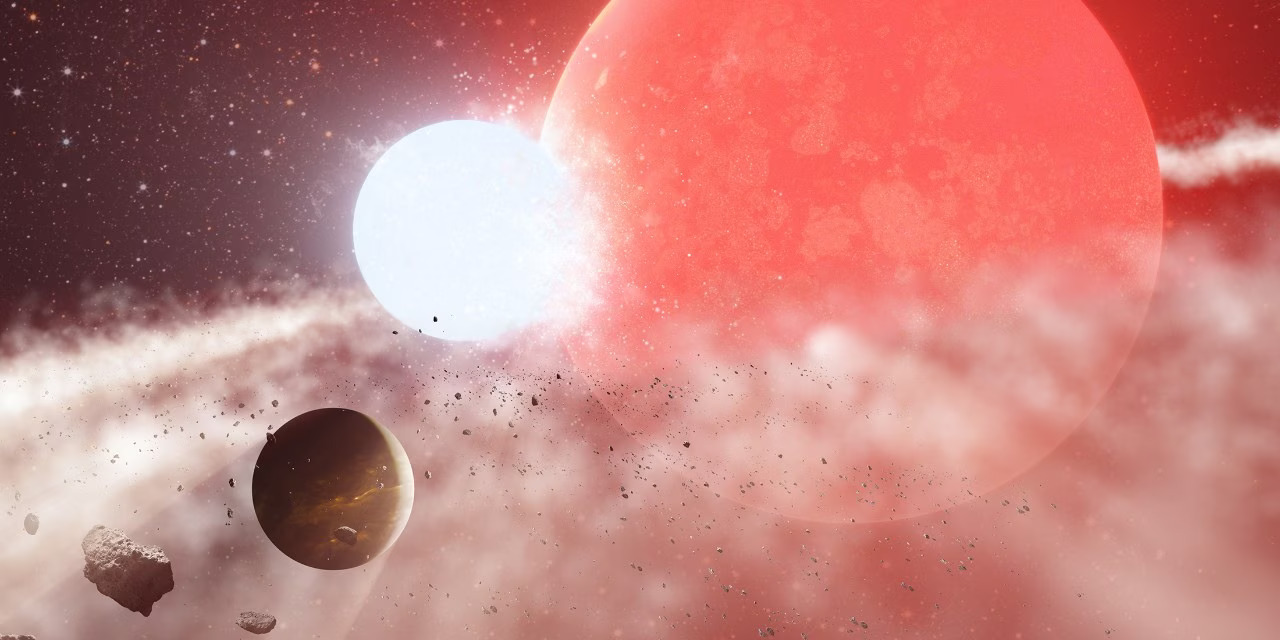
The first possibility is that Halla never faced the danger of engulfment because the Baekdu system initially consisted of two stars, their merger could have prevented either star from expanding enough to engulf the planet.
Another theory suggests that Halla may be a newborn planet and the violent collision between the two stars could have generated a gas cloud from which the planet eventually formed, making it a "second-generation" planet in this star system.
Their findings are published in the journal Nature.
- READ MORE ON:
- planet Halla
- red giant star
- Halla survival
- red giant star explosion


 Google News