

Astronomers may have found strongest evidence so far that red quasars are key element in galactic evolution
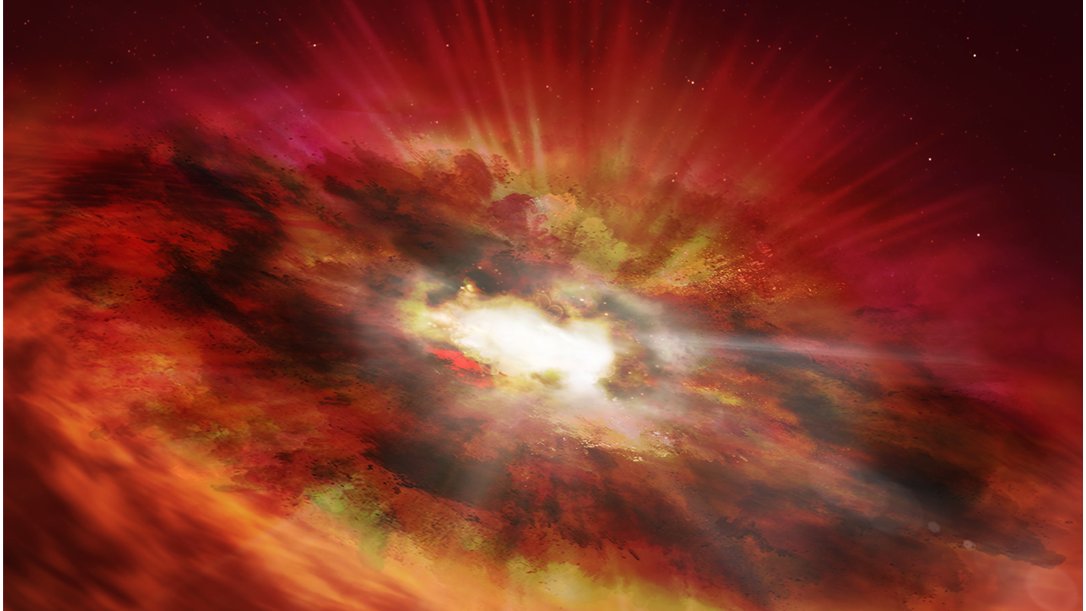
A team of international astronomers, using new data from the Dark Energy Spectroscopic Instrument (DESI), have found that quasars - extremely bright galaxies powered by supermassive black holes - that contained more dust, and therefore appeared redder, were more likely to have stronger radio emission compared to the quasars that had very little-to-no dust, appearing very blue.
Quasars are the most powerful type of active galaxies and they are some of the brightest objects in the Universe. While most of them appear very blue, a significant fraction of these quasars appear very red, although the nature of these objects is still not well understood.
The study, led by Newcastle University and Durham University researchers, used spectroscopic observations from DESI, which is conducting a five-year survey of large-scale structures in the universe, to measure the amount of dust (reddening) in a sample of nearly 35,000 quasars and linked this to the observed radio emission.
DESI is capable of observing much more extreme red (dusty) quasars compared to similar previous spectroscopic surveys, such as the Sloan Digital Sky Survey (SDSS). The team also discovered that redder quasars are much more likely to have strong radio emission compared to typical blue quasars.
"It was really exciting to see the amazing quality of the DESI data and to discover thousands of these, previously rare, red quasars. I feel like this study puts lots of the puzzle pieces together in our understanding of red quasars and definitively links the dust in a quasar to its radio emission. I think this is the strongest evidence so far that red quasars are a key element in how galaxies evolve," said Dr Victoria Fawcett of Newcastle University, who led this study.
According to the researchers, the link between the reddening of quasars and the strength of the radio emission is likely due to powerful outflows of gas driven away from the supermassive black hole, which slams into the surrounding dust, causing shocks and radio emission. These gaseous outflows will eventually blow away all the dust and gas at the galaxy's central, revealing a blue quasar and resulting in weaker radio emission.


 Google News