

A black hole inside a dead star?
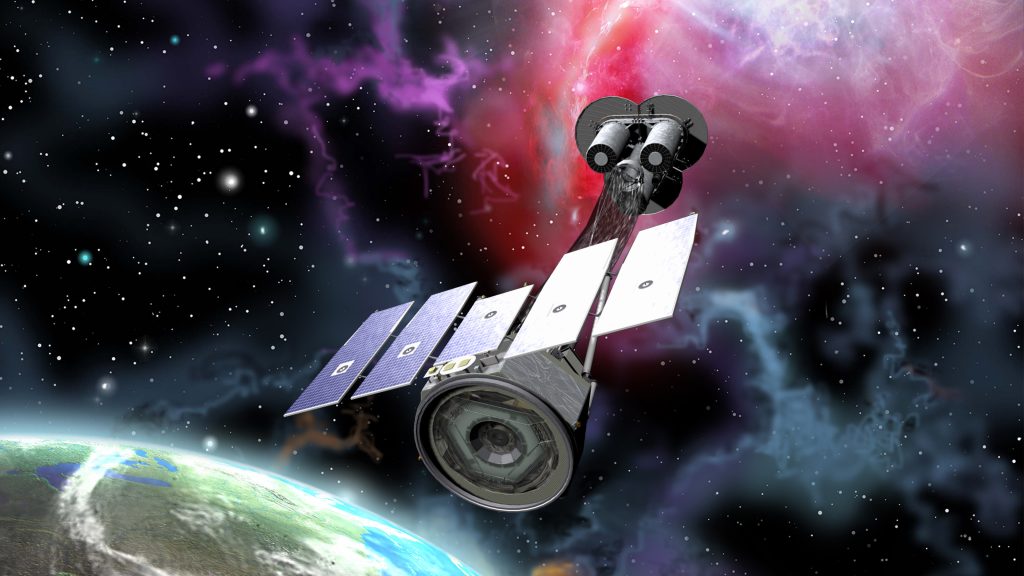
Using data from NASA's Imaging X-ray Polarimetry Explorer (IXPE), researchers have gained new insights into how particle acceleration takes place within the powerful jets emanating from microquasars.
The observations came from a microquasar - SS 433 - which lies at the center of the supernova remnant W50 in the constellation Aquila, approximately 18,000 light-years from Earth.
SS 433 is known for its powerful jets, dubbed the "Manatee Nebula," reaching speeds surpassing 26% of the speed of light, equivalent to an astonishing 48,000 miles per second. Discovered in the late 1970s, the microquasar is a unique system where a black hole draws material from a companion star.
IXPE scrutinized an acceleration site within the eastern lobe of SS 433 for 18 days in April and May of 2023, which emits emissions from energetic electrons spiraling in a magnetic field, a phenomenon known as synchrotron radiation.
"The IXPE data show that the magnetic field near the acceleration region points in the direction the jets are moving. The high level of polarization seen with IXPE shows that the magnetic field is well ordered, with at least half of the field aligned in the same direction," said astrophysicist Philip Kaaret of NASA's Marshall Space Flight Center in Huntsville, Alabama, and principal investigator of the IXPE mission, along with lead author of a new paper about the findings at SS 433.
Previous studies have theorized that the interaction between the jet and the interstellar medium likely creates a shock, leading to disordered magnetic fields.
According to Kaaret, the IXPE data suggests a new possibility - that the magnetic fields within the powerful jets may be "trapped" and stretched when they collide with interstellar matter, directly impacting their alignment in the region of particle acceleration.
Since the 1980s, scientists have theorized that SS 433's jets function as particle accelerators.
As scientists delve deeper into the IXPE data, the mission could help enhance our understanding of magnetic field alignment in various cosmic phenomena, from black hole jets to debris expelled from exploded stars.
Black holes are so violent that as they devour whole planets' worth of matter, they can expel streams of particles that travel near the speed of light!Using #NASAIXPE, we are learning more about how these particles accelerate in an extreme environment >> https://t.co/dBSz3d9c48 pic.twitter.com/J7DSsVpGVd
— NASA Marshall (@NASA_Marshall) January 16, 2024


 Google News