

Climate change posing threat to iconic glaciers in World Heritage sites
Glaciers from almost half of World Heritage sites to disappear completely
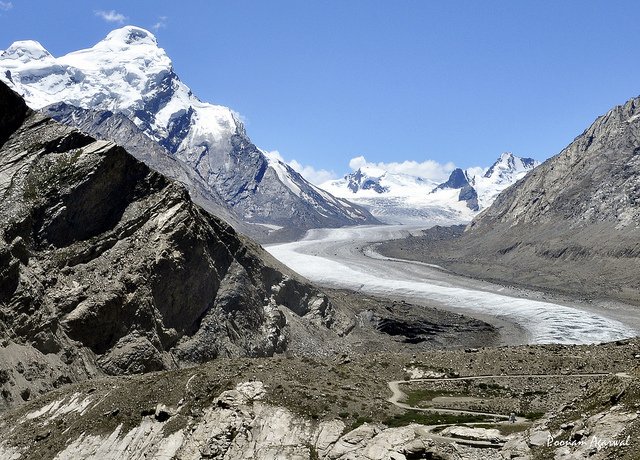
A recent study has warned that glaciers will disappear completely from almost half of World Heritage sites, home to some of the world's most iconic glaciers, such as the Grosser Aletschgletscher in the Swiss Alps, Khumbu Glacier in the Himalayas or Greenland's Jakobshavn Isbrae, if greenhouse gas emissions continue. Also, 33-60 per cent of the total ice volume present in 2017 is expected to be lost by 2100, depending on the emission scenario.
The first-ever global study of World Heritage glaciers, co-authored by scientists from the International Union for Conservation of Nature (IUCN), analyses the current state of World Heritage glaciers, their recent evolution, and their projected mass change over the 21st century. The authors predict glacier extinction by 2100 under a high emission scenario in 21 of the 46 natural World Heritage sites where glaciers are currently found. Even under a low emission scenario, 8 of the 46 World Heritage sites will be ice-free by 2100, IUCN said in a press release.
"Losing these iconic glaciers would be a tragedy and have major consequences for the availability of water resources, sea level rise and weather patterns," said Peter Shadie, Director of IUCN's World Heritage Programme.
The study also highlights the key role that glaciers play for ecosystems and societies at a global scale and also emphasises the need for individual and collective actions to achieve the mitigation and adaptation aspirations of the Paris Agreement on climate change.
"To preserve the iconic glaciers found in World Heritage sites, we urgently need to see significant cuts in greenhouse gas emissions. This is the only way of avoiding long-lasting and irreversible glacier decline and the related major natural, social, economic and migratory cascading consequences," said Jean-Baptiste Bosson, lead author of the study and member of IUCN's World Commission on Protected areas.
According to the IUCN World Heritage Outlook 2 report - an update of the IUCN World Heritage Outlook 2014, climate change is the fastest growing threat, with a 77 per cent increase in sites where it is seen as a high or a very high threat (62 sites in 2017, compared to 35 in 2014). It also remains by far the largest potential threat.
ALSO READ
-
Mozambique Shapes New Climate Strategy to Protect Communities From Extreme Weather
-
Climate Change Is Deepening the Crisis for Millions Living Without a Nationality Today
-
Tunisia’s Water Crisis Puts Jobs and Growth at Risk as Economic Recovery Loses Speed
-
Climate Data Gaps Leave Communities Searching for Clear Answers to Growing Local Risks
-
Marshall Islands Rights Defenders Seek Justice Across Generations, UN Expert Says


 Google News