

Pakistan plans to convert locust swarms into fertilisers
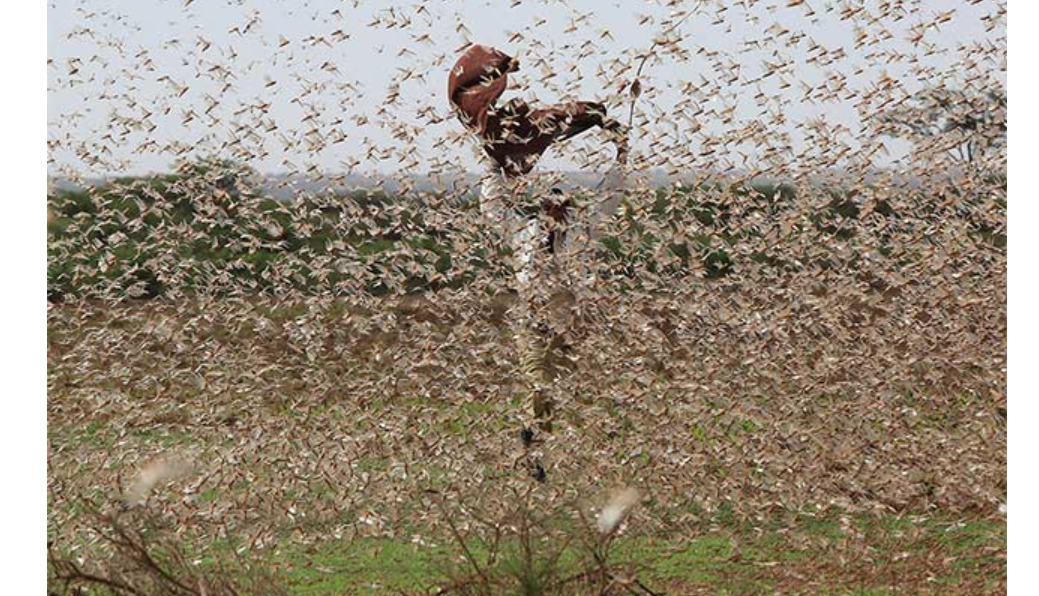
Pakistan has plans to convert locust swarms into fertilisers to tackle the massive pest invasion after it destroyed crops and vegetation on vast tracts of lands, which according to some reports poses a bigger threat to the country’s economy than the coronavirus pandemic.
- Country:
- Pakistan
Pakistan has plans to convert locust swarms into fertilizers to tackle the massive pest invasion after it destroyed crops and vegetation on vast tracts of lands, which according to some reports poses a bigger threat to the country's economy than the coronavirus pandemic. The Ministry of National Food Security and Research (NFS&R) has proposed that the locust collection would be incentivized through community mobilization to control the menace at the grass-root level, The Express Tribune reported.
The ministry would be the pioneer in converting the locust crisis into an opportunity by developing its bio-compost through community mobilization, the report said. "The locust-based fertilizer will have an added advantage of more N (9pc) and P (7pc). Initially, locust will be unruffled through community mobilization under the incentivized scheme," the ministry said.
Professionals would also be involved in research, extension, academia, and civil society in compost processing activities. Later, standard compost would be made from a mix of locust and other bio-waste material. Pakistan had a locust attack last year that arrived from Iran, but this year's one is the most severe in three decades.
According to reports, swarms of locusts spreading across Pakistan are emerging as a bigger threat to the economy than the coronavirus pandemic, with the pests threatening farm output, livelihoods, and food security. "Marketing and distribution mechanisms will also be devised for promoting the use of compost in high value/organic agriculture. Pilot testing of the whole idea will be done in the Cholistan and the Thar Desert during the next 3-4 summer reproduction months," according to the ministry.
"Capacity building of communities will develop in trapping locust (trenching, netting, vacuum sucking, etc.), it said, adding that 50 collection centers will be designated to facilitate communities. The expected outcomes from the project would be to improve crop productivity by 10-15 percent, reduction in the use of recommended chemical fertilizers up to 25 percent, improve soil organic matter (SOM), soil fertility, and soil health.
The ministry stated that through this scheme organic farming would be promoted in Pakistan. The facility developed for compost production will be functional with or without locust components in the long run. Rs one billion worth of compost will be produced during the first year of the project.
"If 1 percent of crop loss is controlled by this project, then there will be a benefit of Rs 32 billion. From 100,000 tonnes of locusts, 70,000-tonne compost will be formed. A single-family can earn Rs 6,000 on average per month. The full cost of the project will be recovered in three years," according to the ministry. As the ministry was chalking out a plan to use the pest for the benefit of agriculture, a lawmaker from ruling Pakistan Tehreek-i-Insaf suggested that the benefit of the locusts in treatment of COVID-19 should also be studied.
"I have been told that it (locust) can be useful against the coronavirus. I think we should also study this aspect of the locusts," Riaz Fatiyana told Parliament on Wednesday. India also faced a locust attack last month and the swarms reached Jaipur for the first time. Swarms of locusts traveled through several areas of Rajasthan, Madhya Pradesh, Maharashtra, and Uttar Pradesh amid their worst invasion in years.
The swarms entered Rajasthan in April from Pakistan and then spread to areas across the western states, helped by strong winds.


 Google News