

BRS Leader K Kavitha's Judicial Custody Extended Till July 18 in Delhi Excise Policy Case
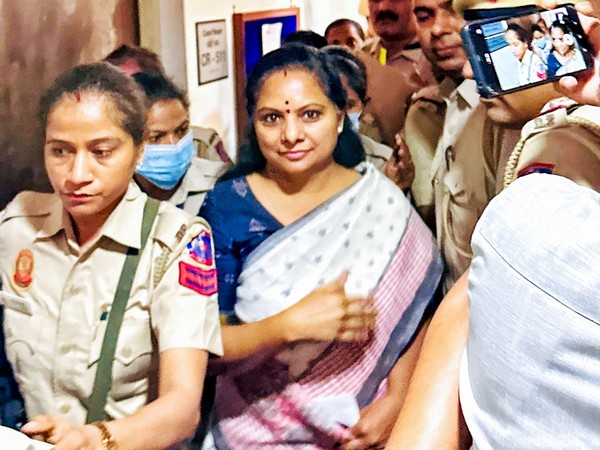
The Rouse Avenue Court extended the judicial custody of BRS leader K Kavitha till July 18 in a CBI case related to the Delhi excise policy. Kavitha was produced via video conferencing from Tihar Jail. Her counsel opposed the remand as the court considers the charge sheet tomorrow.
- Country:
- India
The Rouse Avenue Court on Friday extended the judicial custody of Bharat Rashtra Samithi (BRS) leader K Kavitha until July 18 in connection with a Central Bureau of Investigation (CBI) case related to the Delhi excise policy. Kavitha appeared via video conferencing from Tihar Jail, where her counsel vehemently opposed the judicial custody remand.
Special CBI Judge Kaveri Baweja extended her remand for an additional 14 days. The court is set to consider the charge sheet filed against her tomorrow. Advocate P Mohit Rao, her counsel, opposed the extension during the hearing, emphasizing that the CBI has already filed a charge sheet, pending consideration on July 6.
This marks the third supplementary charge sheet filed by the CBI in the Delhi excise policy case since June 7. Kavitha is in judicial custody for both the CBI and money laundering cases. She was initially arrested by the Enforcement Directorate (ED) on March 15, followed by her arrest by the CBI on April 11.
The Enforcement Directorate (ED) has also filed a charge sheet against her in the Delhi excise policy money laundering case. The CBI inquiry was prompted by a report from the Delhi Chief Secretary, indicating prima facie violations of multiple acts and rules, including the GNCTD Act 1991 and the Delhi Excise Rules-2010.
According to the CBI and ED, irregularities occurred while modifying the excise policy. Undue favours were granted to license holders, and license fees were either waived or reduced. Additionally, the L-1 license was extended without proper approval, leading to illicit financial gains being diverted to accused officials and falsified entries in accounts to avoid detection.
Allegations also state that the Excise Department decided to refund an earnest money deposit of about Rs 30 crore to a successful tenderer against established rules. Despite the absence of enabling provisions, a waiver on tendered license fees was allowed from December 28, 2021, to January 27, 2022, citing COVID-19 as the reason. This reportedly resulted in an alleged loss of Rs 144.36 crore to the exchequer.


 Google News