

VP Dhankhar Calls for National Debate on 'Emocracy' and Good Governance at Murli Deora Memorial Dialogues
Shri Dhankhar referenced historical instances where nations faced demographic crises due to unchecked migration, urging policymakers to take proactive measures to safeguard India’s sovereignty and social stability.
- Country:
- India
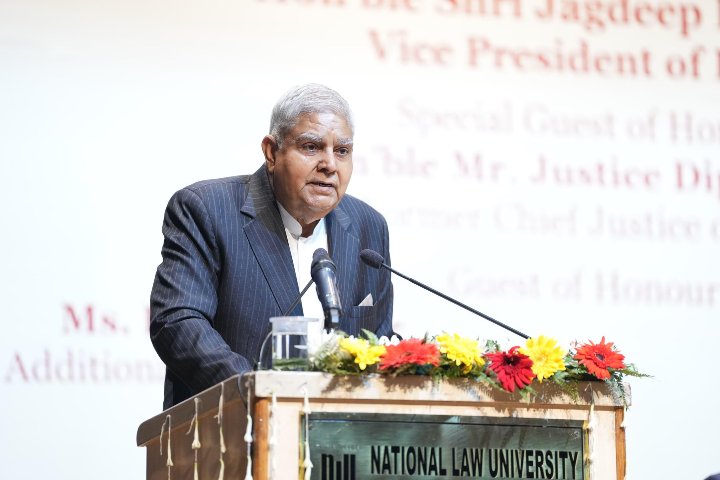
Vice-President of India, Shri Jagdeep Dhankhar, has emphasized the need for a national discourse on the shift from democracy to 'Emocracy'—a governance approach driven by emotions rather than rational policymaking. Speaking at the inaugural session of the first 'Murli Deora Memorial Dialogues' on 'Leadership and Governance,' Shri Dhankhar warned that emotion-driven policies threaten good governance and economic stability. He stressed the importance of prioritizing the long-term welfare of citizens over short-term populism.
Highlighting the dangers of excessive populism, the Vice-President said, "Populist policies often lead to economic distress, making it difficult for leadership to course-correct once the damage is done. Leaders must focus on empowering people in a sustainable manner rather than providing temporary relief that ultimately affects their productivity and economic contribution."
Concerns Over Appeasement Politics and Fiscal Prudence
Expressing concern over the increasing trend of appeasement politics and placatory strategies across the political spectrum, Shri Dhankhar urged political parties to reassess the impact of unrestrained electoral promises. "If governments excessively spend on fulfilling populist electoral commitments, capital expenditure (CAPEX) required for infrastructure and development is significantly reduced, harming long-term growth. Elections are a crucial part of democracy, but they should not dictate governance at the expense of national progress," he noted.
He clarified the distinction between affirmative action and appeasement, asserting that provisions for marginalized communities under Articles 14, 15, and 16 of the Constitution constitute justifiable economic policies. However, he cautioned against policies that prioritize short-term political gains over sustainable economic development.
Demographic Challenges and Illegal Migration
The Vice-President raised concerns about illegal migration, stating that the influx of unauthorized immigrants has caused a demographic shift and put immense pressure on India's resources. "Millions of illegal migrants are placing an unsustainable burden on our healthcare and education systems while depriving Indian citizens of employment opportunities. Some of these groups have even gained electoral influence, which poses a serious challenge to our democratic fabric," he warned.
Shri Dhankhar referenced historical instances where nations faced demographic crises due to unchecked migration, urging policymakers to take proactive measures to safeguard India's sovereignty and social stability.
Threats Posed by Mass Conversions Through Allurements
He also expressed grave concern over mass conversions driven by inducements, likening the issue to a societal malaise more severe than COVID-19. "The most vulnerable sections of society, including the marginalized, tribal communities, and economically disadvantaged groups, are being targeted through inducements. Freedom of faith is a fundamental right, but when it is manipulated through material temptations, it undermines the very essence of this freedom," he remarked.
The Sovereignty of 'We the People'
Reaffirming the constitutional principle of 'We the People,' Shri Dhankhar emphasized that India, as the world's largest democracy, must not allow any dilution of its democratic institutions. "India is unique in having constitutionally structured democratic institutions from the village level to the national level. The sovereignty of the people must remain intact, and governance must always align with justice, equality, and fraternity," he asserted.
Remembering Murli Deora's Legacy
Paying tribute to the late Murli Deora, Shri Dhankhar described him as a distinguished political leader known for his ability to build bridges across political and social divides. "Murli Deora was a leader without adversaries—respected and admired across party lines. His dedication to public service and societal welfare remains an inspiration," he said.
He specifically acknowledged Deora's pioneering role in securing a ban on smoking in public places, which was instrumental in shaping India's public health policies. "His proactive efforts in approaching the highest court for a ban on smoking in public spaces demonstrated his commitment to the larger good of society," Shri Dhankhar stated.
Leadership as a Journey of Service
Concluding his address, Shri Dhankhar underscored that true leadership is a journey of service rather than a position of power. "Leadership is not about standing on a pedestal; it is about walking the path of service to the last, the least, and the lonely. Murli Deora's life is a testament to this ideal," he remarked.
The event was attended by distinguished dignitaries, including Shri C. P. Radhakrishnan, Governor of Maharashtra, Shri Eknath Shinde, Deputy Chief Minister of Maharashtra, Shri Milind Deora, Member of Parliament (Rajya Sabha), and Shri Raghavendra Singh, President of Kotak Mahindra Bank, among others.


 Google News