

National Workshop Spotlights ISL-Based English Teaching for Deaf Learners
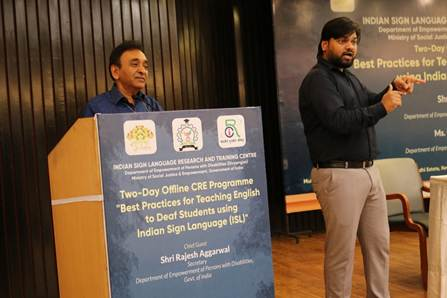
The workshop was formally inaugurated by Shri Rajesh Aggarwal, Secretary, DEPwD, who emphasized that Indian Sign Language must be recognized as the first language of the Deaf.
- Country:
- India
In a significant step towards inclusive education and linguistic empowerment of the Deaf community, the Indian Sign Language Research and Training Centre (ISLRTC) hosted a two-day offline National Workshop on "Best Practices for Teaching English to Deaf Students Using Indian Sign Language (ISL)" from 10th–11th July 2025 in New Delhi. The event was convened under the aegis of the Department of Empowerment of Persons with Disabilities (DEPwD), Ministry of Social Justice and Empowerment, Government of India.
ISLRTC, an autonomous institution dedicated to the promotion and standardization of Indian Sign Language (ISL), brought together over 180 participants from across the country for this focused dialogue on pedagogical strategies for Deaf learners.
Inaugural Address Emphasizes ISL and English Bilingualism
The workshop was formally inaugurated by Shri Rajesh Aggarwal, Secretary, DEPwD, who emphasized that Indian Sign Language must be recognized as the first language of the Deaf. He underlined the crucial role of ISL in developing cognitive abilities and nurturing academic growth in Deaf children.
While advocating for English proficiency as a gateway to employment, inclusion, and communication, Shri Aggarwal stressed the bilingual approach—learning English through ISL—as a model that respects the linguistic identity of Deaf individuals. He also called for the integration of assistive technologies to support literacy and lifelong learning among the Deaf population.
"Language is empowerment. ISL gives identity and expression to Deaf learners, and English connects them to a larger world of knowledge, careers, and inclusion," he remarked.
Expert Sessions: Pedagogy Rooted in Practice and Culture
The heart of the workshop consisted of expert-led sessions, presentations, and interactive dialogues, featuring renowned educators and practitioners in Deaf education, both from India and abroad:
-
Dr. Sibaji Panda, Founder, Happy Hands School for the Deaf, and a trailblazer in English literacy research for Deaf learners, shared strategies based on bilingual cognitive development.
-
Sh. Sunil Sahasrabudhe, Senior Consultant with over two decades in bilingual Deaf education, emphasized learner-centric practices, peer mentoring, and curriculum design that respects Deaf culture.
-
Sh. Rajesh Ketkar, associated with MBM News and Orjet Foundation and a former Director at ISHARA Foundation (Gujarat), presented field-tested frameworks for integrating ISL and English in daily instruction.
-
Sh. Hari Hara Kumar, Deaf Enabled India, Hyderabad, brought perspectives from employment-driven training and literacy enhancement under DEPwD-funded projects.
-
Ms. Sharayu Kadam, TEACH, Mumbai, contributed insights on working across varied state boards and adapting English content in inclusive classrooms.
-
Ms. Chithra Prasad, from the National Institute of Speech and Hearing (NISH), Kerala, shared data-driven best practices developed over 15+ years of direct engagement in Deaf education.
-
Mr. Abbas Ali Behamanesh, from Gallaudet University, USA, joined virtually to introduce participants to global benchmarks in English-ASL bilingual teaching methodologies.
Together, the sessions explored:
-
Visual learning strategies
-
Culturally responsive pedagogy
-
Assessment techniques for Deaf learners
-
Curriculum design that aligns with ISL grammar
-
Teacher training needs and policy advocacy
Deep Engagement from Educators and National Stakeholders
The workshop created a space for constructive dialogue and peer learning, with special educators, ISL instructors, Deaf school teachers, and researchers actively participating in group discussions and feedback circles. Attendees included representatives from:
-
Special and inclusive schools
-
National Institutes (NIs) and Composite Regional Centres (CRCs)
-
NCERT (National Council of Educational Research and Training)
-
NIOS (National Institute of Open Schooling)
This wide representation ensured that discussions were enriched with regional perspectives and diverse classroom realities, bringing ground-level needs into national focus.
Valedictory Session: Commitment to Inclusive Pedagogy
The workshop concluded with a valedictory address by Ms. Manmeet Kaur Nanda, Additional Secretary, DEPwD. She reaffirmed the Ministry's commitment to equity in education, and emphasized the need to replicate and scale such best practices through teacher training programmes, institutional collaborations, and curriculum reforms.
"The future of inclusive education lies in inclusive language instruction. This workshop represents a roadmap for mainstreaming bilingual education using ISL," she said.
Building the Foundation for a Linguistically Inclusive India
As India continues to expand its efforts toward inclusive development, the workshop served as a milestone in recognizing and institutionalizing Indian Sign Language as a central pillar of Deaf education. By focusing on empowering Deaf students with English literacy through their native sign language, the initiative aligns with the broader goals of NEP 2020, Accessible India Campaign, and the UN Convention on the Rights of Persons with Disabilities.
The ISLRTC plans to release a report and recommendations document summarizing the workshop outcomes, which will guide curriculum developers, teacher training institutions, and policymakers in shaping the next generation of Deaf education in India.


 Google News