

Double ridges on Jupiter’s icy moon Europa similar to Greenland ridges: Study
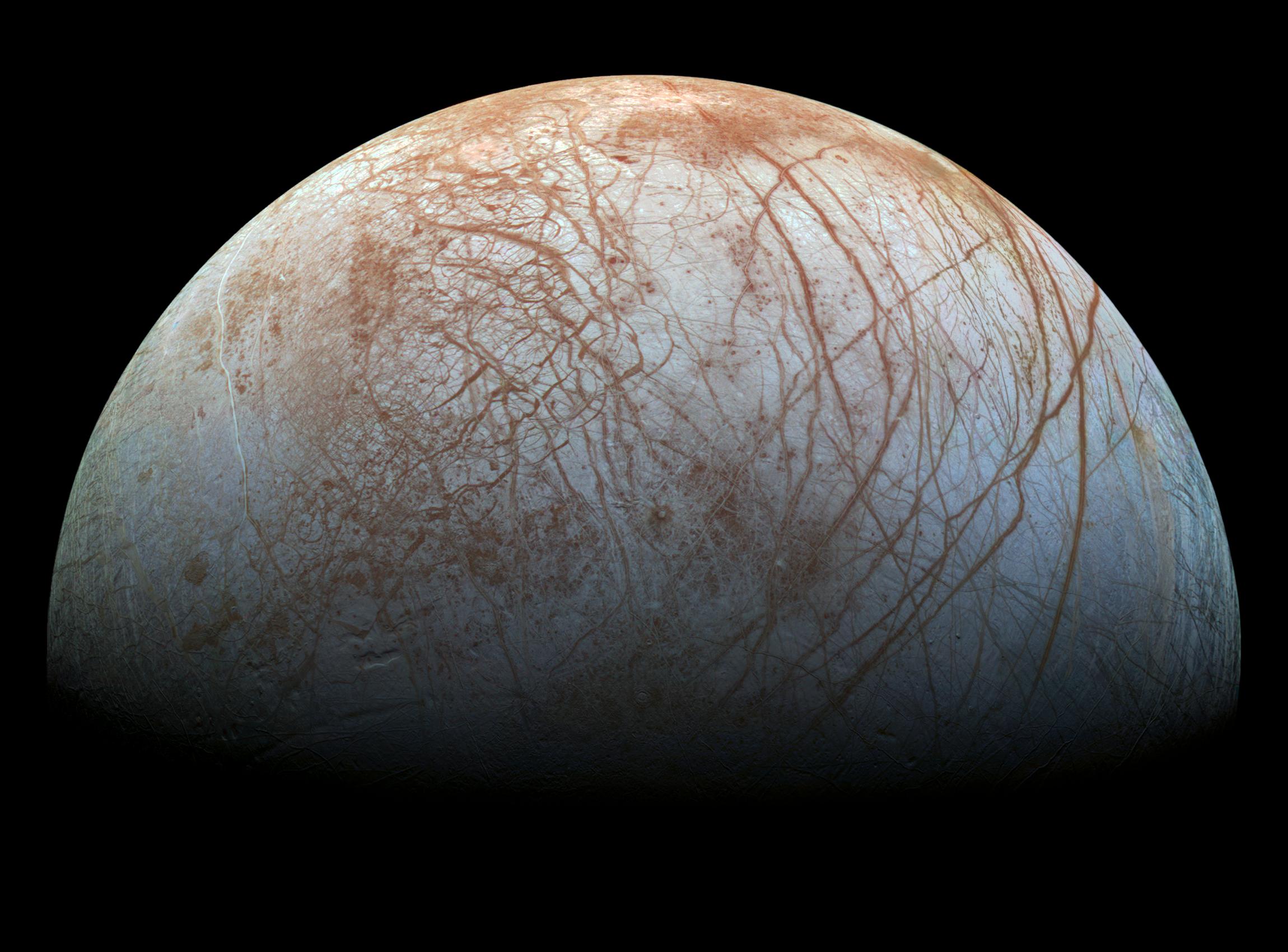
A new study has found that double ridges, the most common surface feature on Jupiter's icy moon Europa, are similar to parallel ice ridges in Greenland, suggesting the Jovian moon's icy shell could be riddled with pockets of water.
Riley Culberg, a Stanford University graduate student and the study's lead author, noticed this similarity during a presentation on Europa's ridges. The findings are published in the journal Nature.
According to researchers, the double ridges observed on the surface of the Greenland Ice Sheet formed when water from nearby surface lakes drained into a layer of impermeable ice within the ice sheet. Once there, the water pocket refroze and fractured the overlying ice, forcing peaks to rise on either side.
The researchers believe that a similar process could be happening on Europa but instead with water forced up toward the surface from the subsurface ocean. Ridges on Europa are found to be much larger and with taller peaks, perhaps due in part to lower gravity on the Jovian moon.
"It's exciting, what it would mean if you have plenty of water within the ice shell. It would mean the ice shell on Europa is extremely dynamic. It could facilitate exchange processes between the surface and the subsurface ocean. It could go in both directions," said coauthor Gregor Steinbrügge, a former Stanford researcher who is now a planetary scientist at NASA's Jet Propulsion Laboratory in Southern California.
Intriguing new science for astrobiologists: Parallel ice ridges in Greenland bear a striking resemblance to ridges such as these on Jupiter's ice-encased moon Europa, suggesting the moon's icy shell could be riddled with pockets of water. Details - https://t.co/97BV0onoF4 pic.twitter.com/CGz0DifIlI
— NASA Europa Clipper (@EuropaClipper) April 26, 2022
The similarity between Greenland ice and the Jovian moon could greatly improve the odds of the agency's Europa Clipper mission which aims to determine if Europa harbours conditions suitable for life. The mission is targeted for launch in October 2024.
Scientists are almost certain that Europa has an ocean underneath its icy surface that could be 10 to 15 miles (15 to 25 kilometres) thick. The spacecraft's ice-penetrating radar instrument REASON (Radar for Europa Assessment and Sounding: Ocean to Near-surface) will be ideal for conducting such a search.


 Google News