

Europe's Gaia telescope sees strange starquakes that change shapes of stars
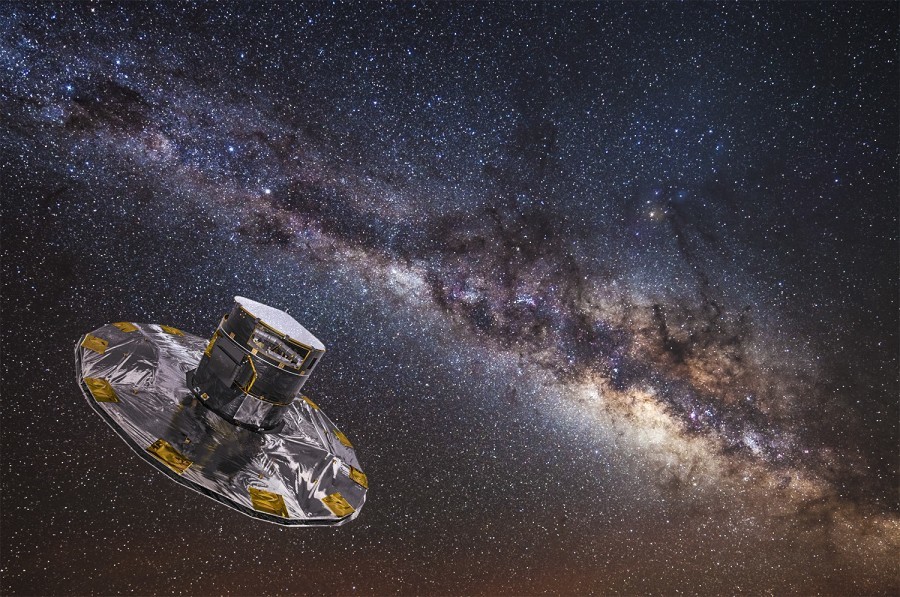
The European Space Agency has released the Gaia mission's third full data set which contains new and improved details for almost two billion objects in our Milky Way galaxy. One of the most surprising discoveries in Gaia data release 3 is that the mission has observed 'starquakes' - tiny motions on the surface of a star.
In #GaiaDR3 @ESAGaia spotted starquakes that change the shapes of stars! They cause a star's surface to move while it rotates as shown in this animation. The frequency of the rotations and pulsations was increased to make them audible for humans. https://t.co/bIFyhbgkgv pic.twitter.com/hhlM9bCOgw
— ESA Science (@esascience) June 13, 2022
According to the agency, the Gaia mission already spotted radial oscillations that cause stars to swell and shrink periodically, while keeping their spherical shape. But it has now also spotted other vibrations that are more like large-scale tsunamis and also change the global shape of a star and are therefore harder to detect.
Starquakes teach us a lot about stars, notably their internal workings. Gaia is opening a goldmine for 'asteroseismology' of massive stars.
In addition to starquakes, astronomers describe stellar DNA, asymmetric motions and other fascinating insights in Gaia data release 3 - the most detailed Milky Way survey to date.
The mission has found that some stars in our home galaxy are made of primordial material, while others like our Sun are made of matter enriched by previous generations of stars. Stars that are closer to the centre and plane of our galaxy are richer in metals than stars at larger distances.
With today's release, the mission is also revealing information about 10 million variable stars, mysterious macro-molecules between stars, quasars and galaxies beyond our own cosmic neighbourhood.
Gaia's data release 3 is based on observations from 25 July 2014 and 28 May 2017.


 Google News