

Special Report: Deflecting asteroids
If they are within one-third the distance from Earth to the Sun, they are classified as near-Earth objects NEOs, and are of special interest because of their potential to destroy our planet. In 1994, US Congress asked space agency NASA to identify 90 percent of NEOs with planet-destroying potential that 1 km in diameter or larger by 2005.
- Country:
- Australia
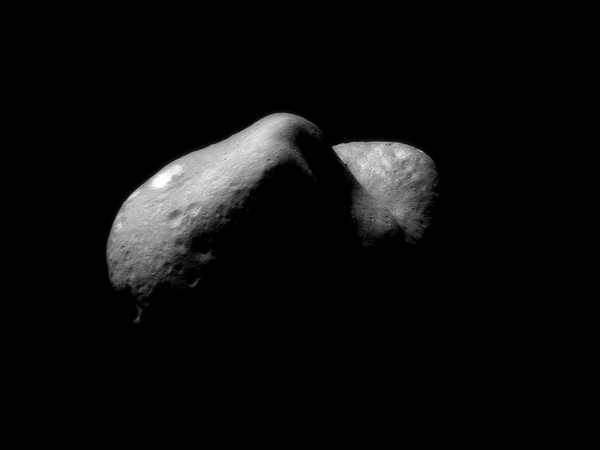
Our solar system is full of rogue rocks. Millions of them orbit around the Sun or around other objects, the shattered remains of planets, moons, or comets. If they are within one-third the distance from Earth to the Sun, they are classified as near-Earth objects (NEOs) and are of special interest because of their potential to destroy our planet. The first NEO was spotted in 1989. In 1994, US Congress asked space agency NASA to identify 90 percent of NEOs with planet-destroying potential — that 1 km in diameter or larger — by 2005. That task complete, NASA was given a new target of 90 percent of NEOs 140m or larger. That goal has remained more elusive — it is estimated only 40 percent of all NEOs in that category have been discovered. Even with millions of dollars in funding and the best technology NASA can muster, asteroids still catch us unawares. NASA completely missed one that smacked into the Norwegian Sea in March this year. A Hungarian astronomer, Krisztián Sárneczky, spotted it with only hours to spare. Scientists believe it's a matter of when, not if, a big one will chart a collision course with Earth. If spotted far enough out, humanity has time to prepare. Time to send out warnings, time to evacuate cities, time to nudge its trajectory, time to hit it with nukes. The key to planetary defense is early detection. The world's early warning systems are surprisingly informal. Collections of observatories' volunteering time and resources make up our principal defense. But NEOs are a relatively new global concern. In time, our collective need for a comprehensive asteroid alert system may pave the way for international collaboration on projects of undeniable importance. REALITY CHECK Of the 1.2 million objects floating in our solar system, 29,264 are near-Earth objects. Every day, 80 to 100 tonnes of dust and small meteorites fall from space onto planet Earth. Almost all of it burns up in our atmosphere. An asteroid's potential danger is a function of its size, its speed relative to Earth's, its mass, and the angle of the collision. Big, fast, heavy rocks coming in at a steep angle are the most dangerous. The first 'asteroid' discovered was a dwarf planet, Ceres. It was spotted by Giuseppe Piazzi, a Catholic priest, and astronomer, in 1801. Dispute about whether Ceres is a planet or an asteroid was responsible for the 2006 demotion of Pluto to dwarf planet status.
BIG IDEAS Quote attributable to Andrew S. Rivkin, Johns Hopkins Applied Physics Laboratory ''Asteroid impacts are unique disaster scenarios because they can be prevented altogether if humankind has enough warning.'' Quote attributable to Sergio Camacho, National Institute for Astrophysics, Optics, and Electronics of Mexico ''The technical aspects of an international response to the threat of an asteroid impact are well-coordinated ...The gaps in Earth's planetary defense lie in the decision-making process.'' Quote attributable to Peter Vereš, Harvard & Smithsonian Center for Astrophysics ''Amateur or semi-professional astronomers play a surprisingly large role in the discovery of NEOs.''


 Google News