

Astronomers spot largest potentially hazardous asteroid hiding in inner solar system
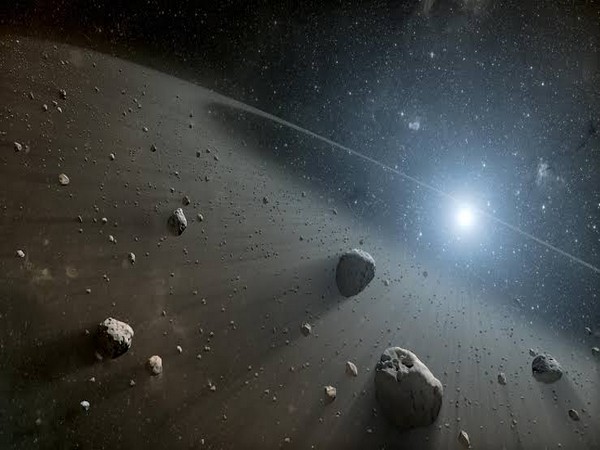
An international team of astronomers has discovered three large near-Earth objects lurking in the inner Solar System and one of them is the largest object that is potentially hazardous to Earth to be discovered in the last eight years.
The inner solar system is a notoriously challenging region to hunt for asteroids as astronomers have to contend with a bright background sky resulting from the Sun's glare. The intense light and heat of the Sun would fry the sensitive electronics.
The discovery was made with the Dark Energy Camera (DECam) mounted on the Víctor M. Blanco 4-meter Telescope at Cerro Tololo Inter-American Observatory in Chile, a Program of NSF's NOIRLab. DECam is one of the highest-performance, wide-field CCD imagers in the world.
"After ten years of remarkable service, DECam continues to yield important scientific discoveries while at the same time contributing to planetary defense, a crucial service that benefits all humanity," said Chris Davis, NSF Program Director for NOIRLab.
The elusive trio of asteroids is named 2021 LJ4, 2021 PH27, and 2022 AP7. While the former two have orbits that safely remain completely interior to Earth's orbit, the third one, a 1.5-kilometer-wide asteroid, has an orbit that may someday place it in Earth's path, the astronomers say.
"So far we have found two large near-Earth asteroids that are about 1 kilometer across, a size that we call planet killers. There are likely only a few NEAs with similar sizes left to find, and these large undiscovered asteroids likely have orbits that keep them interior to the orbits of Earth and Venus most of the time," said Scott S. Sheppard, an astronomer at the Earth and Planets Laboratory of the Carnegie Institution for Science and the lead author of the paper describing this work.
2021 PH27 is the closest known asteroid to the Sun during its orbit its surface gets hot enough to melt lead.


 Google News