

Ocean currents in Jupiter’s moon Europa may affect rotation of its icy shell: Study
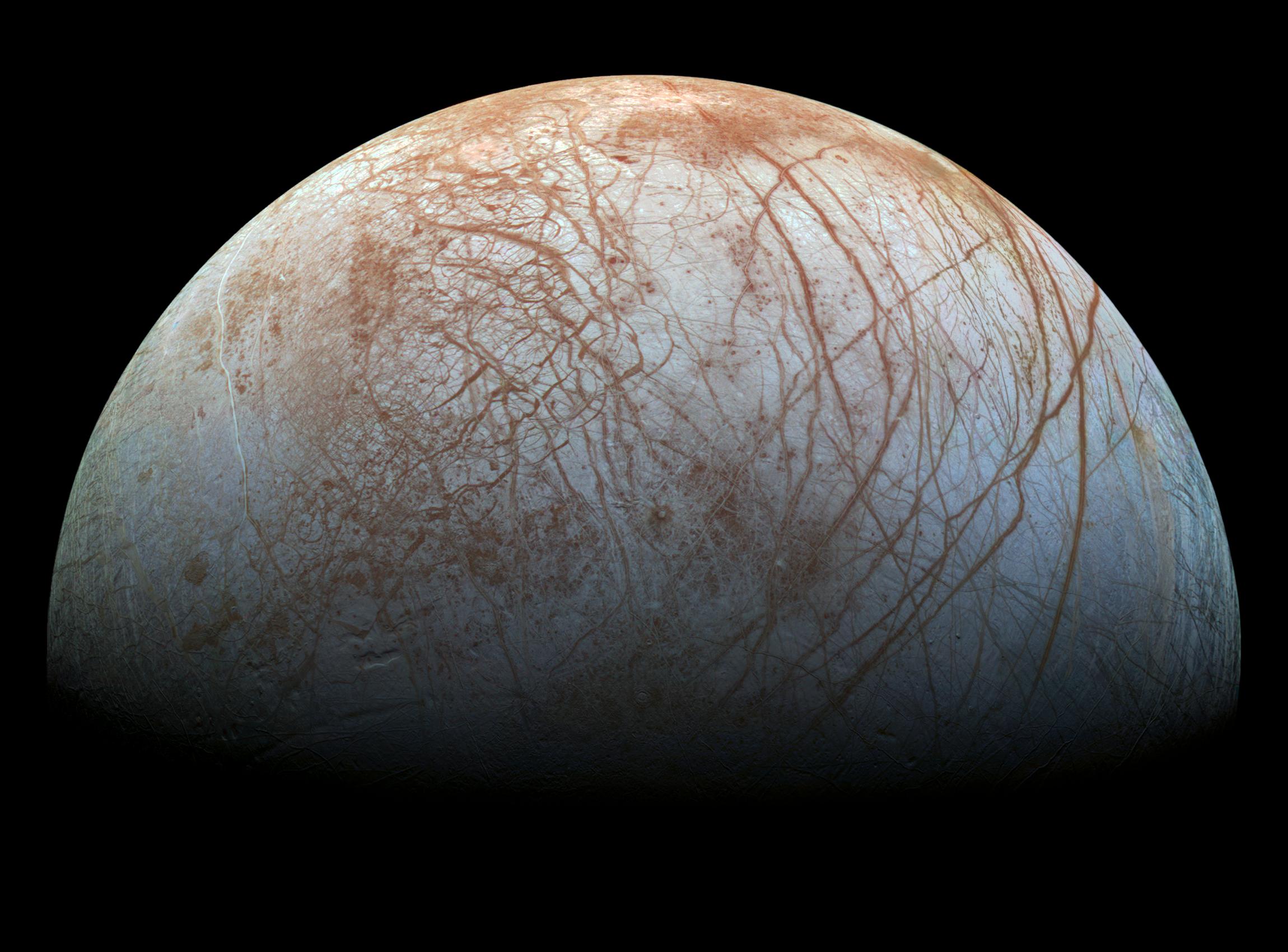
Europa, one of Jupiter's four largest moons, is known for its icy shell that rotates at a slightly different rate than its rocky interior. A new study suggests that ocean currents could be contributing to the rotation of the Jovian moon's icy shell.
"Before this, it was known through laboratory experiments and modelling that the heating and cooling of Europa's ocean may drive currents. Now our results highlight a coupling between the ocean and the rotation of the icy shell that was never previously considered," said Hamish Hay, a researcher at the University of Oxford and lead author of the study published in JGR: Planets.
For decades, scientists theorized that as Jupiter's gravity pulls on Europa, it also tugs on Europa's shell and causes it to spin slightly faster.
The new study, which involved calculating drag - the horizontal force that the moon's ocean exerts on the ice above it, hints at how the power of the ocean flow and its drag against the ice layer could even account for some of the geology visible on the moon's surface.
The slow stretching and collapsing of Europa's icy shell over time due to the push and pull of the ocean currents could potentially lead to the formation of cracks and ridges on the moon's surface, according to the new research.
"The work could be important in understanding how other ocean worlds' rotation speeds may have changed over time. And now that we know about the potential coupling of interior oceans with the surfaces of these bodies, we may learn more about their geological histories as well as Europa's," Hamish Hay, a researcher at the University of Oxford and lead author of the study published in JGR: Planets.
Researchers are optimistic that NASA's upcoming Europa Clipper mission will help determine with precision how fast the icy shell rotates. The mission's main science goal is to determine whether there are places below the surface of Europa that could support life.
Scientists believe there's an enormous internal ocean swirling under Europa's icy outer shell. New models suggest this water may be pushing the ice shell along, speeding up and slowing down the rotation of the moon's icy shell over time: https://t.co/NmOUP25qPr pic.twitter.com/RqDBuxkcR6
— NASA JPL (@NASAJPL) March 13, 2023


 Google News