

Scientists discover key life ingredient on Saturn's moon Enceladus
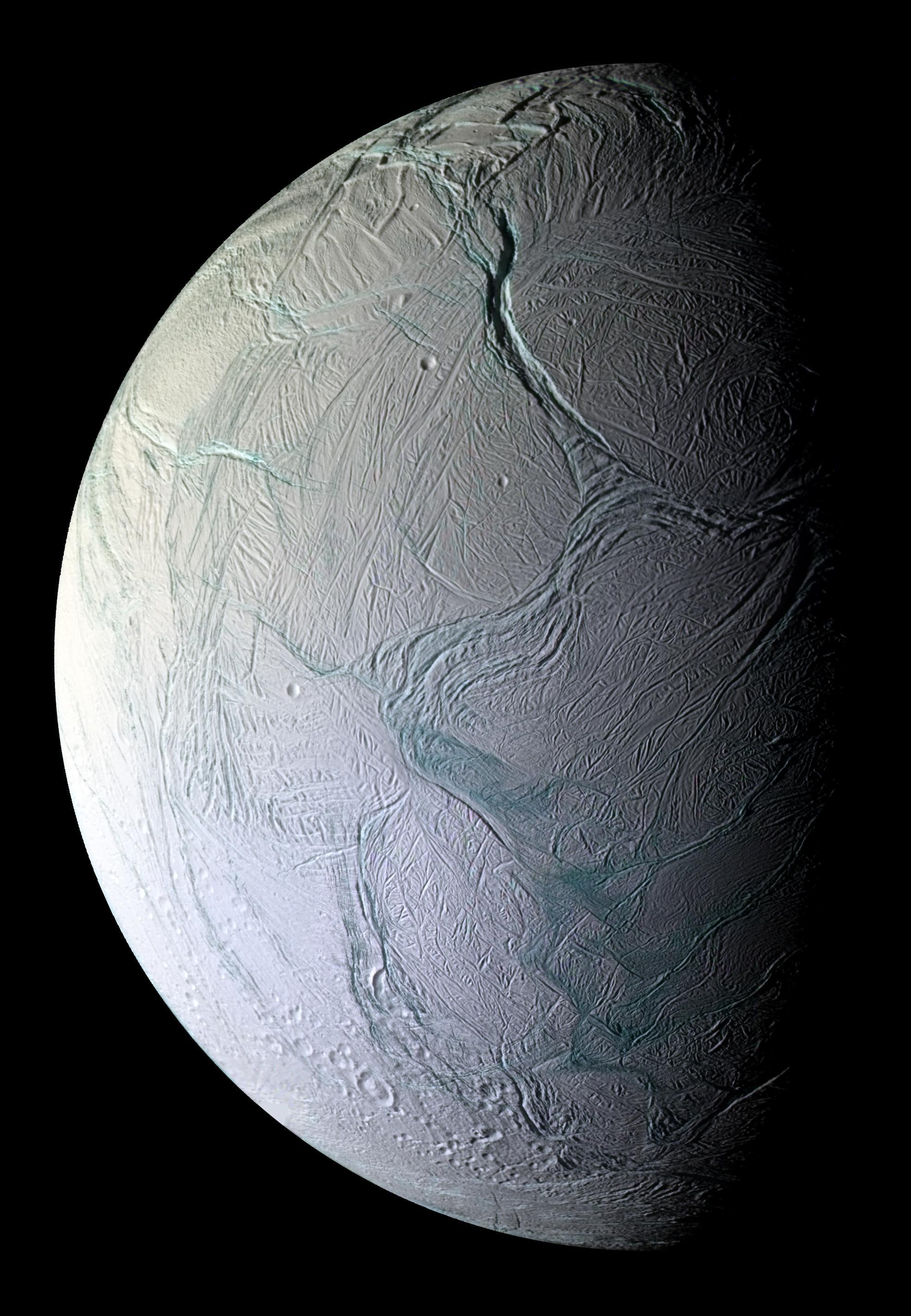
An international team of scientists, utilizing data from NASA's Cassini mission, has found Phosphorus, an essential chemical element for life, within salt-rich ice grains expelled into space from Saturn's icy ocean moon Enceladus.
Enceladus has long fascinated scientists due to its subsurface ocean, which is believed to harbor most of the chemical ingredients necessary for life as we know it. Water from this ocean erupts through fractures in the moon's icy crust as geysers near its south pole, creating a plume. These icy particles from the plume contribute to Saturn's E ring, a faint ring situated beyond the brighter main rings of the gas giant.
Previous analysis of Enceladus' ice grains had already revealed concentrations of sodium, potassium, chlorine, and carbonate-containing compounds. However, Phosphorus - a building block for DNA, which forms chromosomes and carries genetic information - hadn't been detected until now.
"We previously found that Enceladus' ocean is rich in a variety of organic compounds. But now, this new result reveals the clear chemical signature of substantial amounts of phosphorus salts inside icy particles ejected into space by the small moon's plume. It's the first time this essential element has been discovered in an ocean beyond Earth," said Frank Postberg, a planetary scientist at Freie Universität Berlin, Germany, who led the new study, published on Wednesday, June 14, in the journal Nature.
For this study, the researchers accessed the archival data from NASA's Planetary Data System, with a key focus on data collected by Cassini's Cosmic Dust Analyzer instrument, which sampled icy particles from Enceladus in Saturn's E ring. Due to the abundance of ice particles encountered in the E ring compared to the plume, a significantly larger number of compositional signals were available for examination. Through this meticulous analysis, the researchers discovered high concentrations of sodium phosphates, chemically bound molecules comprising sodium, oxygen, hydrogen, and phosphorus, within some of the ice grains.
To further confirm their findings, co-authors from Europe and Japan conducted laboratory experiments. These experiments demonstrated that Enceladus' ocean contains phosphorus, bound within various water-soluble forms of phosphate, at concentrations at least 100 times higher than those found in Earth's oceans. The team's geochemical modeling also suggested that phosphate may be available in abundance in other icy ocean worlds in the outer solar system, particularly that formed from primordial ice containing carbon dioxide and have liquid water with easy access to rocks.
While the discovery of phosphorus in Enceladus' subsurface ocean is an exciting development for astrobiologists and the search for life beyond Earth, co-investigator Christopher Glein, a planetary scientist and geochemist at Southwest Research Institute in San Antonio, Texas, stressed, "Having the ingredients is necessary, but they may not be sufficient for an extraterrestrial environment to host life. Whether life could have originated in Enceladus' ocean remains an open question."
JUST IN: Phosphorus (an essential & scarce element of life) is found on Enceladus, adding to the habitable conditions observed on Saturn's moon. If life could've originated is an open question, but this discovery has astrobiologists excited for future exploration:… pic.twitter.com/E6GIanRnIN
— NASA Astrobiology: Exploring Life in the Universe (@NASAAstrobio) June 14, 2023


 Google News