

European telescope captures first view of NASA spacecraft returning with asteroid sample
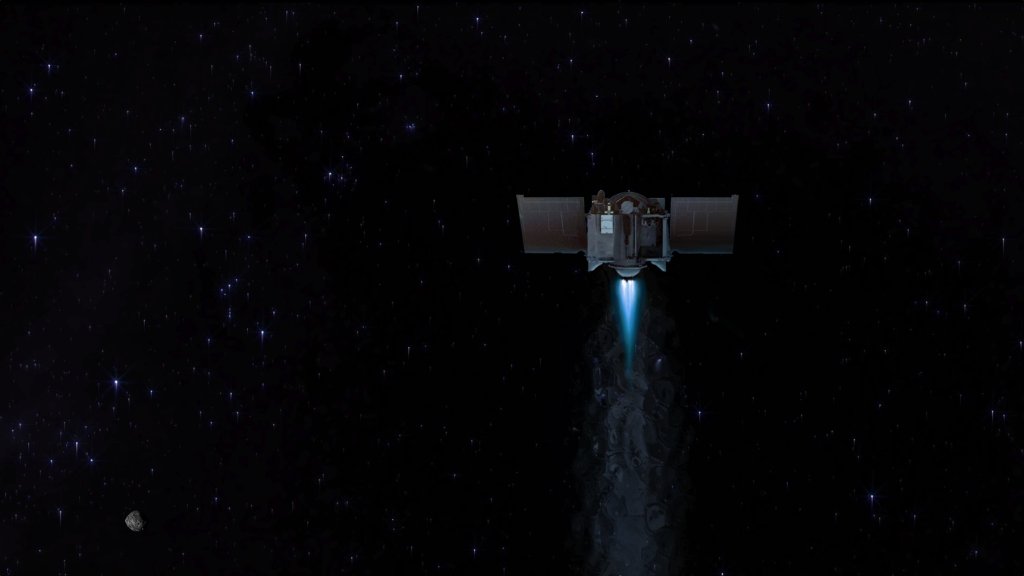
NASA's OSIRIS-REx (short for Origins, Spectral Interpretation, Resource Identification and Security-Regolith Explorer) spacecraft is on its way back home to deliver the first asteroid sample collected in space on Sept. 24, 2023.
The European Space Agency's Optical Ground Station (OGS) telescope in Tenerife recently spotted the OSIRIS-REx spacecraft when it was 4.66 million km from Earth. The agency has shared the first image - a combination of 90 individual images - of the spacecraft on its way home.
"Is it a spacecraft? An asteroid? Well, both. This small central speck is the first image of a spacecraft on its way home, carrying with it a sample from an asteroid hundreds-of-millions, if-not-billions-of-years old. The spacecraft is NASA's OSIRIS-REx, the asteroid is Bennu," the agency wrote in a post.
OGS was originally built to monitor space debris in orbit and test laser communication technologies, but now it also conducts surveys, and follow-up observations of near-Earth asteroids and makes night-time astronomy observations and has even discovered dozens of minor planets. For this observation, ESA's Near-Earth Object Coordination Centre (NEOCC) directed OGS at the returning asteroid explorer.
📷 First view of @NASASolarSystem #OSIRISREx returning with asteroid sample: spotted on 16 September by ESA's Optical Ground Station telescope in Tenerife, OSIRIS-REx was 4.66 million km from Earth. 🔗https://t.co/pQxcJE3r1B #ToBennuAndBack pic.twitter.com/iujAaJoDJh
— ESA (@esa) September 21, 2023
As of September 19, the spacecraft is about 1.8 million miles (2.8 million kilometers) away, travelling at about 14,000 mph (about 23,000 kph) toward Earth.
OSIRIS-REx will release its sample return capsule into the atmosphere and then embark on a journey to study the once rather scary asteroid Apophis. The sample capsule will land within a 250-square-mile area at the Department of Defense's Utah Test and Training Range, about 80 miles southwest of Salt Lake City.
NASA will provide live coverage of the sample capsule landing, starting at 10 a.m. EDT (8 a.m. MDT) on NASA TV, the NASA app, and the agency's website.


 Google News