

NASA tests next-generation Mars helicopters on two worlds
- Country:
- United States
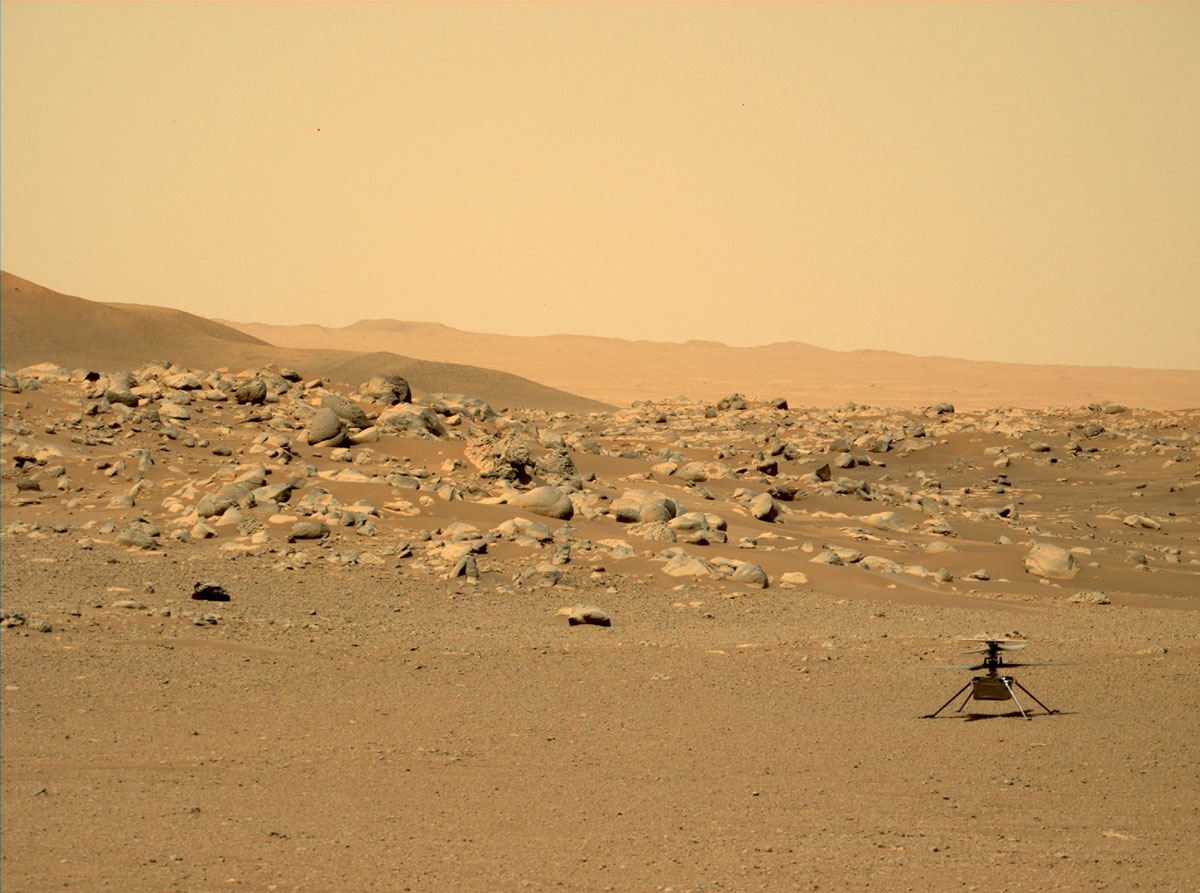
NASA is testing next-generation Mars helicopters on two planets. A new rotor that could be used with future Mars helicopters was recently tested at the agency's Jet Propulsion Laboratory (JPL) in Southern California. Meanwhile, the Ingenuity Mars Helicopter has achieved new altitude and airspeed records on the Red Planet in the name of experimental flight testing.
According to NASA, the new carbon fiber rotor blades are almost 4 inches longer than Ingenuity's, with greater strength and a different design. The agency believes that these blades could enable bigger, more capable Mars helicopters. The challenge is that as the blade tips approach supersonic speeds, vibration-causing turbulence can quickly get out of hand.
"Our next-generation Mars helicopter testing has literally had the best of both worlds. Here on Earth, you have all the instrumentation and hands-on immediacy you could hope for while testing new aircraft components. On Mars, you have the real off-world conditions you could never truly re-create here on Earth," said Teddy Tzanetos, Ingenuity's project manager and manager for the Mars Sample Recovery Helicopters.
To simulate the Martian atmosphere on Earth, engineers looked to JPL's 25-foot wide, 85-foot-tall space simulator - a place where NASA's Surveyor, Voyager, and Cassini spacecraft got their first taste of space-like environments. In September 2023, a team monitored sensors, meters, and cameras as the blades endured run after run at ever-higher speeds and greater pitch angles.
One flight, two perspectives 👀While the #MarsHelicopter captured its own high-altitude 59th flight, @NASAPersevere watched it all unfold from nearby. These side-by-side viewpoints show Ingenuity reach 66 ft (20 m) on Sept. 16, 2023, as part of an experimental flight test. pic.twitter.com/91mLZz6du1
— NASA JPL (@NASAJPL) November 22, 2023
NASA's Ingenuity flew for the first time on the Red Planet on April 19, 2021, hovering 10 feet (3 meters) for 30 seconds above Jezero Crater. Since first taking to the Martian skies, the tiny helicopter has achieved many distance and altitude records on Mars, paving the way for future aerial explorers.


 Google News