

Hubble telescope spies a comic baseball
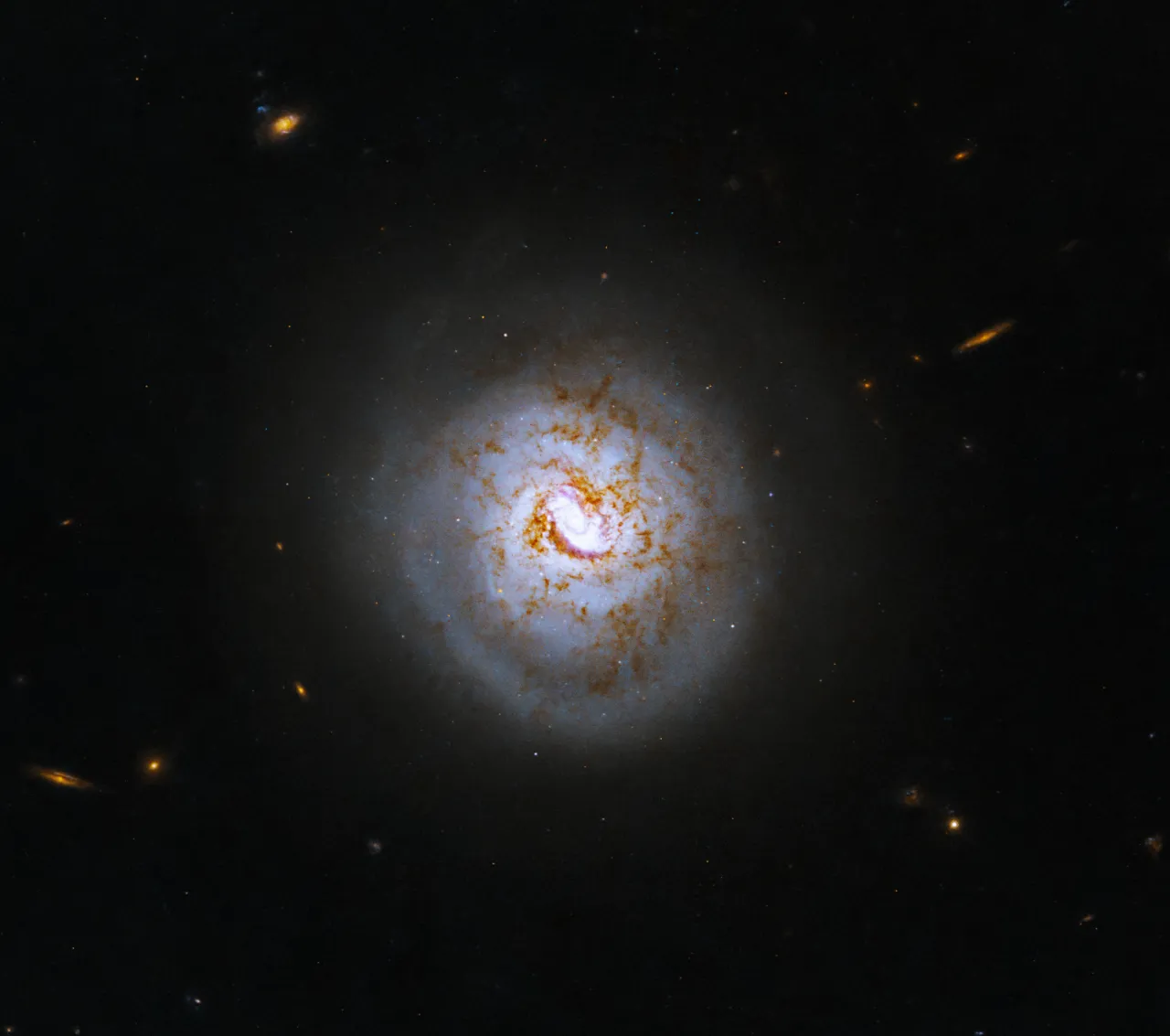
This new view from the NASA/ESA Hubble Space Telescope shows a spiral galaxy that resembles a baseball lobbed into the depths of the universe.
In addition to being a face-on spiral galaxy, ESO 420-G013 is a Seyfert galaxy. Its dark lanes of dust are visible against the background glow of the galaxy's many stars. Seyfert galaxies are typically spiral galaxies with very bright nuclei, the result of supermassive black holes at their centers accreting material that releases vast amounts of radiation.
The cores of these active galaxies are brightest when observing light outside the visible spectrum. Often galaxies with such active galactic nuclei are so bright that the host galaxy itself is not visible, washed out by the glow of its nuclei, but Seyfert galaxies are unique because the galaxy itself can also be seen. The galaxy in question has an almost perfectly round disk, a brighter core, and whirled filaments of dark dust.
Hubble observed ESO 420-G013 as part of a study of Luminous Infrared Galaxies (LIRGs), which are known to be extremely bright in the infrared part of the spectrum. Galactic interactions trigger new regions of star formation in LIRGs, due to which they are highly luminous in infrared light.
Time to meet ESO 420-G013 face-on!This spiral galaxy's dark lanes of dust are visible against the background glow of its many stars in this new head-on view from Hubble. ESO 420-G013 is likely the result of merged galaxies: https://t.co/A5RzZIXB4q#CosmicCollisions pic.twitter.com/qQDGber2oE
— Hubble (@NASAHubble) January 30, 2024
With more than 33 years in orbit and 1.5 million observations, the Hubble Space Telescope has been instrumental in exploring the mysteries of the universe. Observations made by the veteran space-based observatory have changed our understanding of the vast universe - from determining the atmospheric composition of exoplanets to discovering dark energy.


 Google News