

Fish school by randomly copying individuals, rather than following group: Study
- Country:
- Australia
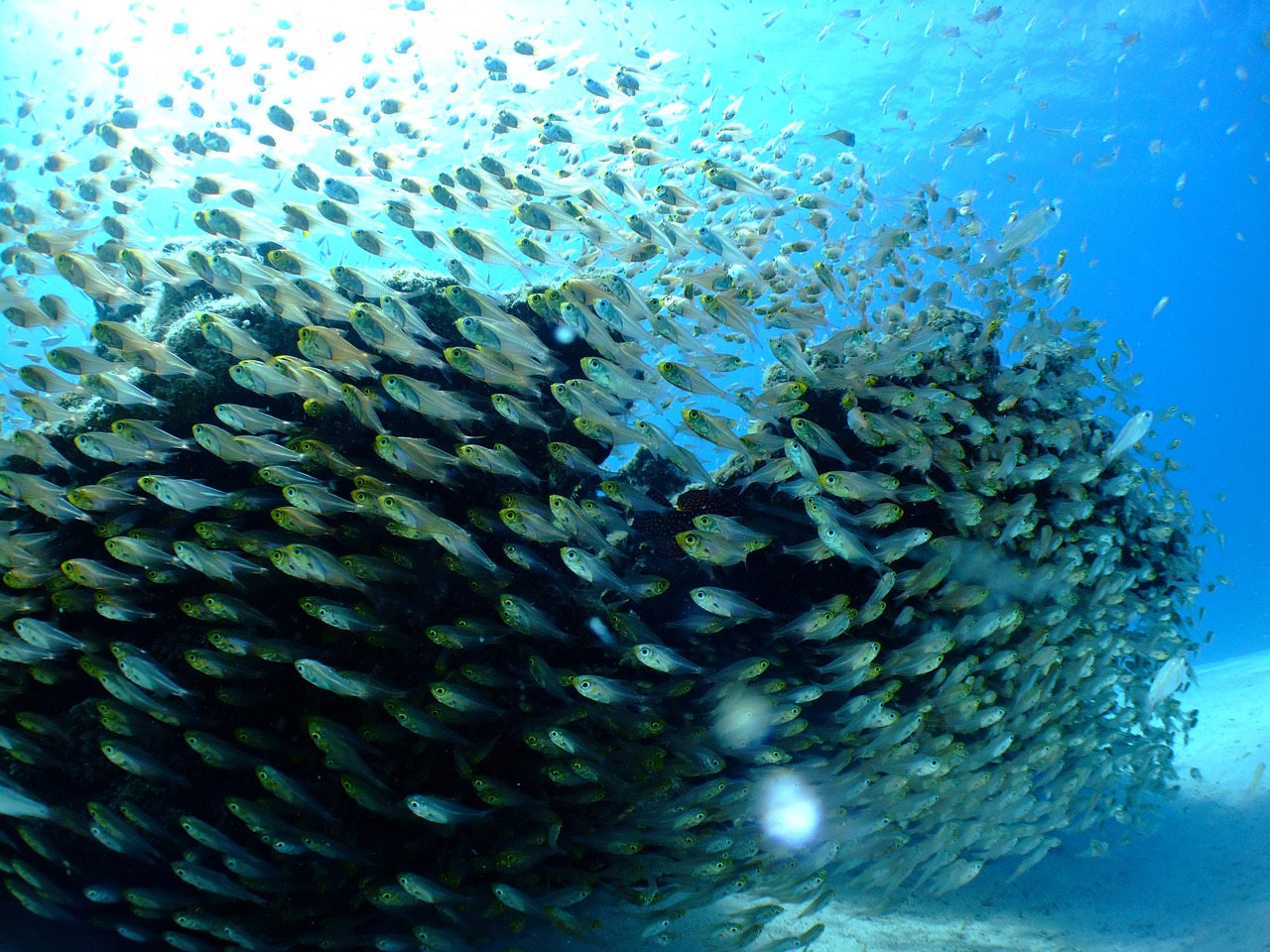
Scientists, including those from India, have shown that fish school by copying each other randomly, rather than calculating and adapting to an average direction of the group, findings which may lead to better ways of developing robotic swarms. The researchers, including Vishwesha Guttal from the Indian Institute of Science (IISc) in Bengaluru, assessed how complex group-level behavior in fishes such as swimming together in a synchronized manner emerge from simple individual actions.
"In the fish that we have studied, schooling turns out to be noise-induced. Noise, in this setting, is simply the randomness arising from interactions between individual fish," said Richard Morris, study co-author from the University of New South Wales in Australia. The scientists closely tracked and filmed schools of 15, 30, and 60 cichlid fish Etroplus suratensis a popular edible fish locally known as karimeen -- swimming in large water tanks. They assessed both the direction in which the fish moved, the degree to which they were aligned towards each other, and also tracked how these behaviors fluctuated over time.
"What we find is that when the fish are moving in a misaligned state, the fluctuations are actually high," said Danny Raj, study co-author from IISc. According to scientists, when fluctuations were high, the whole group became more synchronized in their swimming.
"Everyone's been aware of noise-induced phenomena, theoretically, but it's quite rare to find in practice. You can only observe it when the individuals in a study can actually make decisions," Morris said. "For example, you wouldn't find this type of noise-induced behavior studying electrons or particles," he added.
The researchers said the current findings dispute the widely held 'moving average' theories for schooling and herding behavior, which assume that animals in the coordinated movement are capable of estimating the overall direction of the group. "Every fish only interacts with one other fish at any given time. They either spontaneously changes direction, or copy the direction of a different fish," Morris said. "Calculating an average direction of the group - which was the popular theory until now - is likely too complicated for a fish to compute," he explained.
According to the scientists, noise is usually considered by researchers as an unrelated factor that obscures and distracts from the information, like glare from the sun that is eliminated to get a clearer photo. But based on the current study, they said the random copying between pairs of fish gives rise to a different class of noise, which they said drives their highly coordinated behavior. The researchers said the findings highlight the importance of noise showing that it may encode some important information about the behavioral dynamics of fish and other animals.
"Here the signal is the noise. If you ignored the fluctuations completely, you couldn't explain schooling at all," Morris said.
ALSO READ
-
Japanese Lawmakers Visit India to See Worker Protection and Skills Projects in Action
-
Indian Unions Push for Fair Recruitment and Rights for Care Workers in Germany
-
Cleaner Kitchens, Polluted Skies: Hidden Health Cost of India’s Electricity Boom
-
Japan-Backed ILO Projects Help 23,000 Workers Gain Rights and Fight Child Labour
-
India's Delicate Balancing Act: Navigating Energy Security Amid Middle Eastern Tensions


 Google News