

Google Earth Timelapse: Witness planet's evolution from your phone or tablet
In line with its mission to organize the world's information and make it universally accessible and useful, Google on Thursday introduced several new updates to its Google Earth Timelapse tool that provides a comprehensive picture of the changing Earth—from the global scale to the local scale.
Today's update adds mobile and tablet support for the fascinating tool, making it easier to explore or research the imagery, anytime, anywhere. It also includes a handy new "Maps Mode" toggle to let users navigate the map using Google Maps.
"We're committed to creating products like Timelapse with the planet in mind, and hope that making this data easily accessible will ground debates, encourage discovery, and inform the global community's thinking about how we live on our planet," Google wrote in a blog post.
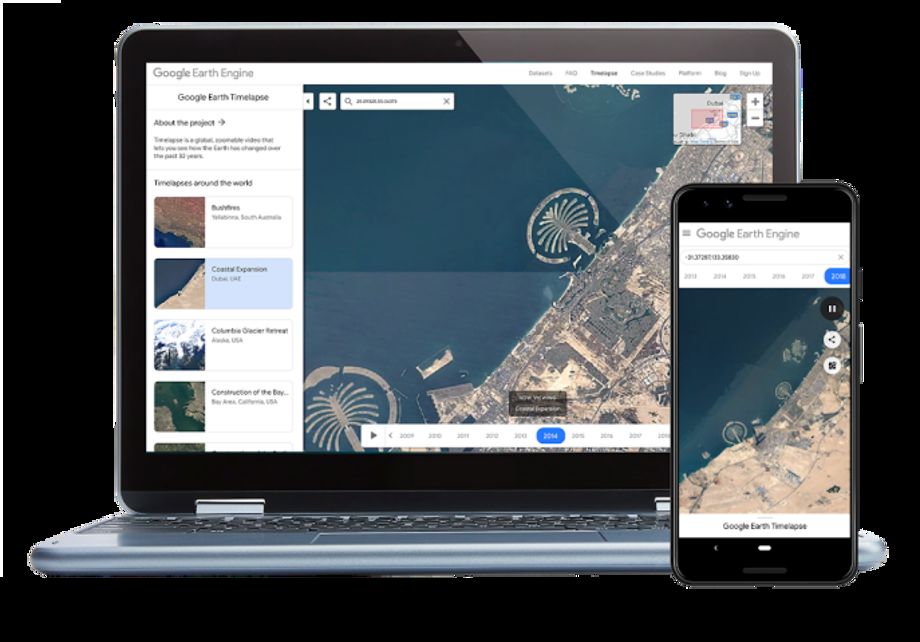
Image Credit: Google
The latest update also adds two more years of imagery to the time-series visualization, now spanning from 1984 to 2018. The update has been possible, as Google said, because of major mobile browsers like Chrome and Firefox who reinstated support for autoplay videos (with the sound muted), which was disabled until recently.
The search giant has joined forces with Carnegie Mellon's CREATE Lab, whose Time Machine video technology makes Timelapse interactively explorable. Using Google Earth Engine, Google's cloud platform for petabyte-scale geospatial analysis, Timelapse uses more than 15 million satellite images obtained from the U.S. Geological Survey/NASA Landsat and European Sentinel programs to create the 35 global cloud-free images. Earth Engine hosts satellite imagery and stores it in a public data archive that includes historical earth images going back more than forty years.


 Google News