

Follow the science: UN plans for a stronger pandemic recovery
Funders responsible for more than $100 million of annual global research investments joined the deputy UN chief Amina Mohammed on Friday to discuss how to unify research efforts, and use science to recover effectively from the COVID-19 pandemic.
In her remarks to the event, Ms Mohammed noted the far-reaching social, economic, and health impacts of the pandemic, the disproportionate effect that it has had on the most marginalized populations, and the 70 million extra people who have been pushed into poverty as a result of measures taken to curb the spread of the virus.
A new future'
"COVID-19", said the deputy UN chief, "has made it evident that we must build a new future through transformative changes that prioritize equity, resilience and sustainability".
The Open Dialogue on Science for Development in the Context of COVID-19 billed as a first-of-its-kind event, was convened by the UN and the Canadian Institutes of Health Research, to highlight the importance of science and global collaboration.
The discussions between the senior representatives of research institutions and senior UN officials were based on partnership strategies, including the UN Research Roadmap for the COVID-19 Recovery, released in November 2020.
With the virus exposing stark global inequities, the roadmap is designed to address the complex health, humanitarian and socio-economic consequences of COVID-19, while boosting speedy recovery efforts, and encouraging targeted research for data-driven responses that focus particularly on the needs of people being left behind. Many of the experts who contributed to the Roadmap also participated in the Open Dialogue.
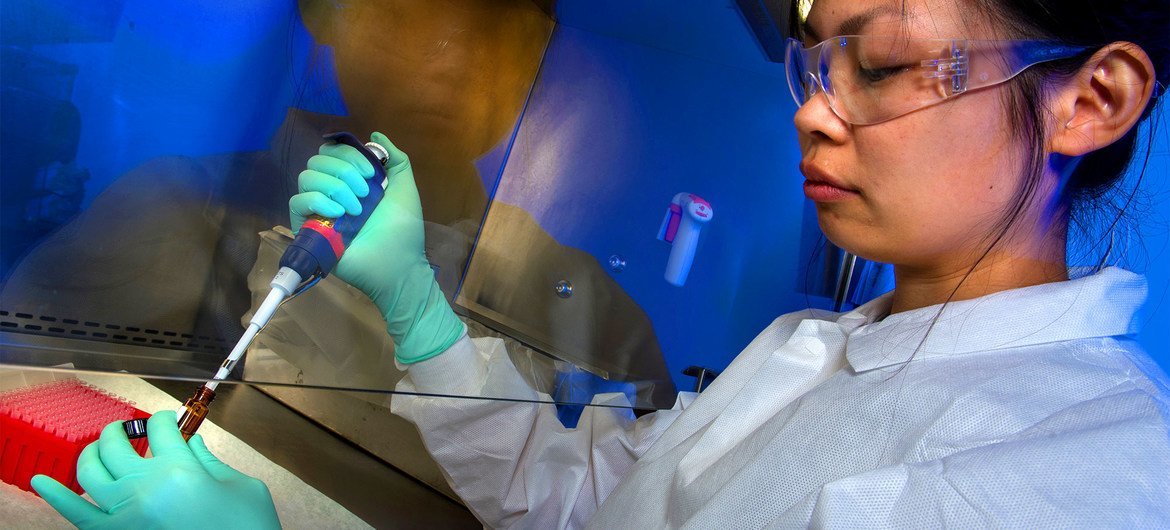 CDCA scientist tests a sample suspected of containing a bacterial toxin.
Closer collaboration
The event served as a stepping-stone towards the UN's aim of ramping up progress towards the Sustainable Development Goals, and the 2030 Agenda for Sustainable Development, through closer collaboration between researchers, funding agencies, governments and civil society organizations, as well as UN entities.
"To succeed, we need solutions and global action that is focused, coordinated and unified", declared Ms Mohammed. "It will require new and strengthened partnerships across the global research community and between researchers, research funding organizations and the United Nations".
,
The UN response to COVID-19, as of January 2021
118 Socio-Economic Response Plans have been finalized by UN Country Teams
Two billion dollars in new funds have been mobilized
Three billion dollars have been repurposed
127 UN Country Teams have repurposed existing funding towards COVID-19 recovery
With UN support, 75 countries have national COVID-19 Socio-Economic Response Plans
Visit UN News for more.
ALSO READ
-
UN Expert Urges Malaysia to Halt Myanmar Returns as Refugees Face War and Violence
-
Longer Lives, Unequal Care: UN Report Exposes Gaps in Support for Older People Globally
-
Century After Slavery Convention, Millions Still Wait for Freedom and Justice
-
Netherlands Pledges Over €309 Million to Strengthen Justice and Prevent Conflict
-
Nicaragua Used Disappearances to Crush Dissent as Eight Died in Custody, UN Reports


 Google News