

Ebola continues to affect highly communities along Ugandan border
According to the International Organization for Migration’s Displacement Tracking Matrix (DTM), the majority of people (roughly 40 percent) crossed the Congolese-Ugandan border last month to engage in economic opportunities.
- Country:
- Uganda
One year after the beginning of the Ebola outbreak in the Democratic Republic of the Congo (DRC), the disease continues to affect highly mobile communities along the Ugandan border at major transit hubs.
According to the International Organization for Migration's Displacement Tracking Matrix (DTM), the majority of people (roughly 40 percent) crossed the Congolese-Ugandan border last month to engage in economic opportunities. Others crossed over to visit family or buy goods.
The highest number of movements tracked by DTM occurred at the border point adjacent to Beni – the epicenter of the outbreak and an area suffering from conflict and displacement.
"There is a risk Ebola may cross into Uganda, but efforts at entry points are helping us to prevent the spread of the disease. Despite the outbreak in DRC it is important that people can continue to move, trade and seek refuge freely," said Dr. Patrick Kaliika, IOM Uganda EVD Health coordinator.
The World Health Organization (WHO) urged that borders should not be closed and no restrictions on trade are made when recently declaring the outbreak in DRC a Public Health Emergency of International Concern.
IOM and partners are accelerating prevention efforts at more than 64 border crossing points – also called Points of Entry (POEs) – in Western Uganda.
"Prevention is better than cure so the approach of monitoring and preparing is crucial for Uganda. Through collaboration with partners I can confidently say we are prepared if another case appears here," said Ayebale Apolo, an epidemiologist with Uganda's Ministry of Health (MoH).
He joined six other officials from IOM, WHO and the Government of Uganda this week in a joint monitoring mission to assess the effectiveness of current POE sites. In the next six months, these organizations will train health, immigration, security, customs, and other officials on how to ensure border control during humanitarian and health emergencies.
IOM currently operates 20 POE screening sites in southwestern Uganda and supports districts and national authorities to monitor and mentor operations in seven districts along the border with DRC.
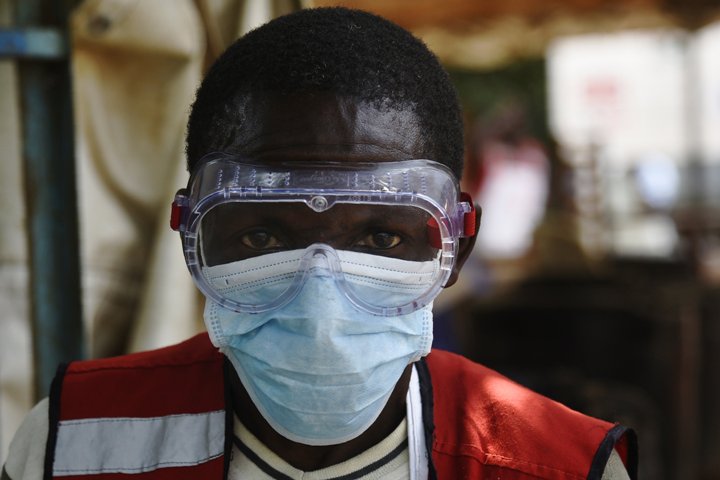
Health workers encourage travelers to wash their hands to prevent transmission and each person is screened for symptoms – including a temperature check. If teams suspect a traveler may be infected, they are transferred to the designated health facility for further assessment and care.
Three cases of Ebola surfaced in Kasese District in Uganda in June, after three infected travelers crossed the border together from DRC. Since then, a new POE site has been established in Kasese and contacts were vaccinated. There are no current cases of Ebola in Uganda.
"IOM hopes this border health project not only better prepares the country to stop the spread of Ebola but also other diseases that are likely to become more prominent in transit hubs," Dr. Kaliika continued.
This initiative falls in line with WHO's Regional Strategic Plan for EVD Operational Readiness and Preparedness as well as the Uganda National EVD Preparedness Plan. It is supported by the Central Emergency Response Fund (CERF).
The Organization also manages 83 screening sites at areas of high transit in DRC and 15 POE sites at border points near high-risk areas in South Sudan.
(With Inputs from APO)
ALSO READ
-
Sudanese Families Flee to Chad as Violence Surges and Refugee Support Falls Behind
-
Yemen’s Civilians Face Fresh Horror as Fighting Displaces 125,000 and Kills Children
-
Somalia Faces Deepening Hunger as Flood Threat Puts Lives and Farms at Risk
-
Yemen Violence Displaces 130,000 as Shelters Fill and Aid Funding Runs Short
-
Drone Strikes Destroy Over 292,000 Textbooks Ahead of Sudan’s New School Year


 Google News