

Institutions Must Cooperate, Not Clash: VP Dhankhar at Book Launch in Lucknow
Taking a strong stance against disrespect towards constitutional roles, Dhankhar emphasized the special position held by the President and the Governors in India's governance.
- Country:
- India
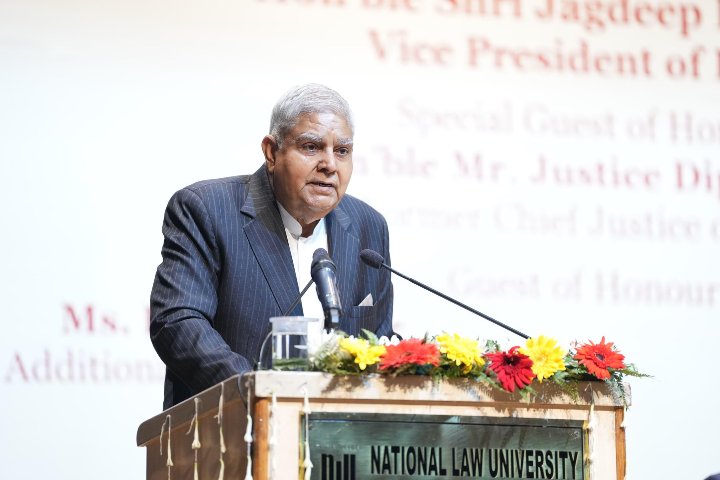
Vice-President Jagdeep Dhankhar, while speaking at the launch of Governor Anandiben Patel's book 'I Like Challenges' in Lucknow, delivered a powerful and candid address that touched upon the core tenets of India's constitutional framework, the strength of democratic institutions, and the indispensable value of open dialogue and mutual respect among institutions.
"Fulfilling Constitutional Duties Is Paramount"
Opening his address with a reflective tone, Vice-President Dhankhar remarked, "I like challenges, and fulfilling constitutional obligations is our primary responsibility. No negligence in this regard can be accepted." Emphasizing the seriousness of upholding constitutional values, he drew attention to the vital role of constitutional functionaries and the non-negotiable nature of their responsibilities.
He recounted a recent experience where he was told he wouldn't receive a book for free, to which he responded humorously but firmly: "I don't have the habit of taking anything for free." Shifting to a more solemn tone, he acknowledged the internal challenges constitutional authorities face — those that arise not from opposition or public discourse but from within the system itself. "Not just you, I too am a victim of these challenges," he told Governor Patel, referring to baseless criticism and governance-related resistance from within institutions.
Citing Scriptures for Moral Fortitude
Dhankhar invoked Indian philosophical traditions to underscore resilience in adversity. "Whenever challenges arise, look towards the Vedas, the Gita, the Ramayana, the Mahabharata. You have a right to perform your prescribed duties, but you are not entitled to the fruits of your actions," he quoted from the Bhagavad Gita. He emphasized that even when challenges feel suffocating, public servants must remain steadfast in their duty without straying from the righteous path.
Historical Perspective on Democratic Memory
Drawing a parallel with historical events, Dhankhar recalled the Emergency period (1975–77) — "the darkest period in Indian history," as he called it — during which civil liberties were suspended and people were jailed without cause. He cautioned that while some believe public memory is short, such betrayals of democracy are never truly forgotten.
He then linked these reflections to contemporary issues, referencing a recent painful incident, though not explicitly naming it. He stressed the principle of presumption of innocence in democratic societies, saying that crimes must be handled strictly through legal frameworks — "If a crime shakes the public conscience, it cannot be covered up."
Defending Constitutional Hierarchies and Dignitaries
Taking a strong stance against disrespect towards constitutional roles, Dhankhar emphasized the special position held by the President and the Governors in India's governance. "These are not ceremonial roles. Their oath is to protect, preserve, and defend the Constitution, and to serve the people," he stated.
He urged everyone, including political leaders and the public, to treat such dignified offices with the seriousness they deserve. "When comments are made on such dignified positions, it is a matter for serious introspection," he warned.
Institutional Harmony Over Confrontation
Reiterating his commitment to constitutional balance, the Vice-President discussed the need for cooperation among the pillars of democracy — the Executive, Judiciary, and Legislature. Referring to past confrontations between the Legislature and the Judiciary in Uttar Pradesh, he remarked, "Our Constitution does not expect confrontation, but rather coordination, cooperation, dialogue, deliberation, and healthy debate."
He acknowledged the strength of India's judiciary, stating that "by global standards, our judges are among the best," while also cautioning against any attempt by institutions to overstep their designated roles. "Just as the legislature cannot script a judgment, the court cannot make laws," he asserted.
Valuing Expression and Dialogue in Democracy
Dhankhar passionately advocated for free expression and the necessity of dialogue in a democratic setup. "If expression exists without debate, it becomes distorted — it transforms into ego and arrogance," he warned, noting that such traits are dangerous both for individuals and for institutions.
Democracy, he said, thrives when diverse voices are not only allowed but also encouraged to interact meaningfully. "Expression and dialogue must flourish together — they are the soul of democracy," he concluded.
Presence of Eminent Dignitaries
The event witnessed the presence of several high-profile dignitaries, including Uttar Pradesh Governor Anandiben Patel, Chief Minister Yogi Adityanath, Cabinet Minister Suresh Khanna, and the Vice-President's spouse, Smt. Sudesh Dhankhar. The launch of 'I Like Challenges' was not just a ceremonial occasion, but also became a significant platform for reflecting on the present and future of India's constitutional democracy.
A Call for Reflective Governance
Vice-President Dhankhar's address served as a clarion call for introspection, ethical governance, institutional harmony, and unwavering dedication to constitutional values. His message underlined that in the face of both internal and external challenges, it is the moral and philosophical backbone of the nation — rooted in ancient wisdom and modern democratic ethos — that provides direction and strength.


 Google News